The lowest spread forex broker is not necessarily the broker advertising the smallest headline number. A 0.0 pip minimum can still produce a higher total trading cost once commission, spread widening, slippage and overnight financing are included. The useful comparison is the cost of executing your own trades on the currency pairs, account type, trade size and trading hours you actually use.
For a short-term trader, the core calculation is straightforward: convert the spread into money, add the round-turn commission, then account for typical slippage. For positions held overnight, add financing or swap charges as well. This turns a marketing claim into an all-in cost that can be compared on the same basis.
What lowest spread really means
A forex spread is the difference between the bid price and ask price. It is commonly expressed in pips. If EUR/USD is quoted with a 0.8 pip spread, a trader buying at the ask and immediately selling at the bid would lose roughly 0.8 pip before commission or slippage, assuming the market itself has not moved.
The word lowest needs context. Brokers may publish a minimum spread, a typical spread, an average spread or a live spread. Those are not interchangeable. A minimum tells you the best level that may appear. It does not tell you how often that level is available or what you are likely to pay during your own trading session.
A low spread broker should therefore be judged on repeatable pricing rather than its best screenshot. The most relevant questions are how wide spreads are during liquid hours, how much they expand around news or session changes, whether commission is charged separately and whether fills are close to the price displayed when the order is submitted.
How to calculate the real trading cost
For a completed trade, a useful baseline is:
All-in trading cost = spread cost + round-turn commission + slippage + applicable financing and other trading fees.
Spread cost can be converted into account currency by multiplying the spread in pips by the pip value for the position size. On EUR/USD, one pip is $10 for a standard 100,000-unit position when the account is denominated in US dollars. A 0.5 pip spread therefore represents about $5 for that position. Pip value differs for other pair structures, position sizes and account currencies.
Convert commission into a pip equivalent
Commission accounts often advertise raw or near-zero spreads while charging a fee per side. To compare them with spread-only accounts, convert the full opening and closing commission into pips.
Suppose a raw account averages a 0.1 pip spread on EUR/USD and charges $3.50 per side for one standard lot. The round-turn commission is $7. Because one pip is $10 for that example position, the commission equals 0.7 pip. The all-in cost before slippage is therefore about 0.8 pip.
Now compare a spread-only account averaging 0.8 pip with no separate commission. Its baseline cost is also about 0.8 pip. The raw account looks much cheaper if only the 0.1 pip spread is compared, but the two examples are economically similar after commission.
Add slippage and financing
Slippage is the difference between the expected execution price and the price actually received. It can be positive or negative. Fast markets, thin liquidity, large orders and stop orders can make execution quality more important than a small difference in displayed spread. A broker showing 0.2 pip but regularly delivering 0.3 pip of adverse slippage may be more expensive in practice than one showing a stable 0.4 pip spread with cleaner fills.
Overnight financing matters when positions remain open beyond the broker's daily rollover point. The FCA has highlighted that retail CFD costs can include bid-offer spreads, commissions and overnight funding charges, and that funding charges can differ significantly across providers. For traders who hold leveraged rolling spot forex or FX CFDs for several days, financing can outweigh a small spread advantage.
A practical low spread broker comparison
The cleanest comparison uses the same currency pair, position size, time window and account type at each broker. It also separates advertised pricing from observed execution. The following framework focuses on costs that can materially change the result.
| Factor | What to compare | Why it matters |
|---|---|---|
| Typical spread | Observed spread during your normal trading hours | Shows the recurring cost rather than the best possible quote |
| Commission | Full round-turn charge for your position size | A raw spread is not the total price when commission is separate |
| Spread stability | Normal hours versus rollover and major news | Frequent widening can erase a headline spread advantage |
| Slippage | Expected price versus actual fill across many trades | Execution can add or reduce cost beyond the displayed spread |
| Overnight financing | Long and short charges for the pairs you hold | Can dominate cost for multi-day positions |
| Account conditions | Minimum deposit, lot size and pricing tier | The cheapest tier may require conditions you do not meet |
| Currency conversion | Conversion rate or fee when account and P&L currencies differ | Creates an additional cost outside the quoted spread |
Do not rank brokers using a single EUR/USD quote if you trade several pairs. A provider that is inexpensive on EUR/USD may be less competitive on GBP/JPY, USD/CAD or emerging-market currencies. Build a weighted comparison based on the pairs you actually trade and the share of your volume assigned to each one.
For a stronger test, look beyond one average. Record the median spread and a high-percentile spread from your own sample, then note how often the quote exceeds your normal range. The median shows ordinary conditions while the tail shows what happens when liquidity becomes less favorable. This matters for strategies that trade around session transitions or scheduled news because occasional wide spreads can affect results disproportionately.
Why minimum spread claims can mislead
A minimum spread answers only one narrow question: how tight can the quote become under some conditions? It does not reveal the distribution of spreads over time. Two brokers can both advertise spreads from 0.0 pips while producing very different average costs.
Raw-spread accounts also create an easy comparison trap. A 0.0 pip quote looks lower than a 0.7 pip spread-only quote, but the raw account may add a commission equivalent to 0.6 or 0.8 pip. The correct comparison is all-in cost at the trade size you plan to use.
Time of day matters as well. Major currency pairs are generally more liquid when their key financial centers are active, while spreads can widen when liquidity falls. Rollover periods and major economic announcements can produce especially different conditions. The broker with the lowest forex spreads during a quiet test at one time of day may not be the cheapest broker during your actual strategy window.
Order size can change the result too. Small retail orders may be filled at the displayed top-of-book price while larger orders may experience partial fills or price movement. Traders using larger size should record the effective average execution price rather than relying only on the quote visible before the order.
Which account type is cheaper
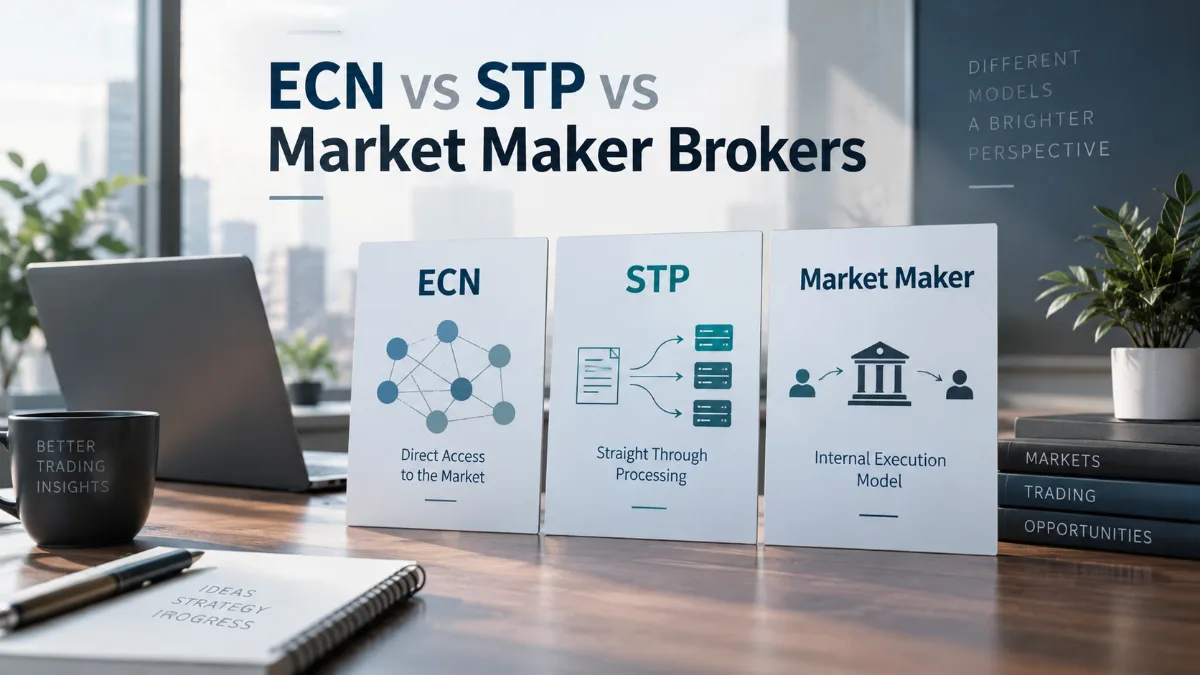
Most low-cost forex pricing falls into two broad structures. A spread-only or standard account embeds more of the broker's compensation in the bid-ask spread. A raw or commission account usually shows a tighter spread and adds an explicit commission.
Neither structure is automatically cheaper. Raw pricing often makes cost analysis more transparent for active traders because the commission is visible and the market spread can be tighter. Spread-only pricing can be simpler for smaller or less frequent trades. The break-even point depends on the actual spread difference and commission schedule.
| Illustrative account | Observed spread | Round-turn commission | All-in baseline on EUR/USD |
|---|---|---|---|
| Raw account A | 0.1 pip | $7 per standard lot | About 0.8 pip |
| Raw account B | 0.3 pip | $5 per standard lot | About 0.8 pip |
| Standard account C | 0.9 pip | $0 | About 0.9 pip |
These figures are mathematical examples rather than broker quotes. They show why a forex broker with lowest spread cannot be identified from spread alone. The account with the smallest visible spread can tie or lose once commission is converted into the same unit.
How trading style changes the answer
Scalping and high frequency manual trading
Strategies targeting small price movements are highly sensitive to execution cost. If the average profit target is only a few pips, an extra 0.3 pip of spread or slippage can consume a meaningful share of expected edge. Scalpers should focus on all-in spread equivalent, fill quality, rejection behavior, execution speed and how pricing behaves during the exact hours they trade.
For this style, even small differences can matter because the cost is repeated many times. A broker that is only slightly cheaper per trade can create a large difference over hundreds of monthly transactions. The comparison should still use a sufficiently large sample because a few unusually good or bad fills can distort the result.
Day trading and intraday swing trading
Day traders usually care about spread and commission but may be less sensitive to tiny differences than scalpers. Stability can matter more than the absolute minimum. If trades are opened during liquid hours and closed before rollover, overnight funding may have little or no impact. The practical winner is often the broker with consistently competitive pricing and dependable execution rather than the lowest isolated quote.
Multi-day and position trading
For positions held for days or weeks, spread becomes a smaller share of total cost relative to financing. A 0.2 pip saving at entry can be irrelevant if one broker charges materially more to maintain the position overnight. Compare the long and short financing treatment for the exact pair because the cost can differ by direction and can change as underlying interest-rate conditions change.
How to test a broker before funding
- Choose representative pairs. Use the currencies you expect to trade rather than selecting only EUR/USD because it usually receives the most competitive pricing.
- Fix the observation windows. Record spreads during your normal session and include periods that matter to your strategy such as market opens, rollover or scheduled economic releases.
- Convert every charge to one unit. Express spread and commission in pips or in account currency for the same trade size. Include currency conversion fees where applicable.
- Test execution. On a demo account you can examine platform behavior, but a demo may not reproduce live fills perfectly. If you proceed with real money, use small size first and compare requested prices with actual execution prices.
- Record enough trades. Calculate average and median spread, adverse and favorable slippage and total cost per completed trade. Separate market orders from stops and limit orders because they can behave differently.
- Recheck non-spread costs. Review financing, withdrawal charges, inactivity fees and any data or platform fees relevant to your use. A lowest spread broker is not low cost if another recurring charge dominates your account.
A simple spreadsheet can make the comparison objective. For each completed trade, log pair, time, position size, quoted spread, commission, opening slippage, closing slippage and financing. Divide total trading cost by the number of completed trades or by total volume to compare brokers on a consistent basis.
Regulation and execution still matter
Cost should not be separated from counterparty and regulatory risk. In retail over-the-counter forex, the structure of the transaction can differ by jurisdiction. The CFTC explains that US retail OTC forex customers trade against their dealer rather than on an open exchange and notes that dealers can earn through spreads, commissions and other fees. That makes due diligence on the legal entity and its regulator part of the broker comparison, not an optional extra.
Execution disclosures can also provide useful evidence. In the United States, NFA rules require Forex Dealer Members to disclose applicable commissions and other transaction cost information on a per-trade basis. Requirements vary across countries, so verify the broker's exact regulated entity and the protections that apply to your account rather than assuming a global brand operates under one rule set everywhere.
Leverage also changes the financial impact of trading costs and losses. A narrow spread does not make leveraged forex low risk. Higher leverage allows a larger position to be controlled with less margin, which means a small market move and the associated transaction costs can represent a larger percentage of the cash committed to the trade.
Red flags in lowest spread advertising
- Only a minimum is shown. If the broker emphasizes "from 0.0 pips" but makes typical or average pricing difficult to evaluate, the headline is not enough for a real comparison.
- Commission is separated from the main claim. A raw spread without the round-turn commission can understate the effective cost.
- The pricing tier is unclear. The advertised spread may apply only to a specific account, deposit level, volume tier or platform.
- Execution language sounds absolute. Claims of guaranteed fills or no slippage deserve close scrutiny because live markets can move between order submission and execution.
- Regulatory identity is hard to verify. A trading website should make it possible to identify the legal entity serving you and the regulator responsible for that entity.
- Non-spread charges are difficult to find. Financing and other fees can matter more than a fractional spread advantage for some strategies.
How to choose the forex broker with lowest spread for you
Start with the strategy rather than the advertisement. Estimate how many trades you make, average position size, pairs traded, normal holding period and usual trading hours. Then calculate the expected all-in cost for each broker using typical observed spreads and the commission schedule that applies to your account.
For very active short-term trading, give extra weight to spread stability and slippage because small execution differences repeat frequently. For multi-day trading, give more weight to financing. If you trade less-liquid pairs, evaluate those pairs directly instead of using EUR/USD as a proxy for the broker's entire price book.
A useful final ranking has three layers. First, eliminate brokers that do not meet your regulatory, account access and platform requirements. Second, compare all-in trading costs on your real trading pattern. Third, test whether the observed live execution is consistent with the theoretical cost calculation.
The phrase lowest forex spreads broker is therefore best treated as a measurement problem rather than a fixed title that belongs to one company. Spreads move, commissions differ by account and execution quality varies by market conditions. The broker that produces the lowest repeatable total cost for your own orders is the meaningful winner, even if another broker advertises a smaller minimum spread.