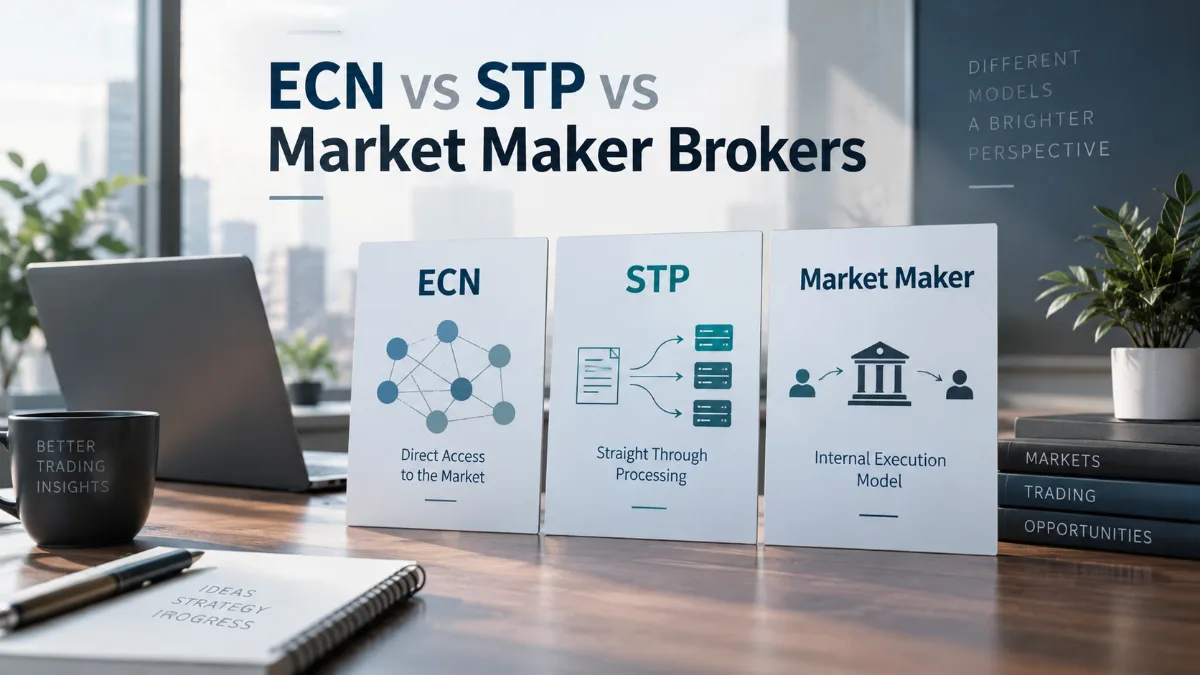
ECN, STP, and market maker describe different parts of how a forex broker may handle orders. An ECN model centers on electronic matching or access to multiple market participants. STP refers to straight-through processing, where orders or offsetting trades are routed automatically to external counterparties. A market maker broker quotes prices to clients and can act as the counterparty to their trades. These categories are useful, but they are not always mutually exclusive. A broker can combine internal execution, external hedging, and automated routing in the same business.
For traders comparing ECN vs STP vs market maker brokers, the practical question is not which label sounds most sophisticated. It is whether the broker is properly regulated, how it executes orders, what the full trading cost is, and how it handles slippage. A well-run market maker can outperform a poorly run broker advertising "true ECN," while an ECN-style account can suit traders who value transparent commissions and tight quoted spreads.
ECN vs STP vs market maker at a glance
| Feature | ECN-style broker | STP broker | Market maker broker |
|---|---|---|---|
| Core idea | Connects orders with multiple participants or liquidity sources through electronic matching | Automatically routes or offsets client flow with external counterparties | Provides its own bid and ask prices and may take the other side of client trades |
| Typical pricing | Variable raw or near-raw spread plus commission | Variable spread with markup or spread plus commission | Often spread-based pricing though commissions are possible |
| Counterparty relationship | Depends on the legal product and account structure | Depends on the legal product and routing arrangement | Broker commonly acts as counterparty |
| External liquidity | Usually central to the model | Usually central to the routing process | May hedge none, some, or all client exposure externally |
| Main strength | Potentially tight spreads and visible commission pricing | Automated external risk transfer and relatively simple execution flow | Consistent liquidity for small retail orders and often simpler cost presentation |
| Main limitation | Commission and slippage can make total cost higher than the headline spread suggests | The term does not reveal how many liquidity providers are used or how prices are formed | Creates a potential conflict when the broker benefits economically from client losses |
What an ECN broker actually does
ECN stands for electronic communication network. In the broad trading sense, an ECN is an electronic system that brings together executable buying and selling interest. In retail forex, brokers often use "ECN" to describe an account where prices come from several liquidity sources and orders are matched or passed into an electronic liquidity pool rather than handled through a traditional manual dealing desk.
The important detail is that "ECN broker" is often a commercial description rather than a complete legal description of the trade. Retail forex and CFD structures differ by jurisdiction. A trader may see prices sourced from banks, non-bank liquidity providers, or other market participants while the regulated broker still remains the legal counterparty to the client contract. Therefore, ECN should not automatically be read as "the broker can never be on the other side."
ECN-style pricing commonly separates the spread from the broker's fee. The displayed spread may be extremely small during liquid market conditions, while a fixed commission is charged per lot or per side. That can make costs easier to analyze for active traders, but the relevant number is the all-in cost after commission, spread, and execution effects are combined.
ECN liquidity is not infinite. Around major news releases or sudden volatility, available prices can move quickly and depth can thin. Market orders can receive positive or negative slippage. The useful test is whether slippage is handled symmetrically and whether fill behavior matches the broker's published policy.
How STP execution works
STP means straight-through processing. It describes automation in the execution chain rather than a single type of marketplace. In one formal retail forex definition, the National Futures Association describes straight-through processing as a Forex Dealer Member automatically executing an offsetting position to a customer order with another counterparty before providing execution to the customer. That definition is specific to the NFA rule context, but it captures the core idea: external offsetting occurs automatically without manual intervention.
In common broker usage, an STP broker receives a client order and routes the risk to one or more liquidity providers. The broker may add a markup to the spread, charge a commission, or use a combination of both. It can also aggregate quotes from several counterparties and route orders according to price, available size, speed, or other execution criteria.
STP does not mean every order goes to a large bank or that the trader accesses the interbank market directly. The external counterparty might be a prime broker, another dealer, a liquidity provider, or an affiliated entity. The label also does not reveal whether the broker has one liquidity source or many.
This is why the ECN vs STP comparison is partly a comparison of different concepts. ECN mainly describes a network or matching environment. STP mainly describes how an order or hedge moves through the execution process. A broker can use STP technology to access ECN liquidity, so the two labels can overlap rather than compete.
How a market maker broker works
A market maker broker continuously offers bid and ask prices at which clients can trade. In an over-the-counter retail structure, the broker may be the contractual counterparty to the client's position. When a client buys, the broker is effectively selling that contract to the client. When the client sells, the broker takes the opposite side of that contract.
That does not mean the broker must keep the entire opposite exposure. Market makers manage risk in different ways. A broker may internalize balanced client flow, hedge large net exposures with outside liquidity providers, hedge selected instruments, or use a hybrid policy that changes with market conditions and risk limits. The European Securities and Markets Authority has explicitly distinguished between firms that hedge all client orders, firms that do not hedge client orders, and firms that partially hedge them. This is why "market maker" and "no external hedging" are not synonyms.
Internalization can let a broker provide immediate liquidity for normal retail order sizes without finding an external match for each trade. The broker may also offer simple spread-only pricing. The trade-off is a structural conflict when the broker's profit can increase as the client loses. Regulation and execution controls therefore matter more than the label alone.
Why broker labels can be misleading
Retail broker marketing often presents ECN, STP, and market maker as three clean boxes. Real execution models are more complicated. A broker can offer one account with raw spreads and commission, another with marked-up spreads, internalize small orders, hedge net exposure in batches, and send selected flow directly to external liquidity. The same firm may therefore display features associated with all three categories.
The legal product also matters. Institutional spot FX is not identical to a retail rolling spot FX or CFD contract. A broker can obtain reference prices from external markets while still being the client's direct counterparty. Separate two questions: where price and hedge liquidity come from and who legally executes the client's trade.
Terms such as "no dealing desk," "agency only," "direct market access," and "institutional liquidity" should be treated as claims that need operational detail. Useful disclosure explains the execution venue, counterparty relationship, liquidity sources, conflicts of interest, price formation, commission schedule, and order handling. A slogan alone does not establish execution quality.
ECN vs STP: spreads and commissions
Cost is one of the main reasons traders compare ECN vs STP. ECN-style accounts often show the narrowest quoted spread because the broker charges a separate commission. STP accounts may instead add a markup to the liquidity provider's spread. Neither structure is automatically cheaper.
Suppose one account shows a 0.2 pip spread and charges a commission equivalent to 0.7 pip for the round trip. Its basic transaction cost is roughly 0.9 pip before slippage and financing. Another account might show a 0.8 pip spread with no separate commission. The second account has the lower stated cost in that example even though its visible spread is wider. The comparison changes if actual fills differ.
For swing traders, overnight financing can matter more than a small difference in entry spread. For scalpers, spread, commission, and execution latency can dominate. For traders using large positions, available depth becomes important because the best quoted price may cover only part of the requested size. Cost should therefore be measured against the strategy rather than judged from the minimum advertised spread.
- Spread: the difference between bid and ask at the moment of execution.
- Commission: a separate fee charged per side, per lot, or by traded notional.
- Slippage: the difference between the expected price and the actual fill price.
- Financing: overnight swap or holding cost for positions kept open beyond the broker's rollover point.
- Other charges: possible conversion, data, inactivity, or withdrawal costs depending on the account.
Execution quality matters more than the label
A broker type tells you how a business may be organized. It does not tell you how well your order will be executed. For retail clients under relevant UK rules, the Financial Conduct Authority requires firms subject to its best execution provisions to consider the total result for the client, including price and execution-related costs. The framework also recognizes factors such as speed, likelihood of execution, order size, and market impact.
A trader should ask how often market orders fill at the requested price, how positive and negative slippage are handled, whether stops can slip in fast markets, and what happens if external liquidity disappears. These questions apply to ECN, STP, and market maker accounts alike.
Slippage and price improvement
Slippage is normal when the market moves between order submission and execution or when available liquidity at the requested price is insufficient. Negative slippage makes the fill worse. Positive slippage makes it better. A strong execution policy should not be designed to pass unfavorable price changes to the client while systematically retaining favorable ones.
Requotes and rejected orders
A requote asks the trader to accept a different price instead of filling the original request. Some systems instead fill at the next available market price, which can increase slippage in fast conditions. A tight advertised spread has limited value if orders are frequently rejected.
Liquidity depth and order size
The top bid and ask show only the best available prices. They do not show how much volume can be executed there. Larger orders can consume several price levels, creating a worse average fill. Traders using significant size should care about depth and average execution price rather than the smallest displayed spread.
Market maker conflicts and what they mean
A market maker broker can face a conflict because it may profit directly from client trading losses when exposure is retained internally. That conflict is real, but it does not prove that every market maker manipulates prices or trades against clients unfairly. A regulated dealer can operate a principal model while being subject to conduct, pricing, disclosure, and conflict-management rules.
The practical response is due diligence. Check whether the broker is authorized for the service it offers, read the execution policy, identify the contracting entity, and verify the legal entity on the regulator's own register rather than relying on a website logo or license number.
ECN and STP structures also have conflicts and dependencies. A broker may choose liquidity providers that benefit an affiliate, apply markups that are hard to observe, or rely too heavily on one counterparty. Agency-style routing reduces some principal-risk conflicts but does not eliminate operational risk, technology failure, poor routing logic, or weak supervision.
Which broker type is best?
There is no universally best broker type. The best choice is the execution model that fits the trader's strategy and is delivered by a properly regulated firm with competitive all-in costs and reliable order handling. The label should be a starting point for investigation rather than the final decision.
| Trader priority | Model that may fit | What to verify |
|---|---|---|
| Scalping and frequent intraday trading | ECN-style or low-markup STP account | Round-trip commission, median spread, slippage, execution speed, and restrictions on short-term strategies |
| Simple pricing and smaller trade sizes | Market maker or spread-only STP account | Typical spread, requote policy, conflict disclosure, and execution statistics |
| Algorithmic trading | ECN-style or STP account with stable infrastructure | API or platform rules, latency, order-rate limits, fill logic, and historical execution quality |
| Large orders | Model with deep external liquidity and transparent execution | Depth, partial fills, average fill price, maximum order size, and liquidity-provider concentration |
| Swing trading | Any well-regulated model | Overnight financing, spread outside peak hours, gap handling, and instrument availability |
If two brokers are equally credible and regulated, compare actual trading data rather than marketing labels. A small live or demo sample can reveal typical spread, commission, execution time, slippage, and behavior around volatile periods. Demo execution may not reproduce live liquidity perfectly.
How to evaluate a broker before opening an account
- Verify the regulated entity. Confirm the company name, license status, permitted activities, and website domain on the relevant regulator's register.
- Identify the legal counterparty. Read the client agreement to see whether the broker acts as principal, agent, or another defined capacity for the product.
- Read the execution policy. Look for how orders are routed, what execution venues or counterparties may be used, and how price quality is monitored.
- Calculate all-in cost. Combine typical spread, commission, financing, and any material account charges. Do not compare minimum spreads alone.
- Review slippage rules. Check whether both favorable and unfavorable price changes can be passed through and how stop orders behave in gaps.
- Assess liquidity claims. If the broker advertises ECN or STP execution, look for concrete information about aggregation, external counterparties, and order handling rather than relying on the label.
- Test the strategy you actually use. Compare fills during the hours, instruments, order sizes, and volatility conditions that matter to your trading plan.
The practical difference between ECN vs STP vs market maker
ECN is most useful as a description of electronic matching and access to a pool of trading interest. STP is most useful as a description of automated routing or external offsetting. Market maker describes a dealer that provides prices and can act as the client's counterparty. Because those functions can coexist, a broker may legitimately use more than one model across different accounts or even within the same risk-management system.
For a trading decision, prioritize regulation, counterparty structure, all-in cost, execution quality, and transparent policies. ECN can be attractive when low spreads and commission-based pricing suit an active strategy. STP can be attractive when automated external routing is clearly explained and competitively priced. A market maker broker can be suitable when it offers reliable liquidity, fair pricing, and strong regulatory oversight. The strongest choice is not the broker with the most appealing acronym. It is the broker whose actual execution conditions are verifiable and fit the way you trade.