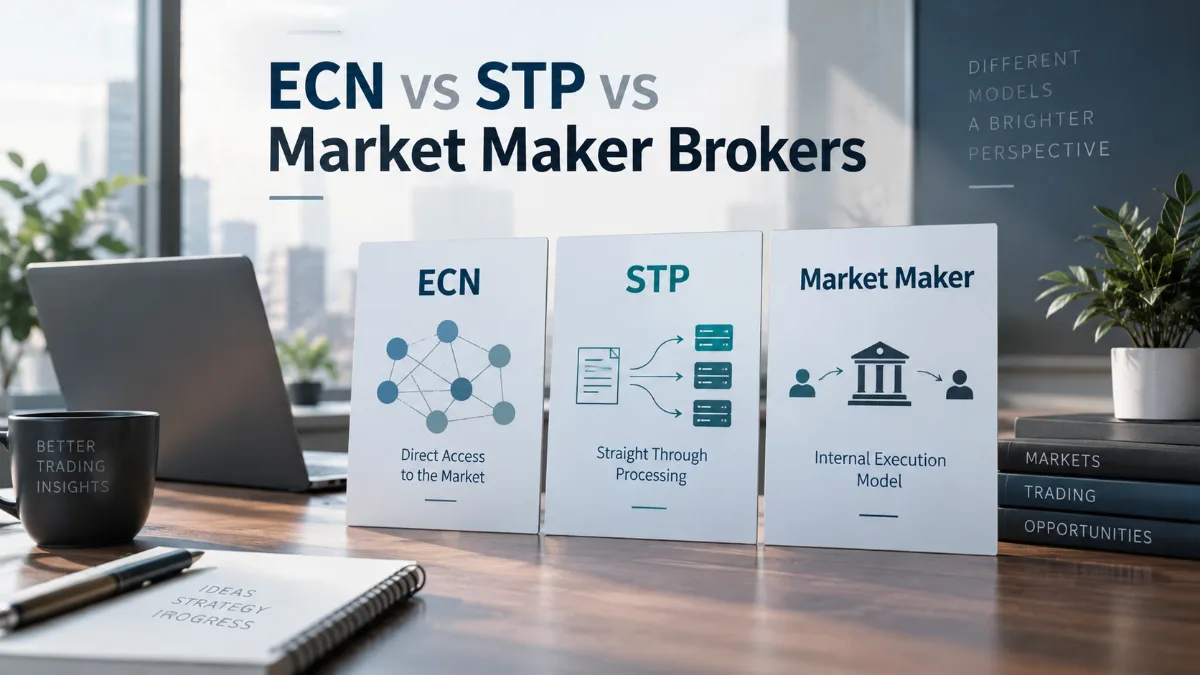
An ECN forex broker is generally understood as a broker that gives clients access to electronically aggregated prices from multiple market participants and charges a separate trading commission instead of relying mainly on a marked-up spread. In practical retail trading, the attraction is straightforward: spreads can be very tight when liquidity is strong, while the broker's fee is shown separately as commission.
That does not mean every account marketed as "ECN" works in exactly the same way. Retail foreign exchange is an over-the-counter market, not a single centralized exchange, and the label ECN is used differently across brokers and jurisdictions. A broker may aggregate quotes from banks, non-bank liquidity providers and other venues while still remaining the client's legal counterparty. The account agreement and execution policy matter more than the marketing label.
The key question is therefore not whether an account says ECN or standard. It is whether the broker provides competitive all-in trading costs, reliable execution, transparent order handling and appropriate regulatory protection for the trader's jurisdiction.
What is an ECN broker?
ECN stands for electronic communication network. At its core, the concept describes an electronic system that brings together trading interest from multiple participants so orders can interact electronically. In securities markets, the U.S. Securities and Exchange Commission describes ECNs as electronic trading systems that automatically match buy and sell orders at specified prices. That securities-market definition should not be copied mechanically into retail forex, but it explains the basic idea behind the term.
In forex brokerage, an ECN broker commonly uses technology that receives prices from several liquidity sources, creates a bid and ask available to clients and routes or offsets client flow according to its execution model. Instead of widening the quoted spread to recover most of its transaction revenue, the broker may display a tighter or "raw" spread and charge a fixed or volume-based commission.
There is also an important jurisdictional distinction. In U.S. retail off-exchange forex, the Commodity Futures Trading Commission warns that the customer trades against the dealer and connects to the dealer rather than to a live regulated exchange. A dealer may hedge client exposure elsewhere, but that does not automatically change the legal relationship between the retail customer and the dealer.
How ECN forex pricing works
From liquidity quotes to a fill
A typical raw-spread setup starts with several external price streams. Each liquidity source may quote a bid, which is the price at which it is willing to buy, and an ask, which is the price at which it is willing to sell. The broker or its technology provider aggregates those quotes and can display a best available bid and ask to the trader.
- Liquidity sources send executable or indicative prices to the broker's pricing system.
- The system aggregates the available quotes and forms the price shown on the trading platform.
- The trader submits a market order or another supported order type.
- The order is processed under the broker's execution policy and may be filled at the requested price or at another available price if the market has moved.
- The broker records the spread paid on the execution and applies any separate commission.
Large orders can interact with more than one price level when the best quote lacks enough volume. A small order may fill at the top price while a larger order receives an average across several levels. The visible spread is therefore not always the final trading cost.
Why raw spreads change
A raw spread is not a promise of a permanently tiny spread. It is normally a variable spread that reflects the prices available to the broker or its pricing system at that moment. During liquid periods in major currency pairs, the best bid and ask can become very close. During news releases, market openings, holidays or thin trading hours, available liquidity can fall and spreads can widen sharply.
The word "raw" does not prove that absolutely no markup exists. The useful test is whether pricing, commission and execution terms are clear enough to calculate the effective cost.
Raw spreads and commission: what you actually pay
The transaction cost on an ECN-style account is usually the combination of the spread and a commission. Depending on the trade, slippage can add to or reduce the realized entry or exit cost. Financing charges can also matter when a leveraged position is held overnight.
A useful comparison is:
All-in opening and closing cost = spread cost + round-turn commission + execution impact + applicable financing or other fees.
Consider a simplified EUR/USD example. One standard lot is 100,000 euros and one pip is worth about $10 when the account is denominated in U.S. dollars and EUR/USD is near ordinary price levels. If the raw spread is 0.2 pips, the spread component is about $2 per standard lot. If commission is $3.50 per side, opening and closing the position costs $7 in commission. The combined spread plus commission is therefore about $9, equivalent to roughly 0.9 pips before slippage or financing.
Pip value changes with instrument structure, account currency and currency pair. Brokers may quote commission per lot, per side, per round turn or per million units of notional volume. Headline commission numbers must therefore be normalized before comparison.
| Cost component | What it means | Why it matters |
|---|---|---|
| Raw spread | Difference between the bid and ask shown to the trader | Can be extremely tight in liquid conditions but may widen when liquidity falls |
| Commission | Separate fee charged for executing volume | Must be added to the spread when comparing account types |
| Slippage | Difference between the expected price and the actual fill | Can materially affect strategies that trade frequently or target small moves |
| Financing | Charge or credit associated with holding a leveraged position across the broker's rollover period | Can outweigh spread differences for positions held for several days |
| Currency conversion | Conversion cost when fees or profits are translated into the account currency | Can create an additional cost that is easy to miss |
ECN vs standard account
The phrase "ECN vs standard account" sounds like a comparison between two execution systems, but that is often misleading. ECN usually refers to pricing and execution architecture. Standard usually refers to a retail account package. A standard account may still receive prices derived from external liquidity, while an ECN-labelled account may still make the broker the legal counterparty to the client.
| Feature | ECN or raw-spread account | Standard account |
|---|---|---|
| Displayed spread | Usually tighter and variable | Usually wider because some broker compensation may be included in the spread |
| Commission | Usually charged separately | Often zero as a separate line item although costs remain in the spread |
| Cost visibility | Spread and commission must be combined | Headline cost can be easier to read because more of it is embedded in the spread |
| Best fit | Often attractive to active traders who care about narrow quoted spreads | Often simpler for traders who prefer straightforward pricing |
| Execution model | Must be verified from the broker's legal documents | Must also be verified rather than inferred from the account name |
Compare the same currency pair, trade size and market conditions. A raw account with a 0.1-pip spread is not automatically cheaper than a standard account at 0.8 pips. If raw-account commission equals 0.8 pips round turn, its apparent advantage disappears before slippage.
When an ECN account can cost less
An ECN account tends to become more compelling when the spread saving is consistently larger than the added commission. That is a break-even problem rather than a branding problem.
Suppose a standard account averages a 1.0-pip spread on the pair and trading session that matters to you. A raw account averages 0.2 pips and its round-turn commission is equivalent to 0.6 pips. Ignoring other costs, the raw account's effective cost is 0.8 pips, so it is cheaper by 0.2 pips per completed trade. If the raw spread widens to 0.5 pips while commission stays at 0.6 pips, the effective cost becomes 1.1 pips and the standard account is cheaper in that example.
Trading frequency and position size
Small differences in all-in cost matter more as turnover rises. A trader making many round trips can accumulate spread and commission costs rapidly. Scalpers and short-term algorithmic strategies therefore tend to examine raw accounts closely. Position size also matters because commission is often tied directly to traded volume.
News and illiquid hours
The average spread shown on a broker's marketing page may tell little about what happens during the exact minutes a strategy trades. Around major economic releases or during thin liquidity, raw spreads may expand and price levels may change before an order reaches the execution system. A trader who operates in those conditions should care about spread distribution, slippage and rejected or partially filled orders rather than the minimum advertised spread.
Execution quality matters more than the label
Two brokers can advertise the same minimum spread and commission while delivering different realized results. Execution quality includes the price actually received, speed, likelihood of execution, treatment of positive and negative slippage, available market depth and the handling of large or fast-moving orders.
This broader view is consistent with regulatory best-execution principles. The Financial Conduct Authority identifies price, costs, speed, likelihood of execution and settlement, size and nature among relevant execution factors. The exact duty depends on the firm, product and jurisdiction, but the principle is useful: the narrowest spread is only one variable.
Latency can create slippage because the market may move between display and execution. Positive slippage gives a better price than expected and negative slippage gives a worse one. Execution reviews should examine both directions rather than average speed alone.
Some liquidity providers use mechanisms such as last look, where a quote can be checked before final acceptance. Their effect depends on the broker's liquidity arrangements and execution policy. "ECN" does not guarantee every order is matched instantly without rejection or price change.
Advantages of an ECN forex broker
- Tighter quoted spreads can reduce friction. During liquid market conditions, raw pricing can be attractive for strategies that enter and exit frequently.
- Separate commission improves cost analysis. Traders can see the explicit execution fee rather than having all broker compensation hidden inside a wider spread.
- Variable pricing can reflect changing liquidity. Spreads can contract when competition between available quotes is strong instead of remaining fixed at a wider level.
Disadvantages and trade-offs
- Commission must be added back to the spread. A visually impressive 0.0-pip quote can still produce a higher all-in cost than another account.
- Variable spreads can expand sharply. Raw pricing exposes the trader to changing market liquidity rather than guaranteeing a constant transaction cost.
- Execution can differ from the displayed quote. Slippage and partial fills become especially relevant in fast markets or at larger sizes.
- The ECN label can create false confidence. It does not by itself prove the broker is regulated, financially sound or free from conflicts of interest.
How to evaluate an ECN broker
- Verify the regulated legal entity. Check the broker against the regulator's official register for the entity that will actually hold the account. A group brand may operate through several legal entities with different protections.
- Read the execution policy and client agreement. Look for who acts as counterparty, how orders are executed, whether orders can be internally matched or externally hedged and what happens during market disruption.
- Normalize the commission. Convert the fee to a round-turn cost for the position size you normally trade. Confirm whether the quoted commission is per side, per lot or per notional amount.
- Measure typical spreads rather than minimum spreads. The useful number is the spread during the sessions and instruments you actually trade. A minimum of 0.0 pips is not the same as an average of 0.0 pips.
- Review slippage and fill behavior. Test small trades in realistic conditions. Compare requested price with executed price and record both favorable and unfavorable slippage.
- Check non-trading costs. Financing, withdrawals, currency conversion and inactivity charges can matter more than a small spread advantage depending on trading style.
- Test the platform and order controls. Stability, order types, server location, connection quality and platform restrictions can affect execution even when the account's nominal spread is competitive.
Separate broker safety from broker pricing. Regulation and legal protections address counterparty risk, while spread, commission and execution data address whether an account is competitively priced for a strategy.
Who is an ECN account for?
An ECN or raw-spread account can suit active traders, scalpers and algorithmic traders whose strategies are sensitive to small transaction-cost differences. It also suits traders who prefer a separate commission rather than broker compensation embedded mainly in the spread.
A standard account may suit lower-frequency traders who value simpler pricing. For positions held for days, financing and market movement can matter more than a fraction of a pip at entry.
Let the strategy drive the decision. Estimate trade frequency, normal position size, holding time and trading session. Compare all-in cost and execution under those conditions instead of choosing by account name.
Common ECN broker misconceptions
Zero spread means free trading
No. A zero displayed spread means the bid and ask happen to be equal at that moment or are quoted that way by the pricing system. Commission can still apply, and the spread can widen before the order is filled. Slippage and financing may add further cost.
ECN means the broker cannot be counterparty
Not necessarily. The broker can use external liquidity or hedge exposure while still being the customer's contractual counterparty. This distinction is especially important in retail OTC forex. The account agreement should state the legal relationship.
ECN always means faster execution
No. Execution speed depends on infrastructure, routing logic, liquidity connectivity, server distance, platform performance and market conditions. An account label cannot guarantee low latency.
ECN is automatically safer
No. ECN describes an execution or pricing concept, not a regulatory status. A poorly regulated or unregulated firm can market itself with ECN terminology. Broker authorization, client-money rules, complaint mechanisms and the applicable legal entity must be checked independently.
Choose by all-in cost and execution quality
The useful answer to "what is an ECN broker?" is not "a broker with zero spreads." An ECN forex broker generally offers electronically aggregated pricing with narrow variable spreads and a separate commission, while the legal and execution structure can vary.
For the ECN vs standard account decision, calculate spread plus round-turn commission first. Then examine slippage, fill quality, financing and non-trading fees. Finally, verify the regulated entity and read the execution terms. The account with the lowest advertised spread is not necessarily the cheaper account, and the account with the ECN label is not necessarily the better broker. The stronger choice is the one whose verified protections, all-in costs and execution behavior fit the way you actually trade.