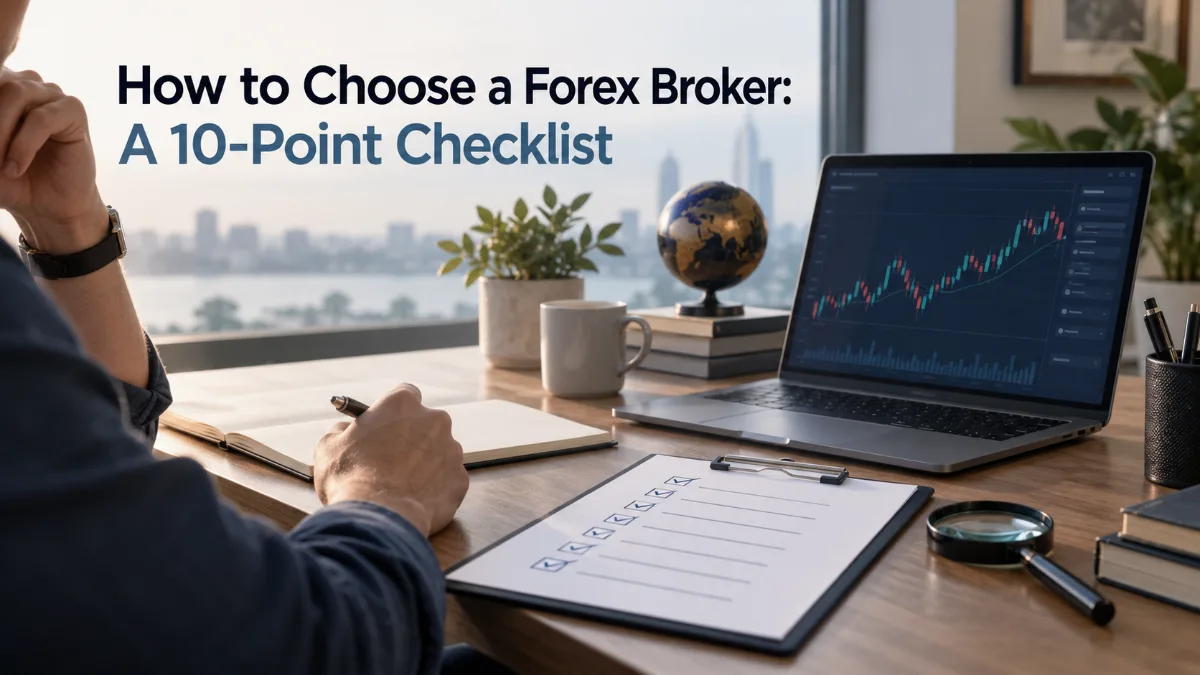
To choose a forex broker well, start with regulation and legal identity before comparing spreads, platforms or bonuses. Then evaluate client money arrangements, total trading costs, execution, leverage, platform controls, withdrawal terms, support and fit with your strategy. A broker that is attractive on one metric can still be a poor choice overall. The strongest decision comes from checking the full operating package and confirming important claims independently.
There is no single best forex broker for every trader. A low-cost broker may be unsuitable if it lacks the instruments you trade. A feature-rich platform may be a weak choice if the legal entity serving your country has limited protections. The practical goal is to identify a broker whose regulation, costs and operating conditions match your location and trading method.
Forex broker checklist at a glance
| Checkpoint | What to verify | Why it matters |
|---|---|---|
| 1. Regulation | Legal entity and regulator | Confirms who is accountable for your account |
| 2. Jurisdiction | Entity serving your country | Protections can differ between group companies |
| 3. Client money | Segregation and insolvency treatment | Affects how customer funds are handled |
| 4. Costs | Spread commission swaps and other fees | Shows the real cost of trading |
| 5. Execution | Slippage fills and order handling | Changes realized trading results |
| 6. Leverage | Margin rules and loss protections | Determines how quickly risk can expand |
| 7. Platform | Stability order types and controls | Affects how reliably you can manage positions |
| 8. Funding | Deposit and withdrawal rules | Tests whether money movement is predictable |
| 9. Support | Availability and problem resolution | Matters when operational issues occur |
| 10. Fit | Markets account type and strategy compatibility | Prevents choosing on reputation alone |
1. Verify regulation and legal identity
Regulation is the first filter because a trading website can be professionally designed without being authorized to provide the service it advertises. Find the broker's full legal company name, registration number and regulator. Then search that information on the regulator's own register. Do not rely on a badge, footer statement or copied license number.
Also confirm that the regulated entity has permission for the activity you intend to use. A financial group can contain several companies with different permissions. The company named in your account agreement is more important than the brand name on the homepage. In the United States, the Commodity Futures Trading Commission tells customers to verify registration and disciplinary history before trading and directs them to NFA BASIC for those checks.
Regulation does not guarantee good execution or prevent every loss. It does create an identifiable legal entity subject to rules and supervision. Treat authorization as a minimum requirement rather than a quality award.
2. Match the regulator to your residence
A broker can be regulated somewhere and still place your account under a different affiliate. This is one of the most important details in any forex broker checklist. Before funding, identify the entity that will contract with you based on your country of residence. Read the account opening page, client agreement and regulatory disclosures until the same entity name appears consistently.
Then check whether the regulator listed for that entity actually covers the service being offered. The Financial Conduct Authority warns UK consumers to check that a firm is authorized and has permission for the relevant financial service. Its register can also show regulatory history and information related to client money permissions.
This matters because leverage limits, complaint routes, compensation arrangements and conduct requirements may differ across jurisdictions. Do not assume that protections advertised on a global website apply to every regional account. If a broker offers to move you to an offshore entity for higher leverage, compare exactly which protections you would give up before accepting.
3. Understand how client money is protected
Ask what happens to your cash after you deposit it. Important questions include whether retail client money is kept separately from the broker's own operating money, which bank or type of institution holds it, whether the arrangement applies to your specific account and how customer claims are handled if the broker fails. The answers depend on jurisdiction and account structure.
Do not reduce this checkpoint to the word segregated. Segregation can describe an operational arrangement without telling you everything about insolvency priority, compensation coverage or exceptions in the client agreement. Look for the actual client money disclosure and read the sections covering custody, permitted use of funds and insolvency.
Keep your trading balance proportional to what you need for margin and normal volatility. A broker account is not automatically equivalent to an insured bank deposit. This distinction is especially important for traders who leave large idle cash balances with a trading provider simply for convenience.
4. Compare total trading costs
The lowest advertised spread is not necessarily the lowest-cost account. Compare the full cost of the trades you expect to place. That can include the bid-ask spread, per-side or round-turn commission, overnight financing, currency conversion, market data charges, inactivity fees and deposit or withdrawal charges. Not every broker uses all of these fees.
Build a simple test basket from your real strategy. If you mainly trade EUR/USD during liquid hours, compare typical spread plus commission for that pair during those hours. If you hold positions for several days, financing may matter more than a small difference in entry spread. If you trade less liquid crosses or around volatile events, average conditions may matter less than how costs behave when liquidity thins.
For raw-spread accounts, add commission to the spread before comparing them with spread-only accounts. Use the same trade size and currency so the comparison is meaningful. Cost claims should be based on the account type you can actually open rather than the broker's cheapest headline tier.
5. Test execution quality in your market
Execution quality is the difference between the price you expect and the result you actually receive. Relevant factors include fill speed, positive and negative slippage, rejected orders, requotes where applicable and how stop or limit orders behave in fast markets. A tiny displayed spread can be less valuable if fills are consistently poor.
Start with a demo to learn the platform, but do not treat demo execution as proof of live execution. Once you understand the software, a small live account can reveal practical differences in spreads, fills and order handling under real conditions. Record a sample of trades rather than judging the broker from one unusually good or bad fill.
Remember that retail OTC forex can involve the dealer acting as your counterparty. The CFTC explains this structure for US off-exchange retail forex and notes that the dealer controls the trading platform and prices presented to the customer. That makes transparent execution policies and independently checkable pricing important decision criteria.
6. Check leverage and margin protections
Higher leverage is not automatically a broker advantage. It reduces the margin required to open a position but increases how much market exposure can be controlled with a given account balance. That can make losses accelerate quickly and can cause positions to be closed when margin requirements are breached.
Check the maximum leverage for your account type, the margin calculation for each instrument, the margin close-out level and whether negative balance protection applies. Also check whether leverage changes before major events or for larger position sizes. These rules should be available before you deposit.
In Europe, retail CFD protections can include leverage limits, margin close-out rules and negative balance protection. The European Securities and Markets Authority reiterated in 2026 that products falling within CFD rules remain subject to applicable product intervention requirements. This is a useful reminder that product labels alone do not determine the protection. The legal classification and local rules do.
7. Inspect platform reliability and order controls
The trading platform should support how you manage risk rather than simply look modern. Verify the order types you use, stop-loss and take-profit behavior, partial close capability, hedging or netting rules, price alerts, charting tools and mobile access. If you automate trades, confirm API or expert advisor support and any restrictions on algorithmic strategies.
Reliability matters most when markets are moving quickly. Look for clear information about maintenance windows, backup access and what happens if the platform becomes unavailable. Test login recovery and two-factor authentication before you need them. A trader who cannot access the account during a volatile session has an operational risk even if the underlying strategy is sound.
Check instrument specifications inside the platform as well. Contract size, minimum trade size, price increment, trading hours and swap treatment can differ by symbol. These details affect position sizing and should be verified before a strategy is transferred from another broker.
8. Test deposits withdrawals and account terms
A broker should make funding and withdrawal rules understandable before money is sent. Check accepted payment methods, account ownership requirements, processing steps, possible fees, minimum amounts and whether withdrawals must return to the original funding source. Identity checks are normal in regulated financial services but unexplained demands for additional payments to release your own funds are a serious warning sign.
Before committing a large balance, consider making a modest deposit and then testing a normal withdrawal after the account is fully verified. The purpose is not to prove that every future withdrawal will be perfect. It is to confirm that the published process works for your account and that support can explain any delay.
Read bonus or promotion terms carefully if they affect withdrawal eligibility. A useful broker selection rule is simple: if the withdrawal conditions are difficult to understand before you deposit, do not assume they will become clearer after you trade.
9. Evaluate support and operational transparency
Customer support is most valuable when something goes wrong. Test it with specific questions about the legal entity, margin rules, execution policy, withdrawal procedure and account fees. Good support should be able to point you to the relevant written policy rather than rely on vague assurances.
Check which channels are available and whether service hours match your trading schedule. If you trade the Asian session but support is unavailable until European business hours, that mismatch may matter. Also confirm the process for formal complaints and escalation. A broker that clearly documents complaints, privacy and security procedures is easier to evaluate than one that leaves critical processes to informal chat messages.
Be cautious when sales staff pressure you to deposit quickly, push unusually high leverage or promise returns. A broker provides access and execution. It cannot remove market risk. Marketing that minimizes risk should count against the broker rather than in its favor.
10. Choose a broker that fits your trading style
The final checkpoint is fit. A broker can pass every safety and transparency test but still be wrong for your strategy. Scalpers may care most about execution consistency, spreads and order restrictions. Swing traders may place more weight on overnight financing and instrument range. Algorithmic traders need stable platform access, automation support and clear execution rules. Beginners may value simpler interfaces and stronger risk controls.
Compare only features that affect your actual decisions. Hundreds of instruments are not an advantage if you trade three currency pairs. Maximum leverage is not useful if your risk plan never needs it. An advanced platform is not better if it adds complexity without improving execution or control.
This is also why the phrase best forex broker should be treated as a fit question rather than a universal ranking. The best candidate is the regulated broker that meets your practical requirements with acceptable costs and clear operating terms.
How to choose the best forex broker in 2026
For anyone searching how to choose the best forex broker in 2026, a key selection issue is the exact product and legal entity behind the offer. Verify both before comparing features or platforms. Brokers can serve different countries through different companies and can offer forex exposure through products that have different regulatory treatment. Start with the contract you are actually opening rather than the brand you recognize.
Use regulation as a gate. Use client money rules and withdrawal terms as protection checks. Use total cost and execution as performance checks. Use leverage and platform controls as risk checks. Then use strategy fit as the final selection criterion. This sequence prevents an attractive spread or promotion from distracting you from more important questions.
Red flags that should stop the process
Some problems are serious enough that a lower spread or better platform should not compensate for them. Stop the comparison if you cannot verify the legal entity that will hold your account, if the company claims regulation that does not match the official register or if the account agreement names a different entity without a clear explanation.
- A salesperson promises guaranteed profits or suggests that losses are unlikely.
- The broker pressures you to deposit immediately or to increase your deposit after a loss.
- Withdrawal requires an unexpected tax, commission or additional deposit paid directly to the broker before funds can be released.
- The website gives inconsistent company names, addresses or regulatory details.
- Risk disclosures are missing while leverage and profit potential are heavily promoted.
- Support refuses to provide written terms for fees, margin rules or withdrawals.
Not every service problem proves misconduct. Payment checks, compliance reviews and technical outages can create legitimate delays. The distinction is transparency. A credible provider should be able to explain the process, point to written terms and give you a formal route for complaints. When basic facts remain unverifiable, the safer decision is to exclude that broker rather than rationalize the uncertainty.
A practical shortlisting method
- Build a candidate list. Include only brokers that legally accept clients in your country and offer the markets you need.
- Verify each legal entity. Match the company name and registration details to the official regulator record and your client agreement.
- Eliminate unclear offers. Remove brokers with ambiguous ownership, unexplained offshore routing, unclear withdrawal terms or missing risk disclosures.
- Compare like with like. Use the same currency pairs, trade sizes, holding periods and account types when comparing costs and execution.
- Test before scaling. Learn the platform, complete verification, test funding and withdrawal and observe live execution with limited capital before increasing exposure.
A disciplined forex broker checklist does not try to predict which broker will always be cheapest or fastest. It separates non-negotiable protections from strategy preferences. Verify who holds the account, understand the rules that apply to it and test the operating conditions you will actually use. If a broker cannot make those basics clear before you deposit, keep looking.