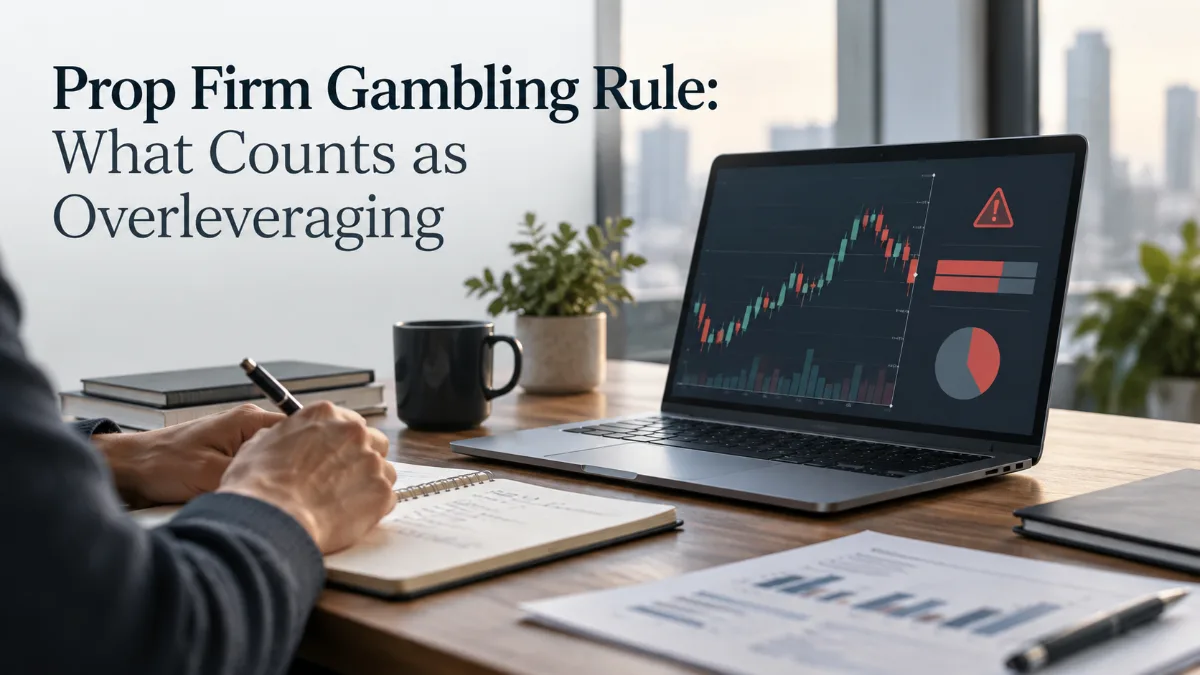
A prop firm gambling rule is usually a conduct or risk-control rule aimed at trades that put an unusually large share of the account at risk on one idea. It may be described as an all-in rule, excessive risk rule, overleveraging rule, prohibited trading practice, or consistency requirement. The important point is that there is no single industry definition. One program may impose a hard percentage cap per trade idea, while another may judge behavior through position size, margin usage, concentration, stop-loss placement, or sudden changes in risk.
The practical question is therefore not just “How much leverage is too much?” A trader needs to know how the firm measures risk, whether positions are grouped together, which account value is used, and whether a breach is triggered by planned risk, floating loss, margin usage, or closed loss. A trade can stay inside a daily drawdown limit and still violate a separate overleveraging rule.
What the prop firm gambling rule usually targets
The rule generally targets a mismatch between ordinary trading behavior and a one-shot attempt to pass an evaluation or generate a payout. The label “gambling” is broad, so it should never be treated as a precise mathematical standard unless the firm's written terms supply one.
Common behaviors that may attract scrutiny include:
- All-in positioning: committing most of the usable risk budget to one market move.
- Sudden size escalation: trading far larger after losses or when close to a profit target.
- Concentrated exposure: splitting one directional idea across several tickets or correlated instruments.
- Martingale-style recovery: repeatedly increasing size after losing trades in an attempt to recover quickly.
- Undefined downside: using no stop loss where the rules require one or allowing potential loss to expand materially.
- Event betting: taking an exceptional position immediately around a high-impact event when the program treats that behavior as prohibited or restricts news trading.
These are rule patterns rather than universal prohibitions. The account agreement and trading rules control the answer for that specific account.
Overleveraging: exposure is not the same as risk
Overleveraging is often misunderstood because traders use “leverage” to describe several different things. Notional exposure is the market value controlled by the position. Margin usage is the collateral required to maintain that exposure. Trade risk is the amount the trader expects to lose if the exit plan is reached. Those figures are related but they are not interchangeable.
The Commodity Futures Trading Commission explains that leverage allows a relatively small amount of margin to control a much larger position and that this amplifies both gains and losses. That general leverage principle matters to prop accounts even when the account is simulated because the program may still evaluate exposure and loss behavior using leverage-based limits.
A position can have high notional leverage but a small intended stop-loss risk. It can also have modest notional leverage and still be dangerous if the trader uses no effective stop or holds through conditions where price can move sharply. The U.S. Securities and Exchange Commission likewise warns that leverage magnifies loss exposure and can cause losses to build quickly. For prop trading the operational lesson is simple: do not judge compliance from lot size or leverage ratio alone unless the firm explicitly uses those metrics.
What counts as a prop firm all-in rule breach?
A prop firm all in rule usually concerns concentration of risk rather than the literal use of the entire account balance. A trader does not need to place 100 percent of available margin into one order for the behavior to look all-in. If one setup can consume most of the remaining daily or overall loss allowance, the economic effect may be similar.
Consider an account with $4,000 of room before a hard loss limit. A new trade that can reasonably lose $3,000 is risking 75 percent of the remaining survival buffer even if the platform still shows plenty of free margin. If the program separately caps risk per trade idea at a lower amount, that trade could be a direct breach. If it has only a qualitative gambling clause, the same concentration may still be reviewed under that clause.
Using a large amount of margin is not automatically an all-in breach when the written rules use a different metric. The decisive question is the firm's measurement method. Do not substitute “I had a stop loss” for the contractual definition.
How prop firm max risk per trade is measured
There is no universal prop firm max risk per trade. Some programs publish a fixed percentage. Others set a monetary limit, cap lot size, cap aggregate exposure, require a minimum margin level, or do not publish a separate per-trade cap at all. A trader should not import a popular 1 percent or 2 percent risk convention and assume it is the firm's rule.
When a program defines risk from the stop loss, the basic calculation is usually conceptually similar to this:
planned trade risk = position size × distance to stop × value per unit of price movement
The instrument determines the unit. Forex traders may use pip value, futures traders tick value, and CFD traders the platform's contract specification. Fees and slippage may require an additional buffer.
The denominator also matters. A 2 percent rule could mean 2 percent of initial balance, current balance, current equity, or another reference value defined by the provider. These are not equivalent after gains or losses. If the rules say “initial balance,” a trader should not recalculate the allowance from a higher current equity unless the terms explicitly permit that.
How multiple positions can become one trade idea
One of the easiest ways to misread an overleveraging rule is to evaluate each ticket separately. A firm may group several positions into one trade idea when they represent the same directional thesis. Splitting a large position into five smaller orders does not necessarily split the risk into five independent trades.
Grouping can occur when positions share one or more of these characteristics:
- the same instrument and direction
- overlapping holding periods
- entries made within a defined time window
- a common stop or target
- multiple instruments with strongly related directional exposure
- re-entry shortly after closing the original position
If three positions each risk $600 and the firm treats them as one idea, the relevant risk may be $1,800 rather than $600. The same logic can apply to scaling into a position. Adding to a winner may be entirely valid as a strategy, but the combined open risk after the add-on is what matters when the rule is based on aggregate trade-idea risk.
Correlation creates another problem. Several symbols can behave like one concentrated macro bet. Not every firm aggregates correlated instruments, so verify whether the rules address coordinated or substantially similar exposure.
Why a stop loss does not automatically make a trade compliant
A stop loss defines an intended exit level. It does not prove that the position satisfies every prop rule. First, the stop may be too far away, producing excessive planned loss. Second, several stopped positions may be grouped into one trade idea. Third, the account may have a separate margin or exposure cap. Fourth, some programs monitor floating loss or equity rather than only the risk implied by the stop.
A trader can also increase risk after entry by widening or removing the stop. Suppose a position is opened with $500 of planned risk and the stop is later moved so that $1,500 is at risk. If the rule continuously evaluates open risk, the relevant figure is no longer the original $500.
A stop order also does not guarantee an exact fill in every market condition. Fast movement or gaps can produce a worse exit than planned. A risk plan set exactly at the firm's maximum therefore leaves little room for execution differences or calculation errors.
A practical risk budget for prop firm accounts
The safest way to manage a gambling rule is to build the firm's limits into a hierarchy before calculating lot size. Start with the hard rules and then set a personal operating buffer inside them. The personal buffer is not a substitute for the rules. It is a way to reduce the chance that normal trading variability pushes the account into a breach.
- Identify the hard loss limits. Record daily loss, overall loss, trailing drawdown, and any equity-based thresholds.
- Identify trade-specific limits. Look for maximum risk per trade, per trade idea, per symbol, per direction, or per group of positions.
- Identify exposure limits. Check maximum lots, contracts, open positions, margin usage, and leverage restrictions.
- Identify behavior rules. Review clauses covering gambling, all-in trading, martingale, news trading, stop requirements, or inconsistent sizing.
- Translate rules into cash risk. Calculate how much one full stop would cost and how much room remains before every applicable limit.
- Add a buffer. Size below the formal maximum so spread changes, slippage, commissions, or small platform differences do not consume the entire allowance.
This hierarchy prevents a common error: sizing a trade only from the daily loss limit. If the daily limit allows a $2,000 loss but the per-idea limit allows only $1,000, then $1,000 is the binding constraint for that setup. If a margin rule is even tighter, the margin rule becomes the binding constraint.
Examples of overleveraging and safer sizing
| Scenario | Why it can be a problem | Better control |
|---|---|---|
| One trade risks most of the remaining daily loss allowance | A normal losing trade can leave almost no room for another setup and may resemble an all-in attempt | Cap risk by the smaller of the firm's trade limit and a conservative share of remaining loss capacity |
| Five small orders express the same directional idea | Ticket-level risk appears small while combined exposure is large | Calculate aggregate risk across all linked positions before adding another order |
| Position size doubles after each loss | Risk accelerates when the account is already closer to its drawdown boundary | Keep sizing rules stable or reduce risk as the remaining loss buffer shrinks |
| A stop is widened to avoid taking a loss | The original risk calculation no longer describes the actual open risk | Recalculate risk after every stop change and prohibit changes that exceed the account limit |
| A trader uses maximum permitted leverage because it is available | Platform leverage is a capacity limit rather than a recommended position size | Size from acceptable loss and rule constraints rather than from maximum buying power |
The examples show why “maximum leverage” and “maximum risk” differ. Available leverage describes platform capacity. Risk rules define what the account permits you to expose to loss. Your own risk plan should normally be tighter than maximum technical capacity.
How to audit a gambling rule before you trade
Do not rely on a checkout page or a short rule summary when the account can be failed for prohibited conduct. Read the full trading rules and search for overlapping terms because the restriction may not be filed under “gambling.” Useful terms include risk per trade, trade idea, overleveraging, all-in, excessive risk, lot size, margin, consistency, prohibited strategy, and responsible trading.
Then answer four questions in writing:
- What exact event triggers a breach?
- What positions are aggregated for the calculation?
- What balance or equity figure is used as the base?
- Is the consequence a warning, rejected trade, payout restriction, soft breach, or account termination?
If the wording is qualitative, request clarification before placing a position near the boundary. Save the applicable rule text and support response where permitted. A phrase such as “excessive gambling behavior” is not mathematically self-executing unless the provider explains how it identifies that behavior.
What to do after a warning or breach
If an account receives an overleveraging warning, stop increasing exposure until you know which measurement triggered it. Review the time of the event, open positions, stop levels, account equity, margin usage, and any recently closed positions. Reconstruct the combined risk rather than looking only at the last order placed.
For a disputed breach, compare the provider's calculation with the applicable rule version. Focus on position size, entry, stop, equity, and grouping logic. If the rule is discretionary, ask which provision was applied and which trades were grouped.
Do not try to “repair” a suspected breach by immediately taking another large trade. A new trade can compound the same exposure problem and may make the account history harder to evaluate. The priority is to identify the binding rule and adjust the sizing process before resuming normal activity.
Common questions about prop firm gambling rules
Is risking 2 percent per trade considered gambling?
Not automatically. Two percent is neither universally permitted nor universally prohibited. It can be inside one program's limit and above another's. It may also become excessive when several positions are combined into one trade idea or when only a small drawdown buffer remains. The firm's rule and the account's current risk capacity determine the answer.
Can I use maximum leverage if my stop is tight?
Only if every applicable rule still permits the position. A tight stop may reduce planned loss, but it does not override maximum lot size, aggregate exposure, margin, concentration, news, or conduct rules. Very large positions can also be more sensitive to spread changes and execution around the stop.
Does splitting one order into smaller trades avoid the all-in rule?
Usually that is unsafe to assume. If the orders express the same idea, the program may aggregate them. Evaluate the combined downside of the full position set and check the provider's definition of a trade idea before relying on ticket count.
What is the safest prop firm max risk per trade?
There is no universal percentage that can be called the safest for every trader or program. A useful internal limit must fit the strategy's stop distance, loss frequency, daily trade count, remaining drawdown, and the firm's hard rules. The formal maximum should be treated as a boundary rather than a target.
Is overleveraging the same as breaking the daily loss limit?
No. A daily loss rule measures account loss over a defined period. An overleveraging rule may measure the risk or exposure of a position before the daily loss limit is reached. A trader can therefore remain inside the daily drawdown threshold and still breach a separate per-trade or prohibited-conduct rule.
The most reliable way to avoid a prop firm gambling rule is to size from defined loss risk and remaining drawdown capacity rather than from the platform's maximum buying power. Treat all related positions as one exposure until the firm's rules clearly say otherwise, calculate risk before entry and after every material adjustment, and keep enough buffer that a normal execution difference does not turn a valid setup into an avoidable rule breach.