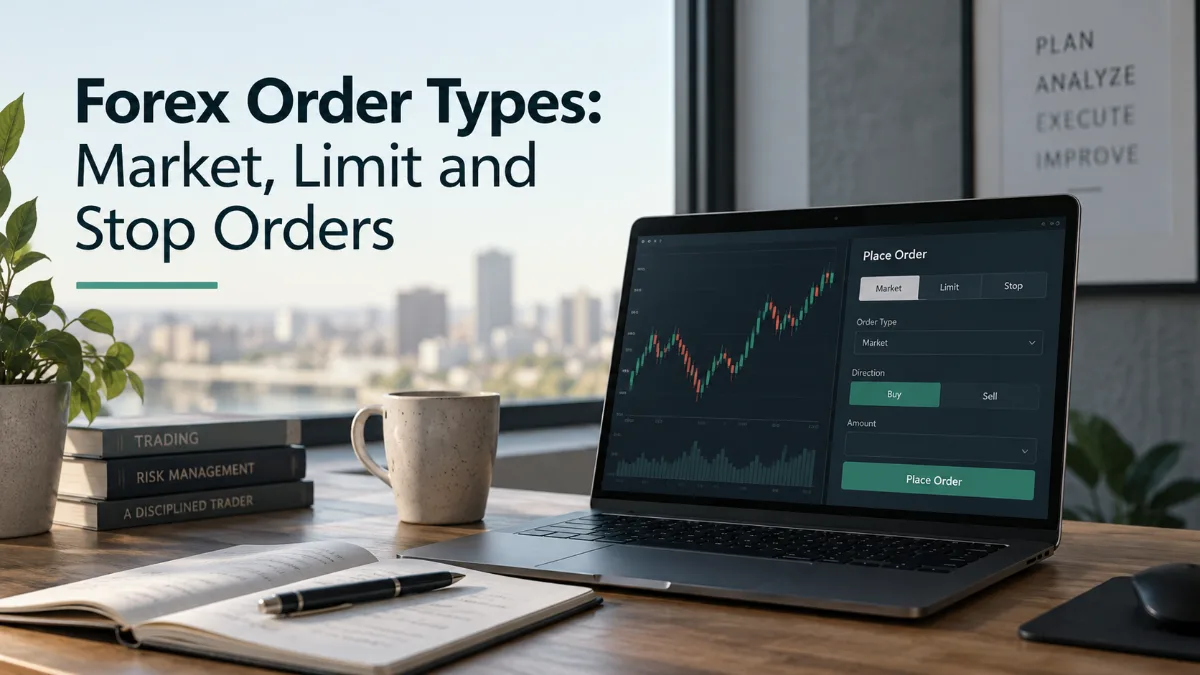
Forex order types tell a trading platform when and under what price conditions to open or close a position. The three core types are market orders for immediate execution, limit orders for execution at a specified price or better, and stop orders that activate after a specified trigger price is reached.
That distinction matters because order type changes both execution certainty and price certainty. A market order usually offers the greatest certainty that an order will be executed, but the final price can differ from the quote seen when the order was submitted. A limit order controls the worst acceptable execution price, but it may never fill. A stop order can help automate an entry or exit after a price threshold is reached, but once triggered it may execute at a worse price during fast movement. These general mechanics are consistent with the order definitions published by Investor.gov, although forex platforms can apply their own detailed triggering and execution policies.
Forex order types at a glance
| Order type | Main purpose | Price condition | Execution trade-off |
|---|---|---|---|
| Market order | Enter or exit immediately | Accept the best available executable price | Higher execution certainty but lower price certainty |
| Buy limit | Buy below the current market | Buy at the limit price or lower | Price controlled but execution is not guaranteed |
| Sell limit | Sell above the current market | Sell at the limit price or higher | Price controlled but execution is not guaranteed |
| Buy stop | Buy after price rises to a trigger | Activates above the current market | Useful for breakout entries but may slip after activation |
| Sell stop | Sell after price falls to a trigger | Activates below the current market | Useful for breakdown entries or protective exits but may slip |
| Stop-limit | Trigger an order while limiting acceptable execution | Stop activates a limit order | More price control but a greater chance of no fill |
How a market order works
A market order instructs the platform to buy or sell at the best price available for the requested size when the order reaches the execution system. In a forex quote there are normally two prices: the bid and the ask. A trader buying a currency pair generally transacts at the available ask, while a trader selling generally transacts at the available bid. The difference between those two prices is the spread.
Suppose EUR/USD is displayed at 1.1000 bid and 1.1002 ask. A market buy would seek execution around the available ask rather than at the bid. A market sell would seek execution around the available bid. The displayed quote is not a promise that the entire order will fill at that exact price. Prices can change between submission and execution, especially around economic releases, session transitions, thin liquidity, or sudden volatility.
This creates slippage, which is the difference between the expected price and the actual execution price. Slippage can be favorable or unfavorable.
When a market order makes sense
A market order is most suitable when immediate participation matters more than a small difference in entry price. For example, a trader may decide that an existing position must be closed now because the original trade thesis is invalid. Using a market order removes the risk that a passive limit order remains unfilled while the market continues to move.
How a limit order works
A limit order sets the worst price the trader is willing to accept. A buy limit can execute only at the limit price or lower. A sell limit can execute only at the limit price or higher. This gives the trader control over execution price, but not over whether execution will happen.
If EUR/USD is trading near 1.1000 and a trader wants to buy only if the pair falls to 1.0950, a buy limit at 1.0950 expresses that condition. If price never reaches an executable level at 1.0950 or better, the order remains pending until it expires or is canceled according to the platform's rules. If the market touches the displayed level but available pricing or order conditions do not satisfy the order, a fill still may not occur.
A sell limit works in the opposite direction. If EUR/USD is near 1.1000 and the trader wants to sell only after a rise to 1.1050, the trader can place a sell limit around that level. The logic is usually mean reversion or entry from a predefined resistance area: wait for a better selling price rather than selling immediately.
What price control really means
Price control does not mean that the market must trade the order. A limit order can remain unfilled even when a chart appears to touch the level. The chart may display only one side of the quote, the spread may have widened, the touch may have been too brief, or available liquidity may have been insufficient under the dealer's execution rules. The exact trigger and fill logic should be checked in the platform documentation or customer agreement.
How a stop order works
A stop order uses a trigger price. When the specified stop level is reached under the platform's trigger rules, the order becomes executable according to its order type. A basic stop order commonly becomes a market order after activation. That means the stop price is an activation threshold, not a guaranteed execution price.
A buy stop is normally placed above the current market. It is used when the trader wants to buy only if price first rises to a higher level. A sell stop is normally placed below the current market. It is used when the trader wants to sell only if price first falls to a lower level. These orders are often associated with breakout entries, but the same stop mechanism can also be used to exit an existing position.
For example, assume EUR/USD is near 1.1000. A trader who wants to enter long only after an upside breakout might place a buy stop at 1.1050. If the trigger condition is met, the order activates. If a sudden jump carries executable prices from 1.1048 to 1.1056, the eventual fill could be above 1.1050. The stop did its job by activating the order, but it did not guarantee the trigger price as the fill price.
Why stop orders can slip
Once a stop becomes a market order, it competes for whatever executable prices are available. If liquidity is limited or price moves rapidly, the next available price can be worse than the stop level. A weekend gap or a sharp reaction to unexpected news can make the difference larger. This is why a stop-loss reduces the need for manual reaction but does not place an absolute cap on trading loss.
The distinction is especially important in retail OTC forex. The Commodity Futures Trading Commission explains that off-exchange retail forex customers trade against their dealer and are limited to the prices and conditions that dealer offers. Therefore order triggering, execution policies, spreads, liquidity arrangements, and account terms can materially affect what happens around a stop level.
Buy limit vs buy stop
The easiest way to understand buy limit vs buy stop is to compare where the order sits relative to the current market and what price movement the trader wants to see before entry.
| Question | Buy limit | Buy stop |
|---|---|---|
| Where is it placed? | Below the current market | Above the current market |
| What is the idea? | Buy after a pullback to a lower price | Buy after an upside breakout |
| What does the trader expect first? | Price declines to the entry area | Price rises to the trigger area |
| Main execution risk | The order may never fill | The fill may be above the stop after activation |
Suppose GBP/USD is trading around 1.2500. A trader believes 1.2450 is a support area and wants to buy only if price pulls back there. That is a buy limit idea. Another trader believes a move above 1.2550 would confirm an upside breakout and wants to buy only after that level is reached. That is a buy stop idea.
The two orders can therefore express opposite entry logic even though both result in a long position. A buy limit seeks a lower entry than the current price. A buy stop waits for evidence of upward movement and accepts that the eventual entry may be higher.
Sell limit vs sell stop
If USD/JPY is near 150.00 and a trader expects resistance around 150.80, a sell limit at that level attempts to enter after a rally. If the trader instead believes a drop below 149.20 would confirm a downside break, a sell stop around 149.20 waits for that decline before activating.
What pending orders mean in forex
Pending orders forex platforms offer are instructions scheduled to become eligible for execution later when their price conditions are satisfied. The most common pending entry orders are buy limit, sell limit, buy stop, and sell stop. Some platforms also support stop-limit combinations and more advanced conditional structures.
Pending does not mean reserved execution. It means the instruction is stored and waiting. Whether it becomes a trade depends on the trigger condition, available pricing, order validity, account status, margin availability, and the platform's execution rules. A trader should therefore separate three events mentally: placing the pending order, triggering the order, and receiving an execution. They are not always the same moment.
Order duration and expiration
Pending orders may include time conditions such as good-till-canceled, day-only, or a specific expiration time. Exact availability and definitions vary by platform. Expiration matters because a valid setup can become stale before price reaches the original entry level.
Stop-limit orders and their trade-off
A stop-limit order combines a trigger with a limit. First the stop price activates the instruction. The activated order then behaves as a limit order rather than a market order. This can prevent execution beyond the chosen limit price, but it creates a new risk: the market may move through the permitted price range without filling the order.
For example, a trader may use a buy stop-limit structure with a stop at 1.1050 and a limit at 1.1055. If the stop is triggered, the order can buy only within the permitted limit condition. If the market jumps directly above the acceptable limit and stays there, the order can remain unfilled. A standard buy stop might have entered at a worse price, while the stop-limit may produce no entry at all.
This is the central trade-off between the two designs. A stop market order prioritizes execution after activation. A stop-limit order prioritizes a price boundary after activation. Neither removes risk.
How spreads affect order triggers
Forex traders should pay attention to whether a platform triggers an order from the bid, the ask, or another defined price. Because a currency pair has two sides, the chart level a trader sees may not be the exact price used to activate every order. A widened spread can therefore trigger an order even when the chart appears not to have crossed the expected level, depending on what the chart displays and what the platform uses as its trigger.
There is no safe universal rule for every retail forex platform. Execution conventions and order definitions must be read in the specific account documentation. In the United States, National Futures Association rules govern aspects of how Forex Dealer Members handle customer forex orders, but platform features and contractual terms can still differ among firms.
How to choose the right order type
The right order type depends on the condition that defines the trade. Start with the decision rule rather than choosing an order because it is familiar.
- Use a market order when the priority is entering or exiting immediately and you accept that the final execution price can move.
- Use a buy limit when you want to buy only at a lower price or better.
- Use a sell limit when you want to sell only at a higher price or better.
- Use a buy stop when you want to buy only after price rises to a higher trigger.
- Use a sell stop when you want to sell only after price falls to a lower trigger.
- Use a stop-limit when you need a trigger but are unwilling to accept execution beyond a defined limit and can tolerate the possibility of no fill.
The order type should match the actual trading thesis. If the thesis is "buy a pullback," a buy stop normally expresses the wrong condition because it activates above the market. If the thesis is "buy only after resistance breaks," a buy limit normally expresses the wrong condition because it waits below the market.
Common mistakes with forex orders
- Confusing the stop price with a guaranteed fill price. A basic stop normally activates an order. It does not guarantee execution at the stop level.
- Reversing buy limit and buy stop. A buy limit is generally below the current market. A buy stop is generally above it.
- Ignoring the bid and ask. A chart may show only one side of the quote while the platform uses another price to trigger or execute an order.
- Assuming a touched limit must fill. A limit order requires executable pricing that satisfies the order conditions. A visual touch alone is not proof of execution.
- Leaving old pending orders active. Market conditions can change while an order remains stored on the platform.
- Using order type as a substitute for risk sizing. Stops can automate exits, but leverage and position size still determine how much money is exposed to a move.
Order types manage instructions not outcomes
Market, limit, and stop orders are tools for expressing execution instructions. They cannot ensure a profitable trade, eliminate slippage, or guarantee that liquidity will be available at a desired level.
If execution now matters most, a market order fits that objective. If the trade is valid only at a specified price or better, a limit order fits it. If the trade should activate only after price reaches a trigger, a stop order fits it. For forex traders, understanding that simple framework is more useful than memorizing platform buttons because it remains valid across different currency pairs and trading setups.
Leveraged forex trading can produce losses quickly, and order mechanics do not remove that risk. Before using real capital, verify the dealer's order definitions, trigger rules, expiration settings, margin policies, and treatment of fast markets in the customer agreement. Use order types as execution controls within a broader risk plan rather than as guarantees about price or loss.