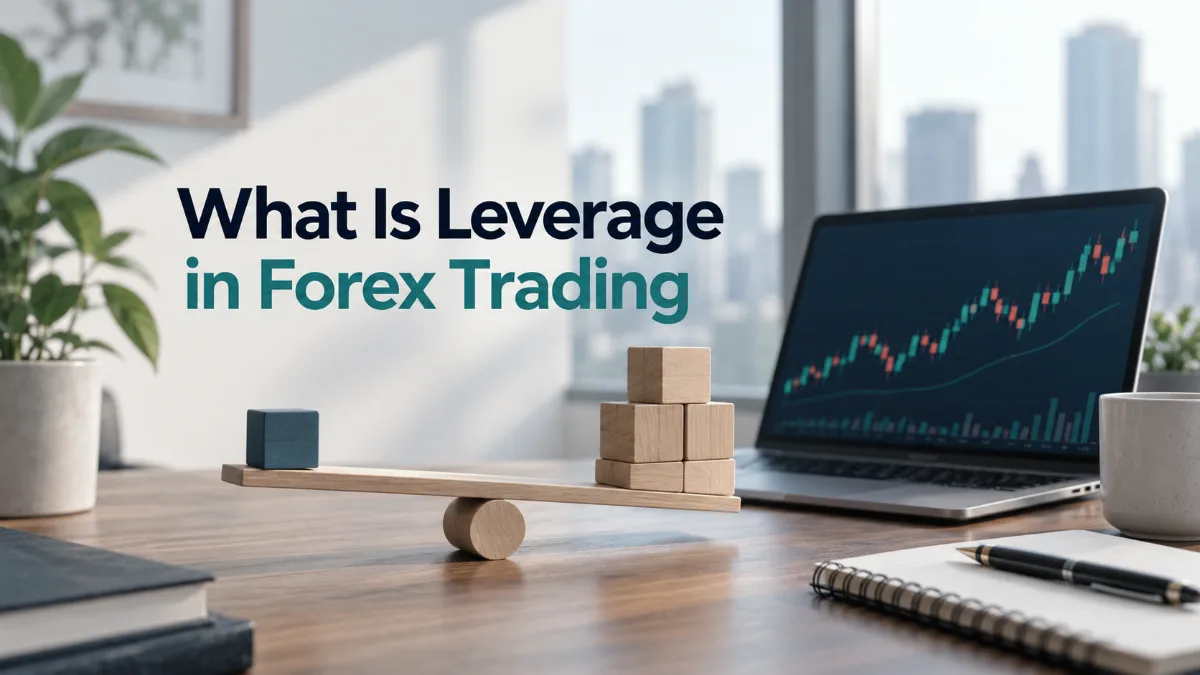
Leverage in forex trading lets a trader control a position that is larger than the cash committed as margin. If a broker allows 20:1 leverage, for example, $1 of required margin can support $20 of market exposure. The attraction is obvious: a relatively small account can take meaningful positions in a market where daily percentage moves are often modest. The risk is equally important. Profit and loss are calculated on the full position size, not only on the margin set aside to open it.
That means leverage does not make a currency pair move more. It makes the same price move matter more to your account because your position can be larger relative to your equity. A 1% move on a $10,000 position is about $100 before costs. If the account behind that position contains $1,000, the same $100 change equals 10% of the account. This relationship is the core answer to the question what does trading with leverage mean.
For beginners, the important distinction is between the maximum leverage a broker offers and the effective leverage a trader actually uses. You do not have to use all available leverage. A disciplined trader can have access to 30:1 or 50:1 leverage while operating at a much lower effective level through smaller position sizes.
Forex trading what is leverage and how does it work?
In forex trading leverage is the ratio between the market exposure of a position and the trader's own capital supporting that exposure. A position worth $20,000 supported by $2,000 of account equity represents 10:1 effective leverage. A position worth $20,000 supported by $1,000 represents 20:1 effective leverage.
Leverage is closely connected to margin. Margin is the amount of capital that must be available to open or maintain a leveraged position. If the required margin is 5% of the position value, the corresponding leverage is 20:1. If the required margin is 2%, the corresponding leverage is 50:1.
Leverage ratio and required margin
| Leverage | Approximate margin requirement | Position supported by $1,000 of margin |
|---|---|---|
| 1:1 | 100% | $1,000 |
| 5:1 | 20% | $5,000 |
| 10:1 | 10% | $10,000 |
| 20:1 | 5% | $20,000 |
| 30:1 | About 3.33% | $30,000 |
| 50:1 | 2% | $50,000 |
The table describes the capital relationship needed to open exposure. It does not tell you how much you should trade. Using the full amount shown in the last column can leave very little room for normal price fluctuations because account equity changes as open positions gain or lose value.
What does trading with leverage mean in practice?
Suppose a trader has $1,000 and opens a $10,000 forex position. The effective leverage is 10:1. If the position gains 1%, the gross gain is about $100. If it loses 1%, the gross loss is about $100. Relative to the $1,000 account, that is roughly a 10% gain or loss before spread, commissions, financing charges and execution effects.
Now suppose the same trader opens only a $2,000 position. A 1% move changes the position by about $20, which is roughly 2% of the account. The currency pair has not become safer or more volatile. The trader simply reduced the size of the exposure relative to account equity.
This is why statements such as "20:1 leverage multiplies every trade by twenty" can be misleading. The broker's leverage limit defines how much exposure may be available for a given amount of margin. The account impact depends on the position actually opened. If a trader with access to 30:1 leverage uses only enough position size to create 4:1 effective leverage, the account is not automatically operating at 30:1.
Leverage vs margin and position size
Leverage, margin and position size describe different parts of the same trade. Leverage describes the relationship between exposure and capital. Margin is the capital the broker requires to support the position. Position size is the actual amount of currency exposure being traded.
Confusing these terms often leads to poor risk decisions. A low margin requirement can make a large position possible, but possibility is not a risk budget. The right position size should usually come from the amount you are prepared to lose if the trade is wrong and the distance between the entry price and the planned exit level.
Maximum leverage is not the same as effective leverage
Maximum leverage is a broker or regulatory limit. Effective leverage is what your open exposure represents relative to your current account equity. If an account has $5,000 of equity and total open positions are worth $25,000, effective leverage is 5:1 even if the account is permitted to use 30:1.
Effective leverage can also rise without opening a new trade. If losses reduce account equity while position value remains broadly similar, the exposure becomes larger relative to the remaining equity. That is one reason leveraged accounts can deteriorate faster during adverse moves.
Position size should come from risk
A practical sequence is to decide the maximum acceptable loss first, identify where the trade thesis would be invalidated, calculate the stop distance and then size the position. Leverage should be checked after that calculation to confirm the required margin is comfortably within the account's available funds. Reversing this sequence by starting with "How much can I borrow?" encourages oversized positions.
Why leverage magnifies forex risk
The Commodity Futures Trading Commission explains that high leverage amplifies both gains and losses because a trader can control a much larger position than the cash posted as margin. This has several practical consequences.
- Small market moves can create large account changes. A move that looks minor on a price chart can be significant when exposure is many times larger than equity.
- Losses reduce future capacity. A 20% loss requires a 25% gain on the remaining capital just to return to the starting balance. Larger drawdowns require progressively larger recoveries.
- Margin pressure can force exits. A broker may require additional funds or close positions when equity falls below required levels.
- Gaps and slippage can exceed the planned loss. A stop order is an execution instruction rather than a guarantee that the exact stop price will be available in a fast market.
- Psychological pressure increases. Oversized exposure can make normal fluctuations feel urgent and can encourage impulsive exits, revenge trades or repeated changes to a trading plan.
How margin calls and closeouts happen
A leveraged forex account has equity that changes with open profit and loss. Brokers also track how much margin is being used and how much remains available. When losses reduce equity far enough, the account can reach a margin warning or automatic closeout threshold. The exact calculation and threshold depend on the broker, product and regulatory regime.
Consider an account with several correlated currency positions. Each trade may look manageable alone, but all positions can lose together if they depend on the same market theme. Total margin usage rises while equity falls. The result can be a closeout even though the trader intended to hold the positions longer. Risk should therefore be assessed at account level rather than trade by trade only.
Depositing only the minimum margin is fragile. Margin is not a maximum loss figure or a stop-loss amount. Traders need free margin to absorb normal price movement and reduce the chance that routine fluctuations trigger a margin problem.
How much leverage can retail traders use?
There is no single global maximum. Leverage rules differ by jurisdiction, product type, client classification and currency pair. In the United States, CFTC retail forex rules require a minimum security deposit of 2% of notional value for major currency pairs and 5% for other pairs. Those minimums correspond to maximum leverage of 50:1 and 20:1 respectively. The CFTC retail forex rule also gives the registered futures association a role in setting specific deposit levels within regulatory parameters.
For UK retail clients trading CFDs and leveraged rolling spot forex, the Financial Conduct Authority requires leverage limits that vary with the underlying asset and can be as high as 30:1 for eligible retail products. The rules also include margin closeout and negative balance protections for covered retail accounts.
These examples show why the number displayed in a broker's account settings should not be treated as a universal standard. Before trading, check the rules that apply to your country, the broker's legal entity and the exact instrument. A high advertised ratio can also be a warning sign when it exceeds the lawful limit for the jurisdiction in which the firm claims to operate.
Best leverage for beginners: a safer decision rule
There is no evidence-based universal ratio that can be called the best leverage for beginners. A useful beginner rule is to use the lowest effective leverage that still allows the planned position size while keeping substantial free margin. The decision should begin with loss tolerance rather than the broker's maximum ratio.
- Set a risk limit per trade. Decide the maximum amount of account equity you are willing to lose if the trade fails.
- Choose the invalidation level. Place the stop where the trade idea no longer makes sense rather than where the margin requirement happens to be convenient.
- Calculate the position size. Divide the allowed monetary loss by the stop distance expressed in monetary value per unit of position.
- Calculate effective leverage. Compare the resulting notional exposure with account equity.
- Check free margin and total portfolio exposure. Leave room for normal fluctuations and consider whether other open trades respond to the same currencies or macroeconomic drivers.
This method naturally produces lower leverage when stops are wide, volatility is high or the account risk limit is small. It also prevents a common beginner error: treating available leverage as a target that should be fully used.
Worked example with a 1 percent risk limit
Assume a $5,000 account and a maximum planned loss of 1% per trade. The risk budget is $50. A trader plans a EUR/USD trade with a 25 pip stop. For EUR/USD, a standard lot of 100,000 euros has a pip value of $10 when the account is denominated in US dollars. To risk about $50 over 25 pips, the position needs a pip value of about $2, which is approximately 0.20 standard lot or 20,000 euros.
If EUR/USD is around 1.10, that position has a notional value of roughly $22,000. Relative to $5,000 of account equity, effective leverage is about 4.4:1. The broker might permit much higher leverage, but the risk calculation does not require the trader to use it. With a 30:1 maximum, initial margin on $22,000 of exposure would be roughly $733. With a 50:1 maximum, it would be about $440. The planned loss remains about $50 if the stop executes near the intended price because position size and stop distance determine that risk.
The example is not a promise that losses will stop at exactly 1%. Fast markets, price gaps, slippage and execution conditions can produce a worse fill. The point is that leverage should serve a preplanned position size rather than determine it.
Common leverage mistakes
- Using maximum leverage because it is available. Broker limits define capacity rather than an appropriate exposure level.
- Thinking margin equals risk. The margin needed to open a trade is not the most that can be lost on the position.
- Ignoring total exposure. Several trades can create a much larger combined bet on one currency or economic theme.
- Increasing size after losses. Trying to recover quickly with more leverage can accelerate a drawdown.
- Ignoring stop distance. The same lot size can represent very different monetary risk with a 20 pip stop and a 100 pip stop.
- Choosing a broker only for high leverage. Regulation, execution quality, withdrawal reliability, costs and client protections are more important than the largest ratio on an advertisement.
Leverage and trading costs
Leverage also magnifies the importance of trading costs because costs are generally linked to position size. A wider position means more spread cost in monetary terms. Commission based accounts charge more as volume increases. Positions held overnight may incur financing or swap charges depending on the instrument, direction and rate structure.
Suppose two traders each have a $5,000 account. One trades $10,000 of exposure and the other trades $50,000. Even if both see the same spread in pips, the second trader pays roughly five times the monetary spread cost because the position is five times larger. Frequent trading can make this difference meaningful over time.
When lower leverage is especially important
Lower effective leverage deserves particular consideration when volatility is elevated, major economic announcements are near, positions will remain open through illiquid periods or several trades are strongly correlated. It is also sensible while learning how quickly unrealized profit and loss can change.
Holding positions over weekends or major event risk can create price gaps. Thin liquidity can widen spreads and make stop execution less predictable. Smaller positions reduce the account equity exposed to an unexpected move.
Key questions to ask before using leverage
- How much money can I lose on this trade if the stop is reached?
- What percentage of account equity does that loss represent?
- What is the notional value of the position?
- What is my effective leverage after including all open positions?
- How much free margin remains after the trade is opened?
- Are several positions exposed to the same currency or market event?
- Could a gap or poor fill make the loss larger than planned?
- What leverage and margin rules apply to this broker and legal entity?
If those questions cannot be answered before entry, the position is difficult to control regardless of the leverage ratio shown on the trading platform.
A practical way to think about forex leverage
Forex leverage is best understood as a capacity tool. It lets a trader control more currency exposure with less required margin, but it does not create an edge and it does not improve a trading strategy. The meaningful risk comes from the size of the position relative to account equity and from how far the market can move before the position is closed.
For a beginner, lower effective leverage is generally easier to manage because it leaves more room for normal market movement, reduces margin pressure and limits the account impact of mistakes. The useful question is not "What is the highest leverage I can get?" It is "What position size keeps this trade and my total account exposure inside a loss limit I can accept?" When leverage is treated as a constraint after risk sizing rather than as the starting point for trade size, it becomes easier to use without allowing it to dominate the account.