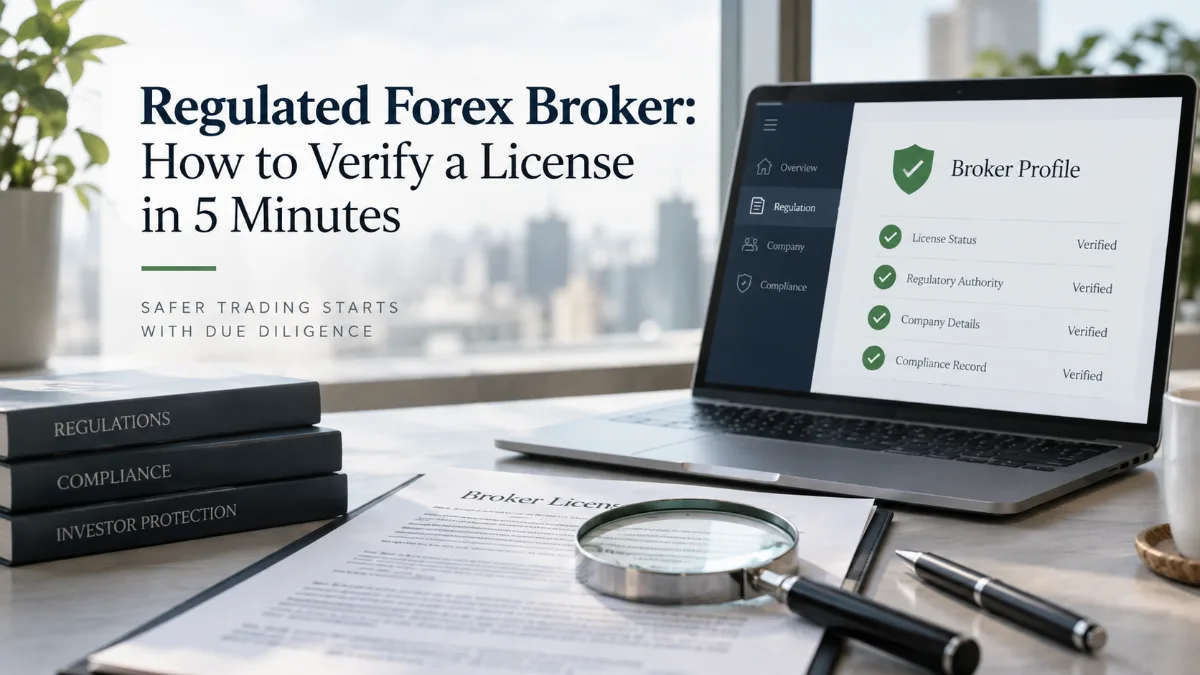
A forex broker license is not one universal certificate that works the same way in every country. What matters is whether the exact legal entity that holds a trader's account has permission to provide the specific forex or CFD service in the client's jurisdiction.
This distinction is important because a broker brand can operate through several companies at once. One group might have a highly regulated entity for UK clients, another entity for European clients and a separate offshore company for customers elsewhere. The protections attached to the account normally come from the contracting entity and its regulator, not from the brand name shown on the trading platform.
Forex broker license types at a glance
| Jurisdiction | Typical regulatory status | Primary regulator | What to check |
|---|---|---|---|
| United Kingdom | FCA authorization with relevant investment permissions | Financial Conduct Authority | Legal entity, status, permissions, client money permissions and approved contact details |
| Cyprus and the EU | Investment firm authorization such as a Cyprus Investment Firm authorization | National competent authority such as CySEC | Investment services, financial instruments, cross-border rights and retail client scope |
| United States | RFED registration or qualifying FCM registration plus NFA membership | CFTC and NFA | Registration category, NFA status, forex dealer designation and disciplinary history |
| Australia | Australian Financial Services Licence with relevant derivatives permissions | ASIC | Licensee name, derivatives authorization, retail client permission and product scope |
| Singapore | Capital Markets Services licence with relevant dealing permissions | Monetary Authority of Singapore | Permission for OTC derivatives and leveraged foreign exchange trading |
| Japan | Financial Instruments Business Operator registration | Financial Services Agency | Registration category and authority to conduct the relevant derivatives business |
| South Africa | Financial services authorization and where applicable OTC Derivative Provider authorization | FSCA | Whether the firm advises or intermediates and whether it acts as an OTC derivatives counterparty |
| United Arab Emirates | Financial services permission under the applicable mainland or financial free zone regime | SCA, DFSA or FSRA depending on jurisdiction | Regulatory zone, permitted activities, client type and product permissions |
| Mauritius | Investment Dealer licence in the appropriate category | Financial Services Commission | Dealer category, derivatives scope and company identity |
| Seychelles | Securities Dealer licence | Financial Services Authority | Licence status, dealer identity and whether the firm may lawfully serve the client's country |
| Saint Vincent and the Grenadines | No domestic forex brokerage licence | Financial Services Authority for company and other regulated matters | Whether the broker holds a separate licence in a jurisdiction that actually regulates its forex activity |
Why the country name alone is not enough
Two firms described as licensed in the same country can have materially different permissions. A regulator may authorize one firm to deal as principal, another to arrange transactions and another only to provide investment advice. A company can also be regulated for one financial activity while lacking permission for leveraged forex or CFDs.
For retail traders the practical test has five parts: identify the legal entity, identify the regulator, confirm the firm's current status, confirm the permission that covers the product and confirm that the entity is allowed to serve clients in the trader's location. Missing any one of these checks can produce a false sense of security.
This is why phrases such as "regulated broker" or "licensed company" are incomplete on their own. Company incorporation proves that a legal person exists. A financial licence proves that a regulator has granted defined permissions under a financial services regime.
Forex broker license UK: what FCA authorization means
In the United Kingdom there is no single document formally named a "forex broker licence" that automatically covers every brokerage activity. A firm serving UK retail clients needs authorization from the Financial Conduct Authority with permissions that match the services it actually provides. Rolling spot forex offered to retail clients falls within the UK's rules for CFDs and similar speculative investments.
A UK trader should therefore do more than find an FCA reference number on a broker's footer. The firm's legal name must match the entity in the client agreement. Its regulatory status must be current. Its permissions must cover the relevant investment activity and product. The website, phone number and other contact details should also be consistent with the regulator's record because clone firms often copy the identity of genuine regulated companies.
UK retail CFD rules also shape what an authorized broker may offer. Leverage is restricted by asset class, with the highest retail limit applying to major currency pairs. Retail accounts receive negative balance protection and a standardized margin close-out framework. These protections apply because of the client's regulatory classification and the entity providing the product, not simply because the wider corporate group has an FCA-authorized subsidiary.
United States: RFED and FCM registration
The United States uses a registration structure rather than the simple label "forex licence." A firm acting as counterparty to leveraged off-exchange retail forex will generally fall into the Retail Foreign Exchange Dealer framework unless an exemption or another permitted regulatory category applies. A Futures Commission Merchant can also conduct retail forex within the rules that apply to its business.
The National Futures Association states that registered RFEDs must be NFA members and that their firms must also be designated as Forex Dealer Members. This makes the US model unusually specific: the trader should verify both the CFTC registration category and the firm's NFA membership or designation rather than relying on a generic claim that the broker is "US regulated."
The framework also imposes substantial financial and compliance obligations on retail forex dealers. It does mean that US retail forex activity is tied to a defined registration regime with ongoing supervision, financial reporting and conduct requirements.
Cyprus and the EU: investment firm authorization
Within the European Union a retail forex and CFD broker is normally regulated as an investment firm rather than through a standalone licence called a forex licence. Cyprus is a common example. A firm authorized by the Cyprus Securities and Exchange Commission is typically a Cyprus Investment Firm and receives permissions for specified investment services and financial instruments.
MiFID-based authorization can support cross-border investment services within the European framework when the relevant legal conditions and notifications are satisfied. That does not mean a Cyprus licence is a borderless global licence. The firm still has to respect the rules that apply to where and how it serves clients, and its exact permissions remain more important than the marketing phrase "EU regulated."
For retail CFDs the European regulatory model also includes product restrictions such as leverage limits, margin close-out requirements and negative balance protection. National regulators implement and supervise the applicable rules. A trader checking a CySEC-regulated broker should verify the legal entity, authorization status, approved services and the domain associated with the firm.
Australia Singapore and Japan: three different models
Australia uses the Australian Financial Services Licence framework. A forex or CFD provider needs an AFSL with the permissions appropriate to its business model, commonly including derivatives-related financial services. ASIC also applies retail CFD product intervention rules. For major currency pair CFDs the retail leverage ceiling is 30:1, with lower limits for several other asset classes.
Singapore uses a Capital Markets Services licence for companies conducting regulated capital markets activities unless an exemption applies. The Monetary Authority of Singapore treats capital markets products as including OTC derivatives and spot foreign exchange contracts used for leveraged foreign exchange trading. A CMS licence therefore needs to be read together with the regulated activities listed for that specific institution.
Japan treats retail FX as a financial instruments business. OTC derivatives are within the Financial Instruments and Exchange Act framework, and firms conducting the relevant business must be registered as Financial Instruments Business Operators. Type I Financial Instruments Business covers OTC derivatives transactions. An overseas licence by itself does not normally give a foreign broker authority to conduct regulated forex business with residents of Japan.
South Africa and the UAE: business model matters
South Africa illustrates why a generic FSP number can be insufficient for understanding a forex broker. The Financial Sector Conduct Authority oversees financial service providers, but acting as an over-the-counter derivatives provider is a distinct regulated function. A broker that is principal to OTC derivatives may therefore need ODP authorization in addition to any permissions relevant to advisory or intermediary services.
The United Arab Emirates is different because the regulatory answer depends on where the firm is established and which market it serves. The mainland framework and the financial free zones have separate regulators. Dubai International Financial Centre firms fall under the DFSA, while Abu Dhabi Global Market firms fall under the FSRA. Outside those zones the Securities and Commodities Authority is a central regulator for relevant securities and investment activities.
For a UAE broker the useful question is not "Does it have a UAE licence?" The useful question is "Which regulator authorized this exact entity and for which activities, products and client categories?" That wording avoids mixing permissions issued under separate legal regimes.
Mauritius and Seychelles: offshore does not mean identical
Mauritius and Seychelles are often grouped together as offshore forex jurisdictions, but their licence structures are not the same. Mauritius uses Investment Dealer categories under the Financial Services Commission framework. The appropriate authorization depends on whether the firm executes client orders, deals in derivatives, makes a market or performs another regulated dealer function.
Seychelles uses a Securities Dealer licence under its securities framework. The local Financial Services Authority has also made clear that a Seychelles licence does not automatically authorize a dealer to operate in every other country. Cross-border business can require approval, an exemption or another lawful basis in the jurisdiction where the service is offered.
Calling either jurisdiction simply "offshore" therefore tells a trader very little. The more useful comparison is the actual licence, the permissions, the public register, capital and governance requirements, client money rules, complaint routes, enforcement history and whether the broker is lawfully serving the trader's country.
Forex broker license SVG: what registration does not mean
Saint Vincent and the Grenadines is a special case because the country's Financial Services Authority has explicitly stated that forex trading brokerage activities are not licensed in the jurisdiction. A Business Company or Limited Liability Company can be incorporated in SVG and engage in lawful business, but incorporation is not a forex broker license.
The Financial Services Authority of Saint Vincent and the Grenadines has warned that a company carrying on forex trading or brokerage from the jurisdiction may be doing so without a domestic forex licence and should obtain the appropriate permission where its activity actually takes place. Later requirements for companies engaged in forex activity also reinforced the expectation that they demonstrate licensing or lawful status in the jurisdictions where they conduct business.
This makes the phrase "forex broker license SVG" potentially misleading. There is no SVG forex brokerage licence equivalent to an FCA authorization, US RFED registration or Seychelles Securities Dealer licence. If a broker is incorporated in SVG, the next question should be whether the same legal entity or another entity in its group has a genuine financial services authorization that covers the account being offered to you.
How to compare regulatory strength without tier labels
Websites often sort regulators into "tier 1", "tier 2" and "tier 3" categories. Those labels can be useful as editorial shorthand, but they are not official legal classifications and there is no universal formula behind them. A better comparison examines the protections and supervisory mechanisms that actually apply.
- Authorization scope: Does the permission cover dealing in forex or CFDs, holding client money, arranging trades or only advice?
- Capital requirements: Is the broker required to maintain regulatory capital that reflects its activity and risk?
- Client asset rules: Are client funds subject to segregation or other custody requirements?
- Retail product rules: Are leverage, margin close-out, inducements or negative balances restricted?
- Public verification: Can a trader confirm the legal entity, status and permissions in an official register?
- Complaint and redress framework: Is there an ombudsman, compensation arrangement or formal dispute process for eligible clients?
- Cross-border legality: Is the broker permitted to solicit and serve residents of the trader's country?
A licence can reduce counterparty and conduct risk without eliminating market risk. It does not insure a trader against normal losses, poor strategy, slippage or adverse price moves. Compensation schemes, where available, also have eligibility rules and normally address firm failure or protected claims rather than losses caused by trading decisions.
How to verify a broker licence correctly
- Find the contracting entity. Read the client agreement, account-opening disclosure or legal footer. Do not verify only the brand name.
- Identify the claimed regulator. Note the regulator, licence or registration number and jurisdiction.
- Search the official register. Use the regulator's own database rather than a broker review site or screenshot supplied by the broker.
- Match identity details. Compare the legal name, company number, website, address and contact information where the register provides them.
- Read the permissions. Confirm that the entity can provide the forex, CFD or derivatives service you intend to use and can deal with your client type.
- Confirm territorial coverage. A valid licence in one country does not automatically authorize active solicitation in another country.
The awkward search phrase "broker license forex" often leads to lists that rank jurisdictions by cost or speed of incorporation. That is useful for a company founder but incomplete for a trader. From a client-protection perspective the decisive question is not how quickly a company can obtain a licence. It is what supervision and legal protections follow from that licence for the specific account.
What a forex broker license can and cannot tell you
A valid forex broker license is a strong starting point for due diligence because it establishes an accountable legal entity and a regulatory perimeter. It can show that the firm has passed an authorization process and remains subject to rules on areas such as capital, governance, reporting, conduct or client assets.
It cannot prove that execution will always be excellent, spreads will always be competitive or the broker will never experience operational or financial problems. It also cannot make leveraged forex suitable for every trader. Licensing answers the question "Is this entity authorized for this regulated activity?" Broker selection still requires separate checks on costs, execution model, platform reliability, withdrawal procedures and the terms governing the account.
The most reliable country comparison therefore starts with legal structure rather than marketing labels. UK FCA authorization, US RFED or FCM registration, EU investment firm authorization, an Australian AFSL and offshore securities dealer licences are not interchangeable badges. Each creates a different regulatory relationship between the broker, regulator and client. SVG company registration is different again because it is not a domestic forex brokerage licence at all.