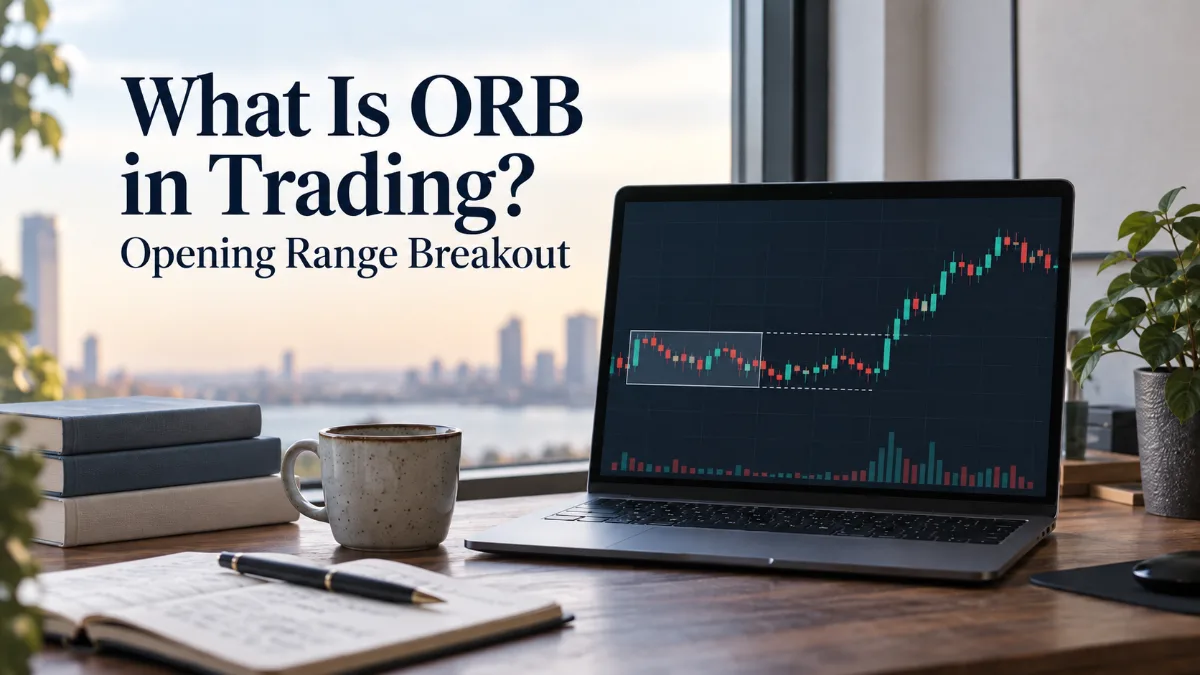
ORB in trading means Opening Range Breakout, a short-term trading method that defines a price range during the first part of a chosen trading session and then looks for a move above the range high or below the range low. The range is normally fixed before any breakout trade is taken. A bullish ORB setup forms when price breaks the opening-range high under the trader's predefined conditions. A bearish setup forms when price breaks the opening-range low.
There is no single official ORB strategy. Traders may define the opening range as the first 5, 15, 30 or 60 minutes, use different confirmation rules and manage exits in different ways. What makes a strategy an ORB is the same core sequence: define the session, let the opening range form, identify its high and low, wait for a qualifying breakout and manage the trade with predetermined risk rules.
How does an opening range breakout work?
An opening range breakout converts the early session into a reference zone. The trader does not need to predict where the market will open. Instead, the trader observes where buyers and sellers establish an initial range and then reacts only if price leaves that range according to a defined trigger.
- Choose the session. For U.S. stocks this may be the regular trading session. For futures, forex or crypto, the trader must specify which session open or clock time defines the setup.
- Choose the range duration. For example, a 15-minute ORB uses the highest and lowest traded prices during the first 15 minutes of the selected session.
- Freeze the range. Once the selected interval ends, the high and low become fixed reference levels for that setup.
- Define the breakout condition. A trader might require price to trade through the level, close beyond it or break and then retest it.
- Set invalidation and exit rules. The entry alone does not define the strategy. Stop placement, position size, profit-taking and time-based exits determine how much risk the trade carries.
The opening price itself is not simply an arbitrary first print. On Nasdaq, the Opening Cross combines opening interest and the continuous book to establish an official opening price, while Nasdaq disseminates opening imbalance information before the cross. This price-discovery process helps explain why ORB traders treat the start of the session as a distinct market phase.
Why do traders focus on the opening range?
The start of a session can absorb information accumulated while the main market was closed, including earnings releases, macroeconomic news and moves in related markets. The early range can therefore become a practical reference for whether initial demand or supply is gaining control.
That does not mean the open is automatically easier to trade. In a study of U.S. equities and exchange-traded products, the U.S. Securities and Exchange Commission found that the opening 15 minutes in its control period were typically characterized by higher volatility, wider quoted spreads and less quoted depth than later periods. For an ORB trader, this is a two-sided feature: larger price movement may create opportunity, but poorer liquidity and wider spreads can also increase slippage and make false breakouts more costly.
Core parts of an ORB strategy
Opening range length
The range length controls how much early price discovery is absorbed before a breakout can occur. A short range such as five minutes creates levels quickly but is more exposed to opening noise. A longer range such as 30 or 60 minutes includes more trading activity but may produce a later breakout after part of the day's move has occurred. No interval is inherently correct. It should be tested on the intended market, session and execution method.
Breakout trigger
A price touching the range boundary does not have to count as an entry. An ORB strategy can require an intrabar trade beyond the level, a candle close outside the range, a minimum distance beyond the level or a break followed by a retest. Each choice changes signal frequency and execution quality.
A close-based trigger may reject brief excursions beyond the range. An immediate stop entry is faster but can be filled during a short-lived spike. A retest may offer a more defined entry area, yet strong breakouts may never return. These are trade-offs rather than universal improvements.
Stop placement and invalidation
The stop should represent the point where the trade thesis is no longer acceptable under the strategy's rules. Common structures include a stop back inside the opening range, beyond the opposite side of the range or at a volatility-based distance from the entry. The wider the stop, the smaller the position generally needs to be if the trader wants to keep account risk constant.
A wide stop can create large monetary risk per share or contract, while an extremely tight stop can be hit by normal opening volatility. Position size should therefore be calculated from the stop distance rather than chosen independently.
Profit target and exit logic
An ORB needs a rule for profitable trades as well as losing trades. Possible approaches include a fixed reward-to-risk target, a multiple of the opening-range width, a trailing stop, a market-structure exit or a time-based exit before the session ends. Some systems scale out of part of the position and manage the rest with a trailing rule.
Exit logic materially changes the strategy's return distribution. A high win rate with small targets is not automatically superior to a lower win rate with larger average winners. The relevant measures include expectancy after costs, drawdown, average win relative to average loss and the consistency of results across different market conditions.
ORB trading rules: a testable framework
The phrase ORB trading rules should refer to explicit conditions that can be executed and tested, not vague instructions such as "buy strength." A complete rule set can be organized as follows:
- Instrument rule: trade only instruments that meet predefined liquidity and tradability criteria.
- Session rule: identify the exact session and timezone used to calculate the opening range.
- Range rule: record the high and low during one fixed opening interval.
- Direction rule: permit long trades above the range high and short trades below the range low unless the system deliberately trades only one side.
- Trigger rule: define precisely what counts as a breakout and when an order is submitted.
- Risk rule: specify the stop before entry and size the position from the allowed loss.
- Exit rule: define profit-taking, trailing and time-based exits before the trade is opened.
- Daily limit rule: decide whether the strategy allows one attempt, one attempt per direction or multiple re-entries after failed breakouts.
These rules are a framework, not a recommendation to use particular parameter values. Two traders can both trade an opening range breakout while running materially different systems because their range duration, trigger and exit logic differ.
A simple ORB trade example
Assume a stock opens its regular session and trades between $49.40 and $50.20 during the first 15 minutes. The opening-range high is therefore $50.20 and the low is $49.40. After the 15-minute period ends, the range is frozen.
A trader's plan says a long entry is valid only after a five-minute candle closes above the range high. Price later closes at $50.35, so the setup qualifies. The trader chooses an entry near $50.35 and an invalidation level at $49.95. The planned risk is $0.40 per share before transaction costs and slippage. If the trader's maximum planned loss for the trade were $100, dividing $100 by $0.40 gives a theoretical size of 250 shares before adjusting for fees, slippage and any broker constraints.
This example illustrates the mechanics, not a claim that the trade will be profitable. If price immediately falls back below the breakout level, the trader may be stopped. If price continues higher, the result then depends on the exit rule. Without predefined exits, the same entry signal can produce very different outcomes.
What causes false ORB breakouts?
A false breakout occurs when price moves beyond the opening-range boundary but fails to continue and returns into the range. The initial move may exhaust available buying or selling interest or the market may rapidly reassess new information.
Traders sometimes try to reduce false signals by requiring a close outside the range, waiting for a retest, using volume conditions, following a larger trend or avoiding unusually wide ranges. None should be assumed to improve every market. A filter can remove losing trades while also removing winners or delaying entries.
The clean way to evaluate a filter is to compare the same strategy with and without it over a sufficiently large sample, including transaction costs. Otherwise, a filter that looks sensible on selected charts may simply reflect hindsight.
How ORB changes across markets
| Market | What can define the open | Main ORB consideration |
|---|---|---|
| U.S. stocks | Regular session open | Opening auctions, overnight gaps, spreads and stock-specific news can strongly affect the first minutes. |
| Equity index futures | Cash-market open or another fixed session time | Futures trade for much of the day, so the trader must define which opening event matters to the strategy. |
| Forex | London, New York or another chosen session | There is no single centralized exchange opening price for the global spot market, so the range depends on the chosen session and data feed. |
| Crypto | A fixed clock time or regional session | Trading is continuous, so an "opening range" is a trader-defined convention rather than a natural daily market open. |
A 15-minute ORB on a U.S. stock and a 15-minute ORB on Bitcoin may share the same label but do not measure the same market event. Session definition is part of the strategy.
ORB strategy filters worth testing
Once a basic ORB is defined, filters are easier to evaluate one at a time. Adding many at once can hide what changed the result and increase overfitting risk.
- Opening gap: separate days with a meaningful gap from days that open near the prior close.
- Relative volume: compare early volume with a historical baseline for the same instrument and time of day.
- Higher-timeframe trend: test whether taking breakouts only in the direction of a larger trend changes expectancy.
- Opening-range width: exclude ranges that are extremely narrow or wide relative to recent volatility.
- Market regime: test whether the same rules behave differently across broad volatility conditions.
- News filter: distinguish scheduled event days or company-specific announcement days if those events materially change opening behavior.
A useful filter must improve the strategy out of sample after realistic costs, not merely make historical charts look cleaner.
How should an ORB strategy be backtested?
A credible backtest must reproduce the information that would actually have been available at the time of each trade. The opening range cannot use future bars, and an entry should not be assumed at a price that was unavailable after the signal became known. If the rule requires a candle close, the backtest cannot enter earlier inside that same candle based on knowledge of its final close.
Execution assumptions matter especially near the open. Model bid-ask spreads, commissions and slippage rather than treating every breakout price as a guaranteed fill. Define what happens when price gaps through a stop or target or when both sides of the range are breached in one session.
Evaluate more than net profit. Useful diagnostics include trade count, win rate, average win and loss, expectancy, maximum drawdown and performance by market regime. After choosing parameters on one sample, test them on unused data. Results that remain reasonably stable across nearby settings are more informative than a single optimized parameter.
Risk and execution matter more than the entry pattern
ORB is usually a day-trading technique, and the risks of day trading remain present even when the entry rule is systematic. The U.S. Securities and Exchange Commission warns that day trading can produce severe financial losses and that leverage can magnify those losses. Fast markets can also produce fills away from the intended price, so a planned stop level does not guarantee the exact loss amount.
Practical risk control starts before the breakout occurs. Decide the maximum account risk per trade, convert that risk into position size using the stop distance and account for the fact that actual execution may be worse than the model. Traders should also understand their broker's order types, margin policies and any market-specific restrictions before placing live trades.
ORB compared with a first-candle breakout
| Feature | Opening Range Breakout | First-candle breakout |
|---|---|---|
| Reference area | High and low of a predefined opening interval | High and low of the first candle on the chosen chart |
| Range duration | Explicitly selected by the strategy | Automatically equals the chart timeframe |
| Flexibility | Can combine several bars into one opening range | Tied directly to one candle |
| Core idea | Trade a break from early-session balance | Trade a break of the first bar's extremes |
A first-candle breakout can be a type of ORB when the first candle represents the entire defined opening range. The terms are not always interchangeable. For example, a trader using a 30-minute opening range on a five-minute chart combines six candles, so the first five-minute candle alone does not define the setup.
Who is ORB trading suited to?
ORB can suit traders who prefer explicit intraday levels, can monitor the session open and are willing to test a rule-based system. The range, breakout level and invalidation can all be defined before entry. It is less suitable for someone who cannot watch or automate the opening period, is uncomfortable with rapid price movement or treats a breakout as guaranteed continuation. False breakouts and clusters of losses can occur.
What is the best opening range for ORB?
There is no universally best opening range. Five minutes, 15 minutes and 30 minutes describe different strategies with different signal frequency, stop distance and sensitivity to opening noise. The appropriate range is the one that survives realistic testing on the intended instrument and session while fitting the trader's execution constraints and risk tolerance.
Instead of optimizing for the single historical setting with the highest profit, compare nearby range lengths. If results disappear at similar intervals, the apparent edge may be fragile.
Does the opening range breakout strategy work?
An opening range breakout can be defined and tested objectively, but the pattern itself does not guarantee positive expectancy. Results depend on the market, sample period, range definition, entry trigger, exit logic, costs and risk management. A chart showing several successful breakouts is not evidence that a particular ORB strategy has a durable edge.
The practical question is whether a fully specified ORB has produced robust results after realistic costs and whether those results persist on data not used to design it. Until that evidence exists for the exact rule set being traded, ORB is best treated as a hypothesis to test rather than a proven source of profit.