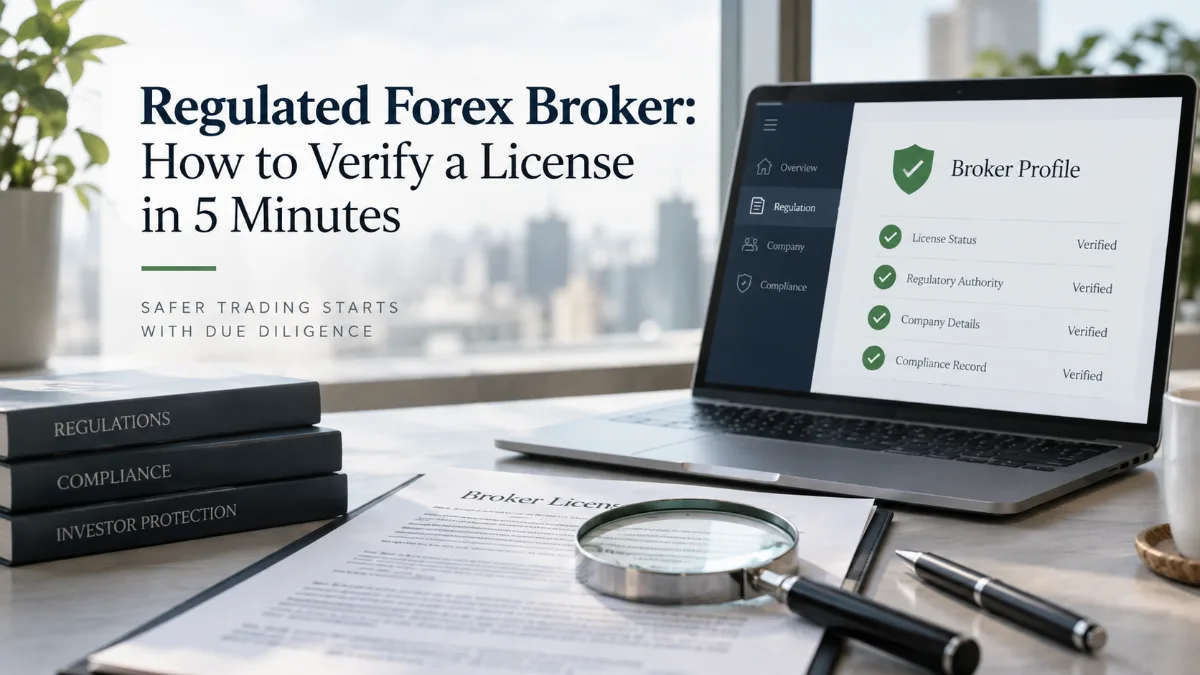
A regulated forex broker should be traceable from its website to an active record in the official register of the regulator it claims to operate under. A broker logo, licence number in a footer or statement such as "fully regulated" is not enough. The legal entity name, regulatory status, licence or registration number, permitted activities and contact details should agree with the regulator's own records.
The most important distinction is between verifying a brand and verifying the legal entity that will hold your account. One trading brand may operate several companies in different jurisdictions. A well-known group can have one strongly regulated entity and another offshore entity operating under different rules. Your broker license check therefore needs to identify the company named in your client agreement rather than stopping when you find any licensed company connected with the brand.
How to check if a broker is regulated in five steps
You can perform a useful first-pass verification in about five minutes. The objective is not to conduct a complete legal investigation. It is to establish whether the broker's core regulatory claims survive independent checking before you deposit money or provide extensive personal information.
| Time | Check | What you need to confirm |
|---|---|---|
| Minute 1 | Identify the legal entity | Company name, claimed regulator, licence number and jurisdiction |
| Minute 2 | Open the official register | The regulator actually lists the claimed company |
| Minute 3 | Check status and permissions | The authorization is current and relevant to the service offered |
| Minute 4 | Match identifying details | Website, address, telephone details and company identity are consistent |
| Minute 5 | Check warnings and your account entity | No obvious clone warning and the licensed entity is the entity serving you |
Step 1: Find the broker's exact legal entity
Start at the broker's website footer, legal documents, terms of business or regulatory disclosure. Look for the full corporate name rather than the marketing brand. Record the regulator name, licence or registration number and the country in which the company claims to be supervised.
For example, a website might use one brand across several countries while its legal disclosures name Company A for UK clients, Company B for Australian clients and Company C for customers in other regions. These are not interchangeable. The relevant company is normally the entity that will enter into the agreement with you and receive or control your trading account.
If the broker does not clearly disclose a legal company name and regulator, that is already a material warning sign. A vague statement such as "regulated internationally" cannot be independently verified. The same applies when the site names a regulator but gives no licence number or legal entity that can be searched.
Step 2: Search the regulator independently
Do not rely solely on a link supplied by the broker. Search for the regulator's official website independently and open its public register. This reduces the risk of being directed to a copied page or a website designed to resemble a regulator.
In the UK, the Financial Conduct Authority maintains the Financial Services Register as the official public record of firms and individuals that are or have been authorized or otherwise recorded by the regulator. The register also helps distinguish current authorization from historical records and can identify firms associated with regulatory warnings.
Search using the licence number first when one is available. A number is usually more precise than a trading name. Then repeat the search using the complete legal entity name. Both searches should lead to the same expected company.
Step 3: Verify status and permissions
Finding the company name is not enough. Open the actual regulatory record and inspect its current status. Terms differ between jurisdictions, but descriptions such as authorized, active or currently registered generally need to be distinguished from statuses such as revoked, cancelled, withdrawn or no longer authorized.
Then determine whether the company's permissions fit what the broker is offering. A financial company can possess a legitimate regulatory registration without having permission for every financial activity. A registration connected with payments, insurance, advice or another service does not automatically authorize a company to operate the forex or derivatives service being advertised to you.
This is also why a company registration certificate is not a forex licence. Corporate registries establish the existence of companies. Financial regulators determine whether particular regulated financial activities may be carried on. A broker can therefore be a legally incorporated business while lacking the financial authorization relevant to your trading account.
Step 4: Match the website and contact details
One of the most important parts of verifying a regulated forex broker is checking whether the company in the official record is actually the company behind the website you are using.
Compare the regulator's information with the broker's details. Look for the legal name, registered or business address, telephone number, email domain and website where those fields are provided. Minor administrative differences can occur, but unexplained differences deserve investigation.
This check helps detect clone firms. A clone may copy the name and genuine licence number of a regulated company while operating through an unrelated website, phone number or email address. The licence itself can be completely real while the person displaying it has no connection to the licensed company.
A particularly strong warning sign is a salesperson who tells you to ignore conflicting contact details in the official register. If you need to contact the licensed firm to resolve the discrepancy, use contact information obtained from the regulator's record rather than a telephone number or email address supplied by the salesperson.
Step 5: Confirm which entity will hold your account
The final step is easy to miss. Return to the broker's account-opening documents and determine which legal entity will contract with you. The licensed company you found must correspond to the entity actually providing your account.
Suppose a broker advertises an authorization from a major regulator on its main website but its client agreement states that your account is being opened with another group company in a different jurisdiction. The first licence may be genuine, but it does not automatically regulate the second company or extend the first jurisdiction's protections to your account.
Check the entity named in the terms of business, account agreement, privacy documentation and deposit instructions. If these documents point to different companies without a clear explanation, do not assume the strongest licence displayed on the website applies to you.
Broker license check: What must match
A successful broker license check is based on several matching identifiers rather than one convincing-looking number. Treat the licence number as the beginning of verification rather than the conclusion.
| Item | What to compare | Why it matters |
|---|---|---|
| Legal entity | Broker disclosure against regulator record | A brand can represent several separate companies |
| Licence number | Broker claim against official register | Fake firms can invent numbers or copy genuine ones |
| Status | Current regulatory status | A historical licence may no longer permit regulated business |
| Permissions | Authorized activities against offered products | A real licence can cover unrelated financial services |
| Website | Domain against official details when listed | Domain mismatches can reveal impersonation |
| Account entity | Client agreement against licensed company | Group-level regulation does not automatically cover every entity |
The strongest result is not merely "I found the licence." It is: I found the same legal entity in the official register with a current status and relevant permissions and I confirmed that this is the company with which my account will be opened.
How verification differs by regulator
The mechanics of a broker license check vary because financial regulation is jurisdiction-specific. There is no single worldwide forex licence and no universal database containing every regulated broker.
United Kingdom
For a UK-facing firm, search the FCA record for the exact entity and examine its status and permissions. The FCA distinguishes authorization from forms of registration that do not by themselves permit every regulated financial service. Its guidance also emphasizes matching a firm's contact details because criminals can copy the identity and reference number of genuine authorized businesses.
If the broker claims FCA regulation but the legal company serving you cannot be connected to an appropriate current record, do not treat a group company or similarly named business as a substitute.
United States
For U.S. derivatives and retail forex checks, the National Futures Association provides BASIC. The database allows investors to research firms by name or NFA ID and includes CFTC registration information, NFA membership information and regulatory actions within its coverage.
Pay attention to the registration category and current membership status rather than simply finding the firm's name. A historical record or a registration for a different capacity is not the same as confirming that a firm currently has the regulatory status needed for the activity it is offering.
Australia
In Australia, the Australian Securities and Investments Commission provides a professional registers search that can be queried by company name, licence number and other identifiers. The register can be used to check Australian financial services licensees and the services for which they are licensed.
ASIC also makes an important distinction for due diligence: holding a financial services licence does not guarantee the quality or integrity of every service provided by the licensee. Regulation establishes a regulatory framework and obligations. It should not be interpreted as an endorsement of a broker's trading conditions, execution quality or suitability for a particular trader.
Red flags that fail a broker license check
Some problems are serious enough that you should stop the account-opening process until they are resolved. The most important red flags are inconsistencies that prevent you from connecting the broker you are dealing with to the regulated entity it claims to represent.
- The licence number belongs to another company. A genuine number copied from an unrelated regulated firm does not validate the broker.
- The legal name is missing. A brand name alone may be impossible to connect reliably with a regulator record.
- The licence is inactive. Revoked, cancelled, withdrawn or historical authorization should not be presented as current regulation.
- The permissions do not fit the service. Finding some form of financial registration is not enough if it does not cover the relevant activity.
- The domain does not match. A different website or unexplained contact information can indicate a clone or impersonation attempt.
- Your contract names another entity. The regulated group company shown in marketing material may not be the company opening your account.
- The broker cites only company incorporation. Incorporation confirms corporate existence rather than authorization to conduct regulated forex activities.
- The broker claims a licence is pending. An application or pending status should not be treated as an active authorization.
- A salesperson discourages independent verification. Pressure to deposit before checking the regulator is incompatible with basic due diligence.
What a regulated forex broker license does not prove
Regulatory verification answers an important question: whether the relevant legal entity appears to hold the claimed regulatory status and permissions. It does not answer every question about broker quality.
A valid licence does not guarantee profitable trading, favorable spreads, fast execution, reliable customer service or the absence of future disputes. It also does not mean every client receives identical legal protections. Compensation arrangements, complaint procedures, client-money rules and product restrictions can depend on the jurisdiction, client classification and entity holding the account.
Regulatory checks should therefore be the first filter rather than the entire broker-selection process. After confirming the licence, evaluate trading costs, execution model, withdrawal terms, client-money disclosures, available protections and the contractual terms applying specifically to your account.
What to do when the information does not match
Do not try to explain away an inconsistency simply because the broker's website looks professional. If the legal entity, licence number, regulatory status, domain or account agreement cannot be reconciled with the official register, stop before funding the account.
Search the regulator's warning information for the brand, legal company and website domain. If necessary, contact the regulator or the regulated firm using contact information obtained independently from the official register. This is particularly important when you suspect that a genuine licence has been copied by a clone website.
If the broker says it recently changed its corporate name, domain or regulatory structure, the burden is still on the firm to provide information that can be independently verified. A complicated corporate explanation is not a replacement for a traceable regulatory record.
Can one broker have several forex licences?
Yes. International broker groups often operate multiple legal entities because regulatory authorization is jurisdiction-specific. That can be legitimate, but each entity must be evaluated separately.
Do not combine several licences into one imaginary global licence. If one company in the group is authorized in the UK and another is licensed in Australia, each authorization applies within its own legal and regulatory context. Your concern is the entity serving your account.
This also explains why two customers using the same brand may receive different products, leverage limits, disclosures or contractual protections. They may legally be customers of different companies.
Is a regulated broker automatically safe?
No. Regulation materially improves the amount of information you can independently verify and subjects a licensed firm to rules associated with its jurisdiction. It does not eliminate trading risk, business failure, misconduct or disputes.
The useful question is therefore not simply "Is this broker regulated?" A stronger question is: Which company regulates my account relationship and can I independently verify that company's current authorization for the service I am being offered?
If you can answer that question with an official regulator record, matching entity information, relevant permissions and consistent account documents, you have completed the core verification. If any part fails, do not treat the words "regulated forex broker" on a website as evidence by themselves.