Prop firm copy trading is sometimes allowed, but permission usually depends on who owns the accounts, where the original trading decision comes from, which program stage the accounts are in, and how the copier is configured. A firm may allow you to mirror your own strategy across several accounts while prohibiting trades copied from another person, an external signal service, or even one of your own outside accounts. The word "copying" therefore covers several different activities that can have very different compliance outcomes.
The safest interpretation is simple: a prop firm trade copier is an execution tool, not automatic permission to duplicate any trade anywhere. Before using one, confirm the current rules for the exact evaluation or funded product you hold. Do not assume that permission during an evaluation carries into a funded account, that a built-in copier makes every configuration acceptable, or that owning both accounts makes cross-platform copying permissible.
What prop firm copy trading actually means
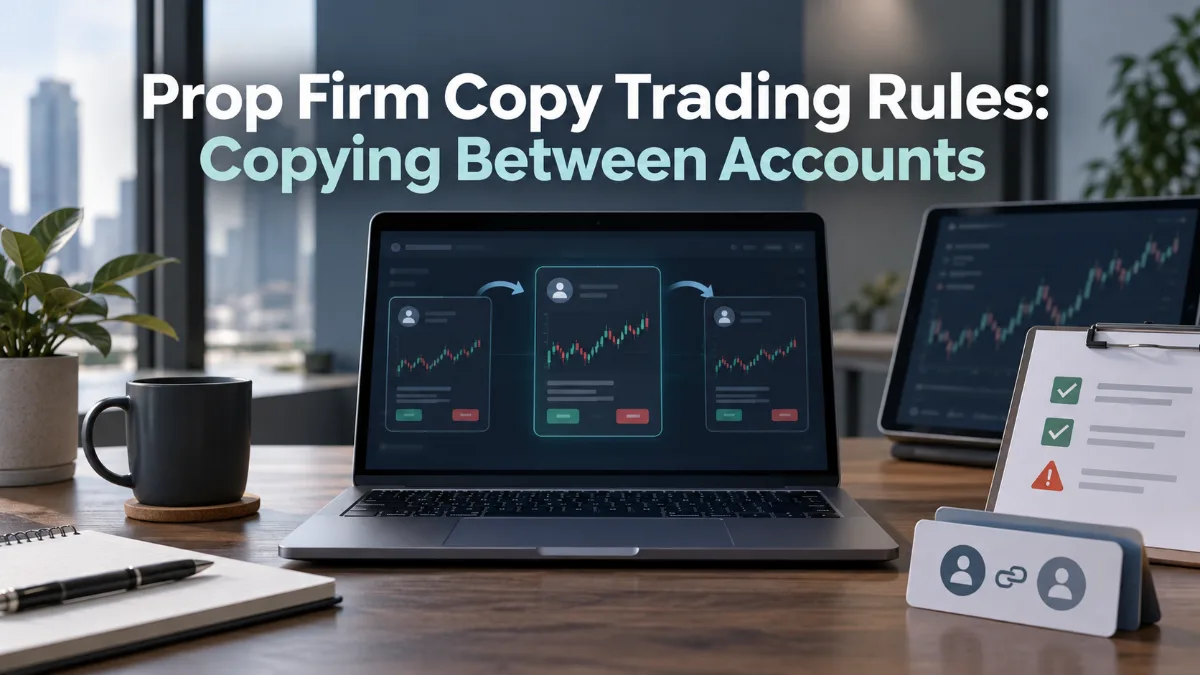
A trade copier takes orders from a lead or master account and reproduces them in one or more follower accounts. Depending on the software, it can copy entries, exits, stop-loss orders, take-profit orders, position-size changes, and pending orders. Some systems copy at a fixed lot or contract size. Others scale positions according to account balance or a multiplier.
That technical definition is broader than the rulebook definition used by many prop firms. Firms often care less about the software itself than about who made the trading decision. If you decide to buy an instrument in Account A and software mirrors your decision into your own Account B, that may qualify as permitted self-copying. If Account A belongs to another trader or follows a signal provider, the same software can become prohibited third-party copying.
This distinction also explains why automated trading and copy trading are not identical. An Expert Advisor can generate its own orders from programmed logic, while a copier normally replicates orders generated somewhere else. A firm may allow one and restrict the other. Third-party EAs can create an additional issue when many customers produce materially identical trades, especially where a program requires independent trading decisions or a unique strategy.
Can you copy trade on a prop firm?
Yes in some programs and no in others. Current prop-firm rulebooks show several models rather than one industry standard. Some permit copying only between accounts owned by the same trader. Some add a combined capital limit. Some allow copying during evaluation but restrict it after funding. Some permit the prop account to act as the lead account while banning inbound copying from an external account. Other programs provide a built-in copier but exclude particular account types from it.
For that reason, the useful question is not merely "can you copy trade on a prop firm?" It is "can this specific account receive these specific trades from this specific source using this specific method?" A compliant answer requires all parts of that chain to be permitted.
| Copying setup | Typical rule concern | What to verify |
|---|---|---|
| Your evaluation account to your second evaluation account | Often permitted only under common ownership and allocation limits | Account count, combined size, program stage, copier rules |
| Your funded account to another funded account | May be treated differently from evaluation copying | Funded-stage policy and capital cap |
| Another trader to your prop account | Frequently treated as third-party signal or strategy copying | Trade-origin and account-ownership restrictions |
| Your personal broker account to your prop account | Same owner does not always make inbound copying acceptable | External-master and inbound-copy rules |
| Your prop account to your personal account | Some firms distinguish outbound copying from inbound copying | Whether the prop account may act as the lead |
| Your account at one prop firm to another prop firm | Cross-firm copying can trigger external-source or coordination rules | Policies at both firms and the direction of copying |
| A signal service to multiple accounts | Decision originates from a third party | Third-party signals and managed-trading restrictions |
Why account ownership is only the first test
Ownership is one of the most common dividing lines in prop firm copy trading. A firm that wants to evaluate the trader's own decision-making may allow one person to replicate the same strategy across that person's accounts while blocking trades shared among unrelated users. This helps separate operational scaling from account sharing or coordinated group trading.
But ownership alone is not enough. A trader can own both the prop account and the external brokerage account yet still violate a rule that prohibits an external account from acting as the master. Another trader may own several accounts at the same firm but exceed a maximum combined allocation if all of them run the same strategy. A third may be allowed to use a copier on simulated funded accounts but not on a later live account.
The practical lesson is to check ownership and trade origin separately. Ask who owns the lead account, who owns the follower account, and who created the underlying decision. A copier that merely transmits your own decision is materially different from software that imports another person's signals.
Copy trade funded account rules can differ by stage
The phrase "copy trade funded account" is easy to misread because prop programs often have multiple stages and may use different execution environments. An evaluation account, a simulated funded account, and a live funded account can have different copier permissions even when they sit under the same brand and profile.
This matters when a trader passes one account but still has other evaluations running. A setup that copied one evaluation into several other evaluations may no longer be valid if the newly funded account becomes the master or follower. Likewise, a platform's built-in copy feature can be enabled for certain simulated account types while being unavailable for live accounts.
Do not infer permission from the label "funded." Read the policy for the exact product. Also check whether payout requests, account scaling, or migration to another account type automatically disconnects followers or changes the maximum position size. These operational changes can create rule breaches even when the original copier setup was compliant.
Inbound and outbound copying are not the same
One of the most overlooked prop firm copy trading rules is direction. A program may allow a prop account to be the lead account while prohibiting that same account from following an external master. The policy logic is straightforward: when the prop account is the lead, the firm can more readily attribute the original decision to its own trader. When it is the follower, the source of the strategy may be harder to verify.
Suppose you place trades manually in your prop account and mirror them to your personal brokerage account. That is outbound copying. Reverse the direction and the prop account becomes a follower of an outside source. Even though you own both accounts, the second configuration may fall under a ban on inbound external copying. Cross-firm setups create the same issue because one prop account necessarily receives decisions generated elsewhere.
Before connecting a copier, identify the direction in plain language: "Account A creates the trade and Account B receives it." Then compare that exact relationship with the rules. This is much safer than relying on generic statements such as "copy trading is allowed."
Third-party signals carry the highest rule risk
Copying another trader's orders is materially different from scaling your own execution. Many prop programs prohibit third-party signals, shared master accounts, coordinated group trading, or arrangements in which someone else effectively trades the account for you. Manual copying can fall into the same category as automated copying if the underlying decision originated with another person.
There is also a regulatory distinction outside the prop-firm contract. The Financial Conduct Authority explains that copy trading without clear manual input from the account holder can, in some circumstances, be classified as portfolio or investment management. That classification concerns regulated financial services and is separate from whether a prop firm allows a particular copier setup. Traders who sell or operate copying services for other people should not assume that a prop firm's internal permission resolves the regulatory question.
Third-party automation also deserves due diligence. The National Futures Association advises investors to investigate new financial technologies, tools, and providers before relying on them. In a prop context, due diligence should include not only performance claims but also data access, order permissions, failure behavior, and compatibility with the firm's terms.
A prop firm trade copier does not synchronize risk limits
A copier may synchronize orders, but it does not merge the risk rules of the accounts. Each follower can have a different balance, trailing drawdown, daily loss limit, maximum position size, scaling tier, permitted symbol list, or payout state. An order that is valid on the lead can therefore be too large or otherwise invalid on a follower.
For example, copying two contracts from a larger lead account into a smaller follower at a fixed 1:1 ratio may consume much more of the follower's permitted risk. Proportional scaling can reduce that mismatch, but it introduces rounding and minimum-size issues. A copier may also fail to reproduce a stop order, reject a symbol mapping, disconnect from one account, or fill followers at slightly different prices.
The result is an important operational rule: risk must be sized for the weakest follower rather than the strongest lead. If one account has the tightest drawdown or smallest position allowance, that account should determine the maximum safe copied exposure. Otherwise a single valid lead order can breach a follower before the trader has time to react.
Hedging can turn a copier error into a violation
Many firms separately prohibit cross-account hedging or coordinated opposite positions. A copier can accidentally create that pattern if one follower misses a close, reverses twice, uses an incorrect symbol mapping, or reconnects after a partial failure. The trader may intend to hold identical positions but end up long in one account and short in another.
This is why copier monitoring matters even when automation is permitted. Check whether the software flattens followers when the lead is closed, what happens after a disconnection, and whether rejected orders trigger alerts. If the platform changes contract availability or account limits after scaling, confirm the copier configuration before the next session.
How to check a copier setup before trading
- Identify every account. Record the firm, program, stage, account size, and owner for each lead and follower.
- Identify the origin of the decision. Confirm whether trades come from your manual analysis, your own algorithm, a third-party EA, another trader, or a signal service.
- Check copying direction. Determine whether the prop account is the lead or follower and whether external masters are permitted.
- Read the exact program rules. Do not rely on a general FAQ if your evaluation, simulated funded account, and live account have separate terms.
- Check allocation limits. Some firms cap the number of accounts or the total capital that can run an identical strategy.
- Check software restrictions. A firm may allow copying but restrict cloud copiers, third-party tools, high-frequency automation, or shared infrastructure.
- Normalize position sizing. Size trades around the tightest drawdown, smallest contract limit, and lowest risk capacity among the followers.
- Test failure behavior. Know what happens when an order is rejected, a connection drops, the lead is liquidated, or a follower reaches its own limit.
- Recheck after account changes. Passing an evaluation, receiving a payout, scaling, or moving to live funding can change the applicable rule set.
If the published wording is ambiguous, ask support about the exact lead and follower arrangement rather than asking whether copy trading is allowed in general. Keep the written answer with your account records. A precise confirmation is more useful than relying on community interpretations or an old rule summary.
Common mistakes that cause avoidable breaches
- Assuming same ownership means automatic permission. External inbound copying may still be prohibited.
- Using evaluation rules for a funded account. Stage-specific restrictions are common enough that the funded policy needs a separate check.
- Copying a signal manually. Manual execution does not necessarily convert someone else's decision into your own strategy.
- Ignoring combined allocation. Multiple individually valid accounts can become non-compliant when identical trading exceeds an aggregate cap.
- Using a fixed multiplier across unequal accounts. The same order can create very different drawdown risk in each follower.
- Leaving stale followers connected. A payout, scaling event, or rule change can make yesterday's configuration unsafe.
- Treating a copier as risk reduction. It duplicates exposure as efficiently as it duplicates profitable trades.
Does copy trading reduce trading risk?
No. A copier can reduce repetitive execution work, but it does not make the underlying strategy safer. If five accounts receive the same losing trade, the operational efficiency simply multiplies the loss across five rule sets. The Commodity Futures Trading Commission also cautions that copying another person's trades and using automated trading technology do not remove market risk or guarantee future results.
For prop traders, the more immediate danger is often rule risk rather than market prediction. A copier can multiply a position into several accounts faster than a trader could place it manually. That speed is useful only when the sizing, account eligibility, and failure controls are correct.
When copying between accounts makes sense
Copying can be operationally useful when a firm explicitly permits self-copying and the trader runs the same personally generated strategy across several eligible accounts. It can reduce manual order-entry errors, keep entries and exits more consistent, and make multi-account management practical. A built-in copier can also reduce integration complexity because the platform already knows the available accounts and instruments.
It is a poor fit when accounts have materially different rules, when the trader frequently changes risk by account, when an external signal source drives the trades, or when the firm requires independent execution. Traders who cannot monitor copier failures should also be cautious. Automation removes clicks, not responsibility.
The rule to use before connecting any account
Only copy a trade when you can explain the full chain of ownership, decision origin, direction, account stage, software, and risk sizing and every part of that chain is permitted by the current rules. If one element is unclear, leave the accounts unlinked until the firm confirms it in writing.
That approach resolves most questions about prop firm copy trading. The key is not whether a prop firm trade copier exists, but whether your exact use of it preserves the firm's requirements for independent decision-making, account ownership, capital limits, and risk control. Rules can change by program, so a configuration that was valid on one account or at one stage should never be treated as a permanent permission for every funded account.