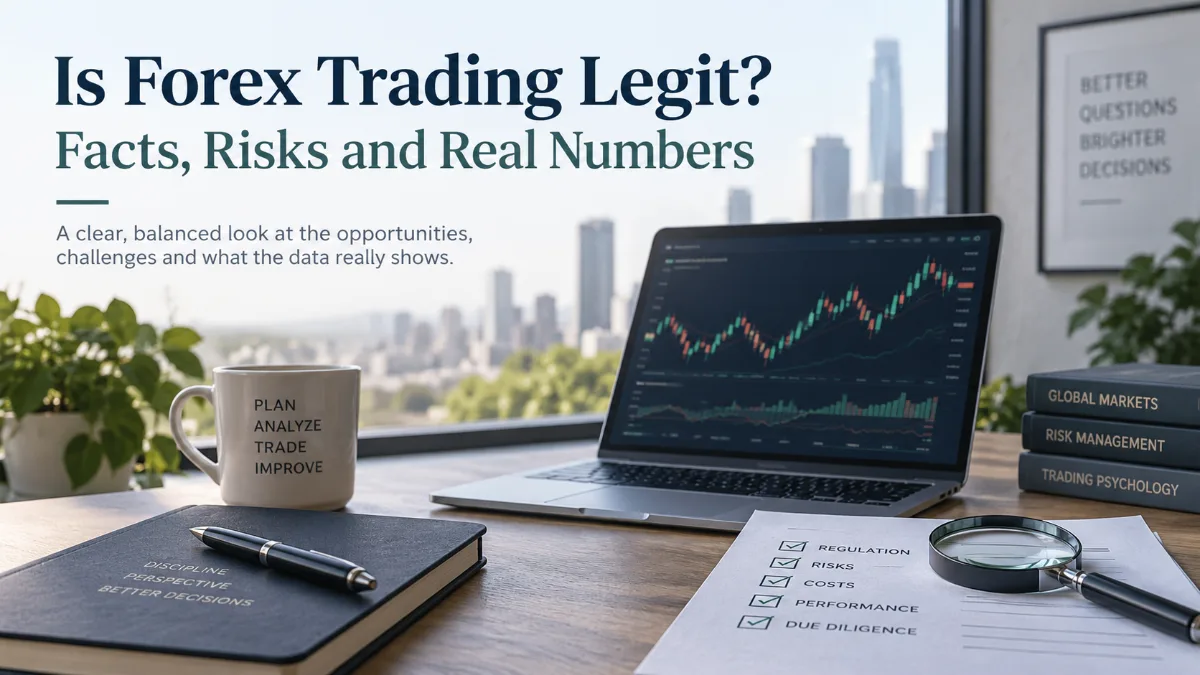
Yes. Forex trading is a legitimate financial activity used every day by banks, companies, governments, investment firms and individual traders. The foreign exchange market exists because currencies must be exchanged for trade, investment, travel, hedging and speculation. The fact that forex is real does not mean every broker is legitimate or that retail trading is easy to profit from.
A regulated forex transaction can be legitimate and still lose money. A fraudulent platform can also imitate real trading while never placing genuine trades. The useful test is therefore whether the product, broker, pricing and withdrawal process are genuine and properly regulated.
Is forex trading legit?
Forex trading is a real part of the global financial system. The Bank for International Settlements reported that over-the-counter foreign exchange turnover averaged about $9.5 trillion per day in April 2025. That figure covers institutional activity across spot transactions, forwards, swaps, options and other foreign exchange instruments. It shows that forex is not a niche internet product created for retail traders. It is one of the world's major financial markets.
Most global forex activity is conducted over the counter rather than through one centralized stock exchange. Retail traders access a much smaller part of this system through brokers or dealers and may trade rolling spot forex, currency CFDs, spread bets or futures depending on the jurisdiction.
Legality depends on jurisdiction. A product that can be offered to retail clients under one regulatory regime may be restricted or structured differently elsewhere. A broker also needs the correct authorization for the clients and products it serves. A professional-looking website, trading app or familiar platform name is not proof of authorization.
Is forex trading a scam?
Forex trading itself is not a scam, but forex is frequently used as the story behind scams. Fraudsters benefit from the fact that currency markets are real, prices move constantly and leveraged trading can appear sophisticated. They can build a website that displays charts and account balances while controlling every number the victim sees.
The Commodity Futures Trading Commission warns about unregistered forex platforms, fake trading profits, social media approaches and withdrawal problems. In some schemes the customer's money is never used for genuine market trading. A displayed profit can simply be a number generated by the operator to encourage larger deposits.
| Sign | More consistent with legitimate trading | More consistent with a scam |
|---|---|---|
| Legal identity | Named company that can be matched to an official regulator record | Vague company name or entity that cannot be verified |
| Returns | Profits and losses are uncertain | Guaranteed or unusually consistent returns |
| Funding | Documented payment methods in the customer's own account | Pressure to send crypto or money to unrelated recipients |
| Withdrawals | Terms and procedures are disclosed before funding | New taxes or fees appear only when withdrawal is requested |
| Sales behavior | Risk warnings and suitability checks where required | Urgency, secret strategies and pressure to deposit more |
| Regulation | Authorization can be independently confirmed | Fake license numbers or links to unrelated regulated firms |
Regulation can reduce some counterparty and conduct risks, but it does not make trading profitable or remove market risk.
What percentage of forex traders lose money?
There is no credible single percentage that describes every forex trader worldwide. Loss rates depend on the country, dealer, product, time period, leverage level and whether the data count people, accounts or trading periods. Any website claiming that one exact global percentage applies to all forex traders is oversimplifying the evidence.
For a concrete benchmark, the CFTC states that about two out of three retail foreign exchange traders end each quarter in the red based on profitability data from registered US retail foreign exchange dealers. In percentage terms that is roughly 67%. The figure is especially useful because it is specific to retail foreign exchange rather than to trading in general.
Another often quoted range comes from European regulation of contracts for difference. The European Securities and Markets Authority reported that analyses across several jurisdictions found that 74% to 89% of retail CFD accounts typically lost money. That range should not be presented as the percentage of forex traders who lose money because CFDs include products linked to assets other than currencies. It is still relevant because rolling spot forex and currency CFDs are commonly sold with the same core feature that drives much of the risk: leverage.
The sound conclusion is narrower: most retail leveraged accounts lose money in the available regulator datasets, but the percentage varies. Traders should use the loss-rate disclosure for the specific regulated provider and product rather than assume a universal number.
Why do so many retail traders lose?
Retail losses are not explained by one mistake. Forex trading combines uncertain price movement with leverage, transaction costs and behavioral pressure. A strategy can be directionally correct often enough to feel successful while still losing money after costs or after a small number of oversized losses.
Leverage changes the loss curve
Leverage allows a trader to control a position much larger than the cash committed as margin. That increases capital efficiency, but it also magnifies the effect of small currency moves on the account.
Consider a simplified example. A trader with $1,000 uses 30:1 leverage to control a $30,000 position. A 1% adverse move in the position represents a $300 gross loss before spreads, commissions or financing. That is 30% of the original $1,000 account. A move of roughly 3.33% against the full position would mathematically equal the initial $1,000, although real brokers may close positions earlier under margin rules.
Leverage does not make a bad trade bad. It makes the financial consequence of being wrong much larger relative to the trader's capital. The same amplification applies to gains, which is why high leverage is attractive in the first place.
Trading costs create a hurdle
A trader does not start every position at zero economic cost. The bid and ask spread creates an immediate hurdle. Some accounts also charge commissions. Positions kept open may incur financing or rollover charges. Fast markets can add slippage, meaning an order is filled at a worse price than expected.
Each cost can appear small in isolation. Frequent trading makes them cumulative. A strategy that has a slight theoretical edge before costs can become unprofitable once spreads, commissions and financing are included. This is one reason a high number of winning trades does not automatically mean a profitable account.
Short horizons are difficult to forecast
Currency prices react to interest rate expectations, inflation data, employment reports, political developments, capital flows, risk sentiment and unexpected events. Many of these forces are processed rapidly by professional market participants. A retail trader may form a reasonable macroeconomic view and still lose because the timing, entry price or market reaction differs from the forecast.
The same news can also produce different price responses depending on prior expectations. A currency can fall after positive data if traders had already priced in an even stronger result.
Risk management can fail before the strategy
A trader can survive many small losses if position size is controlled. One oversized position can undo that discipline. Correlation can also hide concentration. Holding several trades that all depend on the US dollar weakening may look diversified because different currency pairs are involved, but the underlying risk can be similar.
Stops reduce exposure but do not guarantee an exact exit price in every market condition. During gaps or rapid repricing the executed price can differ from the requested stop level. Risk planning therefore has to consider position size and total account exposure rather than rely only on stop orders.
How legitimate forex trading actually works
Retail forex does not necessarily send every order into one universal marketplace. In over-the-counter trading the customer's dealer may be the counterparty, so the platform can be a dealer interface rather than a direct window into a centralized exchange.
This structure is not automatically improper. What matters is whether the dealer is authorized, follows applicable conduct rules and handles pricing, client money and withdrawals under the relevant framework.
Different products create different legal relationships. Currency futures are standardized exchange-traded contracts. Retail rolling spot forex and currency CFDs are typically OTC products. Physical currency conversion is different because the customer exchanges currencies rather than holding a leveraged speculative position.
| Type of currency transaction | Typical purpose | Main risk |
|---|---|---|
| Physical or bank conversion | Travel, payments or transfers | Exchange rate and fees |
| Retail leveraged forex | Short-term speculation | Leverage, dealer risk and trading costs |
| Currency futures | Speculation or hedging | Market risk, leverage and contract mechanics |
| Institutional forwards and swaps | Hedging, funding and balance-sheet management | Market, liquidity and counterparty risk |
How to check whether a forex broker is legitimate
Checking a broker should start outside the broker's own website. Fraudulent firms can copy regulatory language, addresses and even the identity of real authorized companies. The objective is to prove that the exact legal entity and website you are dealing with correspond to an official record.
- Find the legal entity name. Do not rely only on the trading brand. Locate the company name that is supposed to hold the license.
- Search the regulator's register independently. Use the regulator for the jurisdiction in which the firm claims authorization. Do not trust a registration link supplied in a message or advertisement without checking the destination.
- Match the details. Compare the website domain, telephone number, address and legal name with the official record. A clone scam may copy a genuine firm's license number while using different contact details.
- Confirm the permitted activity. A financial company may be registered for one service but not authorized to offer leveraged forex to retail clients.
- Read withdrawal terms before depositing. Check payment methods, identity verification requirements, fees and any restrictions. A demand to pay a new tax or deposit additional money solely to release a withdrawal is a serious warning sign.
- Review the risk disclosure. A legitimate provider should not market leveraged forex as safe income. Where regulators require account loss percentages or standardized warnings, those disclosures should be visible.
A small successful withdrawal is not proof that a broker is safe. Some fraudulent schemes allow early withdrawals to build confidence before seeking a larger deposit.
Common forex scam patterns
- Guaranteed-return trading. The promoter promises a fixed daily or monthly return despite the uncertainty of currency prices.
- Fake managed accounts. A supposed expert asks for control of funds or credentials and displays fabricated performance.
- Signal and bot schemes. Marketing presents a secret indicator, copy-trading service or AI system as if it removes market risk.
- Withdrawal traps. The platform shows profits but demands additional tax, insurance, commission or verification payments before releasing funds.
- Clone firms. Criminals copy the name or license details of a real regulated company while using a different website or contact channel.
- Social media relationship scams. A new online contact gradually introduces trading and directs the victim to an unfamiliar platform.
- Recovery scams. After a loss, another operator claims it can retrieve the money for an advance fee or further transfer.
Can you make money trading forex?
Yes, profitable forex trading is possible. The existence of profitable professional and retail participants is not in question. The important point is that possibility is not the same as probability for an inexperienced leveraged trader. Public regulator data show that losses are common among retail accounts.
Profitability also cannot be judged by win rate alone. Suppose a strategy wins 45% of trades and gains an average of 1.5 units of risk on each winner while losing 1 unit on each loser. Its simplified expectancy is 0.45 multiplied by 1.5 minus 0.55 multiplied by 1, which equals positive 0.125 units per trade before costs. A system can therefore win less than half the time and still have positive expectancy.
The reverse is also true. A strategy that wins 70% of trades but earns only 0.4 units on each winner and loses 1 unit on each loser has an expectancy of 0.70 multiplied by 0.4 minus 0.30 multiplied by 1, which equals negative 0.02 units before costs. A high advertised win rate can therefore conceal poor risk and reward characteristics.
Real performance should include spreads, commissions, financing and slippage across different market conditions. Drawdown also matters because a strategy requiring intolerable losses may not be practically usable.
A realistic framework before risking money
- Use risk capital only. Money needed for rent, debt payments, emergencies or near-term goals is not suitable trading capital.
- Learn the product structure. Understand margin, leverage, costs and liquidation rules before using real money.
- Define risk before entry. Decide the maximum acceptable loss on the trade and across the account rather than choosing position size from the profit target.
- Test a repeatable method. A demo account can help with mechanics and rule testing, although simulated execution cannot reproduce every live condition.
- Keep records. Track entry logic, exit logic, costs, position size and results so a lucky streak is not mistaken for a durable edge.
- Reduce leverage rather than maximize it. The broker's maximum permitted leverage is a ceiling, not a recommended setting.
- Separate trading from sales pressure. A legitimate opportunity does not require an immediate deposit because an account manager claims the market will disappear.
Who should avoid leveraged forex trading?
Leveraged forex is a poor fit for anyone who cannot afford a substantial or complete loss of trading capital. It is also unsuitable for people who need predictable income, are trying to recover debt quickly or are using money reserved for essential expenses.
It may also be wrong for someone seeking long-term wealth accumulation without testing strategies, monitoring risk or understanding derivatives. Diversified long-term investing serves a different purpose from short-term leveraged currency speculation.
Anyone tempted to increase position size after losses should be particularly cautious because leverage makes loss-chasing financially dangerous.
Bottom line: Legit market and real risk
Forex trading is legit but it is not automatically safe. The underlying market is a core part of global finance. The retail products built on that market can involve substantial leverage, trading costs and dealer risk. Fraud adds a separate layer of danger because fake platforms can imitate genuine brokers and genuine price charts.
There is no universal global loss rate. US regulator data indicate that roughly two out of three retail forex traders lose money in a typical quarter, while broader CFD datasets have historically shown higher loss rates. Those figures challenge claims of easy income but do not predict every trader's outcome.
The practical test is simple: verify the broker independently, understand exactly what product you are trading, treat leverage as a risk multiplier and judge any strategy by net results rather than marketing claims. Legitimacy answers whether the activity and provider are real. Profitability is a separate question that must be earned under uncertain market conditions.