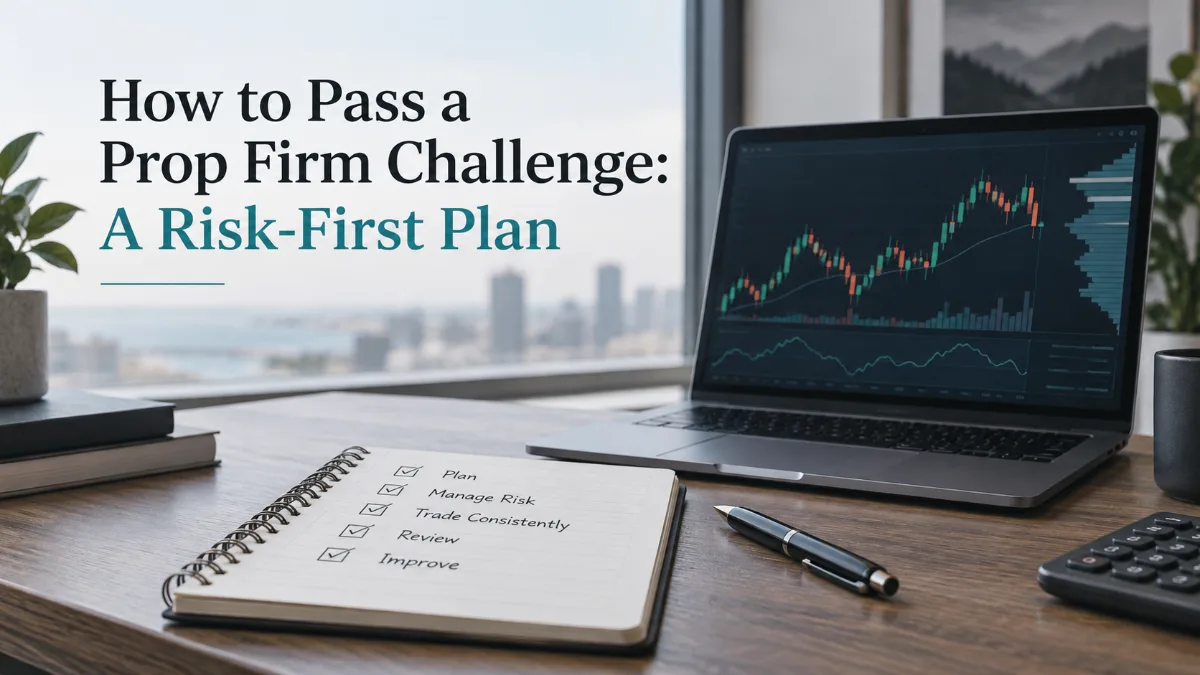
The most reliable way to approach a prop firm challenge is to treat the drawdown limit as the scarce resource and the profit target as a secondary objective. A trader who focuses only on reaching the target can increase size too quickly, overtrade after losses or take low-quality setups because the finish line feels close. A risk-first plan reverses that logic. It defines how much capital can be put at risk before the first trade, limits how much damage one bad session can cause and makes passing the challenge a by-product of executing a repeatable process.
There is no universal formula that guarantees a pass. Challenge rules differ by provider and account type, and profitable trading is uncertain. The goal is not to maximize return as fast as possible. It is to leave enough margin for error that normal losses and short losing streaks do not cause a rule breach.
How to pass a prop firm challenge with a risk-first plan
A useful prop firm strategy starts by converting the provider's rules into your own operating limits. Do this before choosing entries or thinking about the profit target. The challenge may include a maximum daily loss, an overall drawdown limit, a trailing drawdown, minimum trading days, news restrictions, position-size limits or consistency rules. Some calculations may be based on balance while others may use equity and unrealized profit or loss. The exact wording matters because two rules with the same percentage can behave differently.
- Write down every hard rule. Record the profit target, daily loss limit, maximum loss limit, reset time, drawdown method and any restrictions that affect when or how you may trade.
- Create softer internal limits. Your personal stop levels should leave space between ordinary trading losses and the firm's breach threshold.
- Define one unit of risk. Decide what a normal full-loss trade costs before you enter it.
- Set a daily shutdown rule. Stop when the session reaches your predefined loss boundary or when execution quality deteriorates.
- Trade only tested setups. A challenge is a poor place to add unfamiliar strategies simply because the target creates urgency.
- Review rule usage after every session. Track not only profit and loss but also how much of the daily and total drawdown budget remains.
This turns the challenge into a constrained risk problem. The trader's job is to preserve enough attempts for the strategy's edge to appear.
Start with the rules before you start with the market
The first task is to understand how the account can fail. A daily loss limit may reset at a specified time. A maximum loss limit may be static or may move with account performance. Open losses may count toward a breach even when no trade has been closed. A consistency rule may limit how much of total profit can come from one day. Restrictions may also apply to economic news, overnight positions, weekend holding, automated systems or copying trades.
Build a one-page rule sheet and check each item against the provider's current terms. Do not rely on an old review or another trader's summary. If a rule is ambiguous, use the stricter interpretation until the provider clarifies it. A profitable strategy can still fail if it conflicts with the account's rules.
| Challenge rule | Risk-first response |
|---|---|
| Profit target | Treat it as the destination rather than a reason to increase risk. |
| Daily loss limit | Use a lower internal daily stop so one session cannot reach the hard boundary. |
| Maximum loss limit | Track remaining drawdown as available risk capital. |
| Trailing drawdown | Monitor the reference level and understand when it stops moving if applicable. |
| Minimum trading days | Avoid forcing trades simply to complete a required day. |
| Consistency rule | Prefer stable size and avoid dependence on one oversized winning session. |
| Trading restrictions | Remove prohibited periods or methods from the plan before execution. |
Build a risk budget that is smaller than the firm's limit
Your internal risk limit should be meaningfully tighter than the challenge's hard limit. The exact buffer depends on the strategy, win rate, stop placement, trade frequency and drawdown behavior. There is no evidence-based percentage that is optimal for every trader, so fixed numbers should be treated as examples rather than universal rules.
For illustration, a trader might risk about 0.25% to 0.50% of the account on a normal setup and stop after a small sequence of full losses. Another strategy may need a different structure. The principle is that ordinary losing trades should fit inside the internal budget without putting the account close to a breach.
Leverage can make this discipline more important because it increases the effect of a market move on account equity. The Commodity Futures Trading Commission explains that high leverage amplifies both gains and losses in retail forex. In a prop challenge, even when the environment is simulated, larger notional exposure can still consume the challenge's drawdown allowance faster.
Size every trade from the stop rather than the target
Position size should be derived from the amount you are willing to lose if the stop is hit. The basic relationship is simple: planned account risk divided by the monetary loss per unit at the stop gives the position size. The implementation differs across instruments because forex uses pip values, futures use tick values and CFDs or stocks use price movement per unit.
Suppose the maximum planned loss on one trade is $300. If the chosen stop would lose $15 per contract, the position size is 20 contracts before considering any platform restrictions, slippage or execution constraints. If market conditions require a wider stop, size should fall. Widening the stop while leaving size unchanged silently increases account risk.
This prevents a common mistake: choosing position size first and then placing a stop wherever the desired dollar loss happens to land. Market structure should determine where the thesis is invalidated. The risk budget should determine the allowed exposure.
Treat correlated trades as one risk decision
Three open trades are not necessarily three independent bets. A long position in one equity index, another highly correlated index and a risk-sensitive currency pair may all lose for the same underlying reason. The account can therefore carry much more effective exposure than the number of tickets suggests.
Group positions by common driver and cap the combined risk. If several trades depend on the same theme, reduce each position or choose the clearest expression. Around major scheduled events, correlations can rise and several positions may move against you at once.
The objective is not to eliminate correlation. It is to avoid multiplying one thesis until a normal market move becomes a challenge-ending event.
Use fewer setups and demand clearer conditions
The best strategy for prop firm challenge conditions is not automatically the strategy with the highest possible return. It is the strategy you can execute consistently within the account's loss rules. A setup with occasional large wins but deep losing streaks may fit a tight drawdown structure poorly. A lower-volatility approach with repeatable entries may fit better.
Limit the challenge to setups that already have a defined entry, invalidation point and exit process. If your plan normally uses two setups, keep those two. Do not add a third because the account is behind schedule. A challenge changes incentives, and those incentives often encourage traders to mistake activity for progress.
Frequent intraday trading can create substantial risk, particularly when leverage or margin is involved. FINRA advises active traders to understand market dynamics, firm systems, margin rules and capital allocation. The same mindset applies to a challenge: more trades do not automatically improve the chance of passing.
Define a daily stop before the first trade
A daily stop is a decision rule for ending the session. It can be based on realized loss, total loss including open positions, a number of full-risk losses or a combination of those measures. Its purpose is to prevent a bad session from expanding into a rule breach through revenge trading or uncontrolled size changes.
The shutdown rule should be defined when you are calm. One example is to stop after two or three full-risk losses, or earlier if the planned daily loss budget is reached. That number is not a universal prescription. A strategy with many small trades may require a different rule than a strategy that takes one or two setups per day.
A useful stop condition can also be behavioral. If you miss an entry and immediately chase price, move a stop without a strategy reason or increase size to recover losses, the quality of the process has changed. Ending the session may protect the account even when the numerical daily limit has not been reached.
Do not increase size because the target feels close
Challenge psychology can become most dangerous near the finish line. A trader who is one strong day from the target may double size to finish quickly. That can erase several disciplined sessions.
Keep risk stable unless your written plan contains a pre-defined scaling rule that was tested before the challenge. If risk changes only because the account is near the target, the change is driven by outcome pressure rather than strategy evidence.
The same rule applies after losses. Increasing size to recover a drawdown faster changes the distribution of outcomes exactly when the account has less room for error. A risk-first plan usually does the opposite: it keeps size stable or reduces it when the remaining drawdown budget becomes more valuable.
Measure progress in risk units as well as dollars
Dollar profit can hide whether the process is becoming more dangerous. Track results in risk units, often called R. If one normal losing trade equals 1R, a gain of 2R equals twice the planned risk. This makes trades with different stop distances easier to compare.
Also record maximum adverse excursion, rule breaches avoided, trades taken outside the plan, correlated exposure and whether size matched the intended risk. These measures show whether a profitable day came from good execution or from taking more risk than planned.
A simple review can ask four questions: Did I follow the approved setups? Did every position stay within planned risk? Did I stop when the shutdown condition was reached? Did any rule come closer to breach than expected? If the answers are clean, the process is moving in the right direction even if the account did not make money that day.
Use a pass plan instead of a deadline
Trying to pass by a specific personal deadline can create unnecessary trades. If the challenge itself does not impose a tight time limit, there is little strategic value in deciding that the account must be completed this week. The market does not provide high-quality setups on demand.
Plan around opportunity instead. Estimate how many valid setups your method typically produces, how much risk each uses and what a normal losing streak looks like from your own records. Then judge whether the challenge rules are compatible with that behavior. If the account requires risk or trade frequency that your historical process does not support, the problem may be account fit rather than discipline.
What to do after a drawdown
A drawdown should trigger diagnosis before recovery. First determine whether losses came from normal strategy variance, poor execution or a mismatch between the strategy and the challenge rules. Those causes require different responses.
- Normal variance: keep the process stable if trades followed the tested plan and risk remained controlled.
- Execution errors: reduce activity until the specific behavior is corrected. Examples include chasing entries, moving stops or trading prohibited periods.
- Rule mismatch: change the operating plan only if the strategy can still be executed honestly within the challenge. Do not distort a strategy beyond recognition just to keep the account alive.
- Severe remaining drawdown: consider whether continuing has positive practical value. Tiny remaining loss capacity can force position sizes so low or behavior so defensive that the original strategy no longer functions properly.
Do not define recovery as getting back to breakeven quickly. Define it as returning to correct execution while preserving drawdown capacity.
Common mistakes that cause avoidable challenge failures
- Trading the profit target instead of the setup. The target becomes a reason to enter trades that would not be taken in normal conditions.
- Using the firm's maximum loss as a working stop. A hard breach threshold is not a sensible daily risk allowance.
- Ignoring open equity. Unrealized losses may matter under the account's rules even before positions are closed.
- Stacking correlated positions. Multiple tickets can represent one concentrated market bet.
- Changing size emotionally. Risk rises after a loss or near the target without a tested scaling rule.
- Forcing minimum trading days. A required day should not become an excuse for an unqualified setup.
- Relying on memory for restrictions. News rules, holding rules and drawdown calculations should be written into the operating checklist.
- Buying repeated resets without diagnosing the failure. A new account does not fix a process that repeatedly breaches the same risk rule.
A practical prop firm strategy for the next session
Before the session opens, know the exact remaining daily loss capacity and total drawdown capacity. Mark the setups you are allowed to trade and the periods when you will not trade. Calculate normal risk per position and the combined risk allowed across correlated trades. Define the condition that ends the day.
During the session, size from the stop, not from confidence. Reject entries that bend the setup rules. Track open equity if the challenge uses it in loss calculations. After a loss, do not increase exposure to recover faster.
After the session, compare execution with the plan. If the account gained but the process violated risk rules, treat the day as a warning. If the account lost within plan, treat it as a normal cost. The goal is a sequence of sessions in which no single mistake determines the challenge.
The pass decision comes from survival first
How to pass a prop firm challenge is ultimately a question of controlled exposure. The trader must know the rules precisely, risk less than the hard limits allow, size positions from predefined loss amounts, control correlated exposure and stop trading before a bad session becomes a breach. Profit still matters, but it should come from repeated qualified setups rather than from forcing the target.
The strongest risk-first plan is therefore simple to state: preserve drawdown capacity, keep position sizing consistent, trade only proven conditions and let the profit target be reached through execution rather than urgency. If the strategy cannot make progress without regularly approaching the account's breach limits, the answer is not more aggression. It is a better fit between the trading method and the challenge rules.