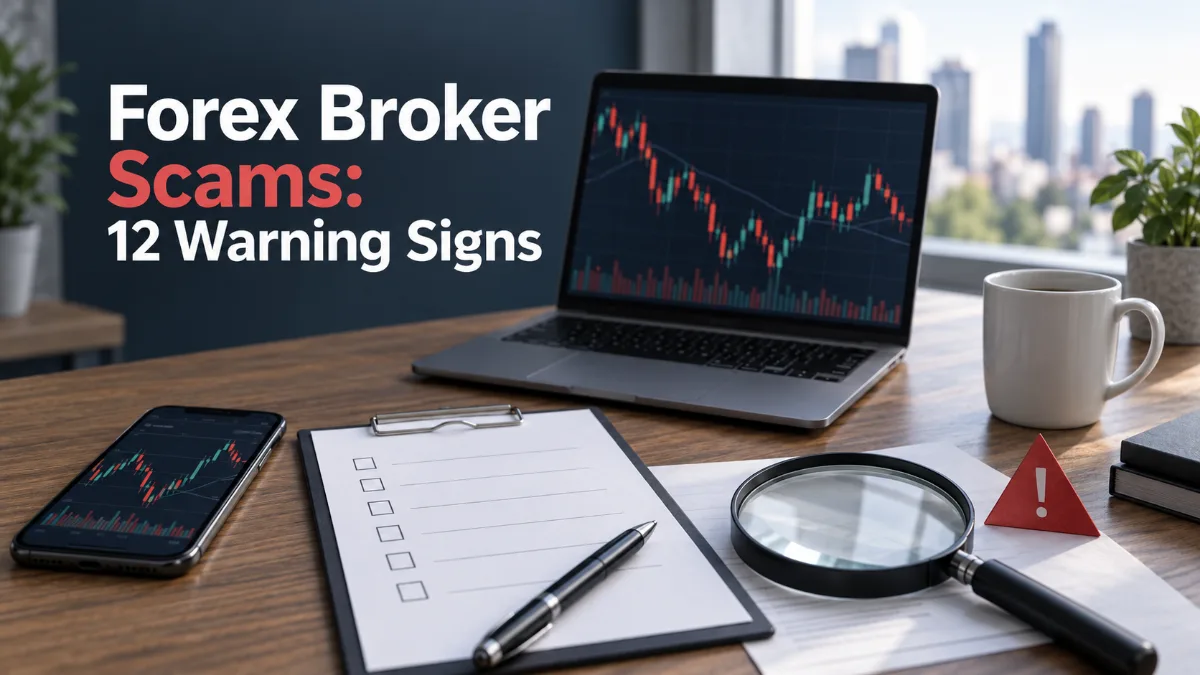
A forex broker scam usually becomes easier to spot when you stop judging the sales pitch and start verifying the legal entity behind it. A polished website, a trading app, a license number and even a familiar company name are not enough. The decisive checks are whether the broker is genuinely authorized for the service it offers, whether its contact details match the regulator's records and whether deposits and withdrawals follow normal financial controls.
No single red flag proves fraud in every case. Some legitimate brokers may have poor service or restrictive trading terms without being scams. The concern rises when several warning signs appear together, especially unverifiable regulation, mismatched contact details, guaranteed returns, pressure to deposit and obstacles when you try to withdraw.
The 12 forex broker scam warning signs
1. The legal entity cannot be verified
A real broker should tell you the exact legal entity that operates your account. That is more specific than a brand name. You should be able to identify the company's registered name, the regulator responsible for it and the authorization or registration that covers the service being offered to you.
If the website only displays a brand name, a vague statement such as "globally regulated" or a certificate image with no independently verifiable record, treat that as a major warning sign. Regulation is jurisdiction-specific. A company registration document also does not automatically mean the firm is licensed to provide retail forex or leveraged trading services.
2. The license details do not match the broker
One of the most important forex broker scam warning signs is a license that belongs to a real firm but not to the website or salesperson contacting you. Fraudsters can copy a genuine firm's name, address and reference number while substituting their own phone number, email address or domain. The Financial Conduct Authority specifically warns about these clone firms and advises consumers to compare the contact details they were given with the details on the regulator's official record.
For that reason, verifying only a license number is not enough. Check the legal name, trading names, website domain, phone number, email address and permitted activities. If the broker says the regulator's contact information is old and asks you to trust different details, independently contact the regulator or the genuine firm using information obtained from the official register.
3. Profits are guaranteed or risk is minimized
Forex trading involves market risk. A broker or salesperson who guarantees profits, promises a fixed return from currency trading or presents leveraged forex as virtually risk-free is giving you a reason to stop. The Commodity Futures Trading Commission identifies promises of extraordinary or supposedly certain forex profits as signs of possible fraudulent sales pitches.
Be equally cautious when the promise is dressed up as technology. Claims that an AI system, secret algorithm, copy-trading bot or professional account manager cannot lose do not remove market risk. Even a genuine trading strategy can have losing periods. The issue is not whether a broker markets technology. It is whether the marketing denies or conceals the possibility of loss.
4. You were approached unexpectedly
Unsolicited contact does not by itself prove a forex scam, but it changes the risk calculation. Be more skeptical when the relationship starts through a social media message, dating app, messaging group, cold call or unexpected email and quickly moves toward an investment conversation.
A common danger pattern is escalation. The first contact may be friendly and low pressure. The person may then move the conversation to a private messaging app, introduce a "broker" or "analyst" and encourage a small initial deposit. The apparent success of that first deposit can be used to push for a much larger transfer.
5. You are pressured to deposit immediately
Pressure is designed to shorten the time available for verification. A suspicious broker may say a bonus expires today, a market event creates a one-time opportunity, your account will be closed or a senior trader has reserved a special position for you. None of those claims should prevent independent due diligence.
A legitimate decision does not become safer because it must be made faster. If a salesperson resists questions about regulation, discourages you from checking the firm or repeatedly calls after you ask for time, stop the process. Do not let a deposit deadline replace identity and license checks.
6. Payments go to unusual destinations
Pay attention to where your money is actually being sent. A broker may display one corporate name on its website but instruct you to pay a different company, an individual, an unrelated payment processor or a crypto wallet with no clear contractual explanation. That disconnect deserves scrutiny.
Crypto funding is not automatically fraudulent, and payment processors can be legitimate. The stronger warning sign is a lack of traceable connection between the recipient and the regulated broker that supposedly holds your account. Be especially careful if the broker accepts only digital assets, refuses ordinary payment routes without explanation or changes payment instructions at the last moment.
7. Withdrawals become difficult after you make money
Withdrawal problems are among the most serious broker scams signals because they reveal what happens when money needs to move back to the customer. Suspicious behavior can include ignored withdrawal requests, endless document demands that appear only after a withdrawal is requested, unexplained cancellation of requests or repeated pressure to keep trading instead of cashing out.
Some legitimate brokers must perform identity checks and may restrict withdrawals for compliance reasons. That is why delay alone is not proof of fraud. The question is whether the broker can explain the requirement clearly, apply it consistently and point to contractual or regulatory grounds. Moving requirements and contradictory explanations are much harder to justify.
8. You must pay a new fee to unlock your money
A particularly dangerous pattern occurs when a platform shows a large account balance but says you cannot withdraw until you send more money for "tax", "insurance", "liquidity", "verification", "security", "commission" or "account unlocking". The label can change while the economic structure stays the same: you are asked to make another payment before receiving funds that supposedly already belong to you.
Do not assume that an additional payment will release the balance. Ask for the legal basis, contractual basis and an independently verifiable explanation from the relevant institution. If the demand appears only after withdrawal and payment must be sent to a new recipient or crypto address, treat the situation as high risk.
9. The trading balance cannot be independently reconciled
A number on a trading dashboard is not proof that the underlying money or trades exist. Scam platforms can present convincing charts, positions and profits while giving the customer no reliable way to reconcile what happened. A growing balance may simply be part of the persuasion process.
Look for consistent account statements, identifiable transaction records, clear deposit history and trade data that make sense together. Large profits that appear without a plausible trading history should increase skepticism. If an "account manager" controls all trading and cannot explain positions, execution prices or losses in a coherent way, do not treat the displayed balance as independently verified money.
10. The claimed jurisdiction does not fit the offer
Regulated brokers operate under rules that vary by country. That means a broker claiming to be regulated in a particular jurisdiction should offer products and account conditions that are compatible with the permissions attached to that entity. A license from one country does not automatically authorize a firm to serve every customer worldwide.
Be cautious when the website uses the prestige of a well-known regulator while your agreement names a different offshore company, or when the salesperson cannot tell you which entity will actually hold your account. The relevant question is not "Is this brand regulated somewhere?" It is "Which legal entity is contracting with me and is that entity authorized to provide this service to me?"
11. Ownership and contact information are hard to confirm
A broker handling customer money should not be difficult to identify. Warning signs include no meaningful headquarters information, a location that cannot be connected to the legal entity, constantly changing domains, support channels that exist only inside messaging apps or corporate names that differ across the website, payment page and account agreement.
A broker with no verifiable physical presence or meaningful corporate footprint deserves additional scrutiny. A physical address alone is not proof of legitimacy, but a firm that cannot establish where it operates, who owns the customer relationship or how its stated address connects to the contracting entity creates a basic due diligence failure.
12. Someone asks for control of your device or financial accounts
Technical support should never require you to surrender control of your money. Treat requests for online banking passwords, card security codes, crypto wallet seed phrases or authorization to transfer funds as severe warning signs. The same applies when a supposed broker or account manager wants remote access to your computer so they can move money on your behalf.
A legitimate broker may require identity documents and may provide platform support. That is different from asking for credentials that allow someone to impersonate you or control external accounts. If remote access or credential sharing has already occurred, change affected passwords from a trusted device and contact the relevant financial providers promptly.
How to identify a scam broker step by step
- Find the exact legal entity. Read the account agreement, website footer and deposit instructions. Record the full corporate name rather than relying on the brand.
- Identify the relevant regulator. Determine which authority should supervise the entity for the product and customer location involved. Do not use a regulator link supplied by the salesperson as your only route.
- Search the official register yourself. In the United States the National Futures Association provides BASIC, which includes CFTC registration, NFA membership and disciplinary information for covered firms and individuals. Other jurisdictions have their own official registers.
- Match more than the license number. Compare names, domains, phone numbers, addresses and regulated activities. A copied license number can be used by a clone firm.
- Check who receives the deposit. The beneficiary should make sense in relation to the contracting entity. Investigate unexplained third-party recipients or sudden changes in payment destination.
- Read the withdrawal rules before paying. Look for fees, identity requirements, processing conditions and any clauses that could restrict access to funds. Do not rely solely on a salesperson's verbal explanation.
- Search official warning notices. Regulators publish alerts about unauthorized firms and clones. Absence from a warning list is not proof that a broker is safe because new scams can appear before an alert is published.
- Stop when the evidence conflicts. A regulator record that points to a different domain or phone number is not a minor inconsistency. Resolve it through the official institution before sending money.
Quick check for broker scams
| Check | Lower-risk sign | Higher-risk sign |
|---|---|---|
| Legal identity | Exact entity is named and verifiable | Only a brand or certificate image is shown |
| Regulation | Official register details match | License belongs to another firm or domain |
| Sales claims | Risk of loss is clearly disclosed | Guaranteed or nearly certain profits |
| Contact | Stable corporate channels | Private messaging and repeated unsolicited contact |
| Funding | Recipient fits the contracting entity | Personal account or unexplained third party |
| Withdrawals | Published rules are applied consistently | New conditions appear after the request |
| Account access | You control your own credentials | Requests for passwords or remote control |
What to do if you may have paid a forex scam
Stop sending additional money, even if the platform says another payment is required to release a withdrawal. Preserve evidence before accounts or websites disappear. Save the account agreement, transaction receipts, wallet addresses, bank details, emails, messages, phone numbers, screenshots and the exact website domain.
Contact the bank, card issuer, payment service or crypto platform used for the transfer as soon as possible and explain that the payment may be connected to fraud. Ask what recall, dispute or fraud-reporting options are available for that specific payment method. Recovery is not guaranteed and the available process depends on how the money was sent.
Report the firm through the relevant financial regulator and appropriate law enforcement or fraud-reporting channel in your country. If the broker claimed a license, include the claimed legal name and license number as well as the actual domain, phone number and payment recipient. Those mismatches can help distinguish a clone from the genuine regulated firm.
Be cautious after reporting a loss. People who have already lost money can be targeted again by supposed investigators, lawyers, regulators or recovery agents who promise to retrieve funds for an advance fee. Verify any recovery service independently before sharing more personal information or paying anything.
How legitimate risk differs from a forex scam
Losing money with a regulated broker does not automatically mean the broker is fraudulent. Forex prices can move quickly, leverage can magnify losses and trading strategies can fail. A legitimate broker can also have service problems, spreads that widen under certain conditions or compliance checks that delay a transaction.
The distinction is evidence and process. Normal trading risk comes from market movements and disclosed account terms. Scam risk comes from deception about identity, authorization, custody, performance or access to funds. When evaluating a suspected forex broker scam, focus first on whether the entity is real, whether the regulator recognizes it, whether the contact details match and whether your money can move according to clear rules.
Which warning signs matter most
The strongest warning signs are the ones that challenge the broker's identity or your ability to recover your own funds. An unverifiable entity, a cloned license, a deposit sent to an unrelated recipient or a demand for more money before withdrawal should carry more weight than cosmetic issues such as an old website design. Think in combinations rather than isolated clues. One weak signal may have an innocent explanation, but identity mismatches plus payment pressure plus withdrawal barriers form a much more serious pattern.
If you remember one method for how to identify a scam broker, make it this: verify the legal entity independently before evaluating the sales story. Then match the regulator record to the exact website and contact details you are using. A broker that fails those checks should not receive your money simply because its platform looks professional or its salesperson sounds knowledgeable.