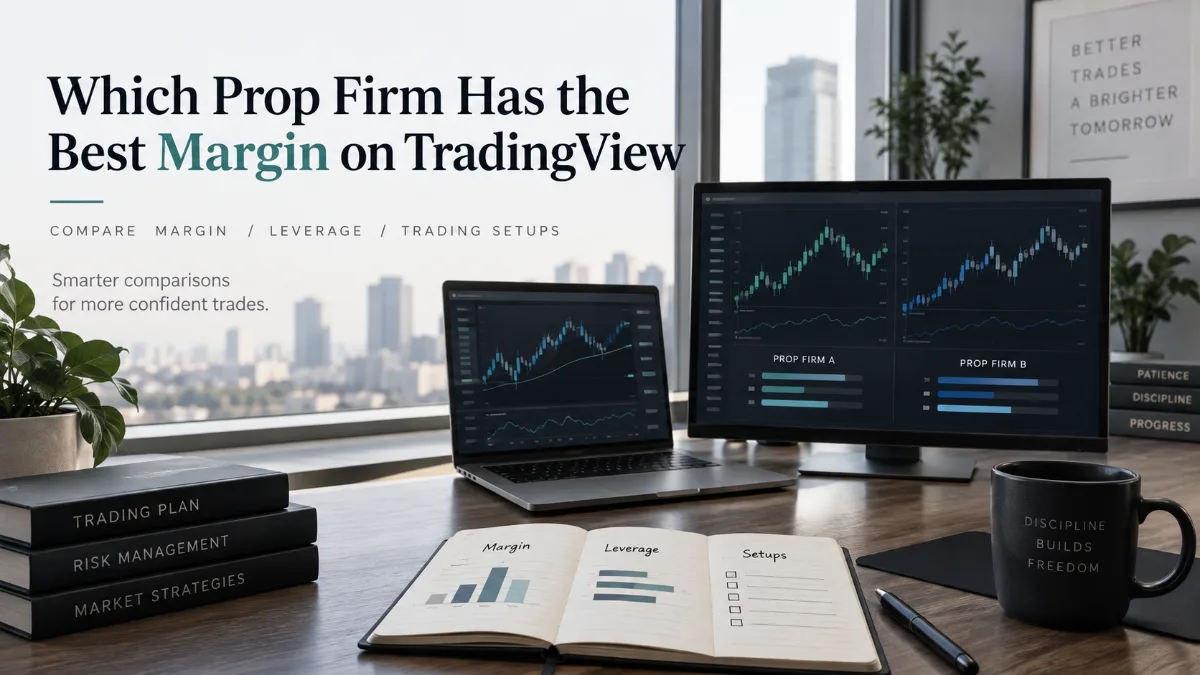
If by "best margin" you mean the lowest margin requirement or the highest usable leverage while placing trades directly from TradingView, FTMO is the strongest verified forex and CFD option in this comparison. Its Standard account offers leverage up to 1:100 and FTMO supports direct TradingView execution through the OANDA broker profile. On many major forex pairs that translates to a 1% margin requirement before considering the firm's separate drawdown rules. FXIFY reaches up to 1:50 on FX and gold with the relevant account setup, while AquaFunded can offer 1:100 during evaluation but normally reduces forex leverage to 1:50 on funded accounts and provides TradingView charting through MatchTrader or TradeLocker rather than the same direct TradingView connection.
For futures traders the answer changes. Futures prop firms usually do not give traders a simple retail-style leverage ratio that can be compared across firms. They control exposure through maximum contract size, daily loss rules and trailing drawdown. A TradingView prop firm can therefore look generous on nominal account size while offering less practical risk room than a smaller account elsewhere.
What prop firm margin actually means
Margin and leverage are related but not identical. Leverage describes how much market exposure an account can control relative to the capital assigned to it. Margin is the amount of account equity required to support that exposure. A simple approximation is:
Required margin = notional position value divided by leverage.
For a position with $100,000 of notional exposure, 1:100 leverage implies about $1,000 of required margin. At 1:50 the same exposure requires about $2,000. At 1:30 it requires roughly $3,333. Lower margin can make position sizing more flexible, but it does not increase the amount you can safely lose. The prop firm's daily loss and maximum loss rules still determine how much adverse movement the account can tolerate.
This distinction matters because a trader can have ample free margin and still violate a prop firm rule. If a $100,000 challenge permits a 5% daily loss, the meaningful daily risk ceiling is $5,000 even if the leverage setting would technically allow a much larger position. For that reason the useful question is not simply "which prop firm has the highest leverage?" It is "which firm gives my strategy enough buying power without making the drawdown structure impractical?"
A practical margin example on TradingView
Assume a trader wants $200,000 of combined forex exposure across two positions. At 1:100 leverage the approximate margin requirement is $2,000. At 1:50 it is about $4,000 and at 1:30 it is about $6,667. That difference can matter when several trades are open at the same time because used margin reduces free margin available for additional positions or adverse price movement.
Now add prop-firm risk. Suppose the account has $100,000 of simulated capital and the trader plans to risk $500 on each of the two positions. The combined planned loss is $1,000 if both stops are reached. In that situation 1:50 leverage may already provide more than enough buying power. Moving to 1:100 changes the margin consumed by the positions but does not improve the planned loss or the firm's daily loss allowance. The higher ratio is useful headroom rather than a reason to double position size.
This calculation is also why margin comparisons should use the instruments you actually trade. A firm can advertise 1:100 forex leverage while offering much lower leverage on indices, metals or crypto. The nominal account balance stays the same but the margin needed for a position can change sharply by asset class. Before buying a challenge, calculate the largest normal position your strategy would open on each market and confirm that the specific account plan supports it.
TradingView prop firm comparison for forex and CFDs
| Prop firm | TradingView access | Maximum forex leverage | Approximate margin on $100K notional | Main qualification |
|---|---|---|---|---|
| FTMO | Direct TradingView execution through OANDA broker profile | Up to 1:100 on Standard | About $1,000 | Strongest direct TradingView margin setup among the verified forex and CFD firms compared here |
| FXIFY | TradingView available as a trading platform on supported plans | 30:1 standard and up to 50:1 with the relevant setup | About $3,333 at 30:1 or $2,000 at 50:1 | Lower leverage than FTMO but still suitable for many intraday strategies |
| AquaFunded | TradingView charting inside MatchTrader or TradeLocker | Up to 1:100 in evaluation and normally 1:50 when funded | About $1,000 in evaluation or $2,000 at 1:50 | High evaluation leverage but not the same direct TradingView workflow |
The table makes one important point visible: TradingView compatibility is not a single technical standard. FTMO allows simulated orders to be managed from TradingView through an OANDA broker profile. FXIFY lists TradingView as an available platform for supported programs. AquaFunded uses platforms with TradingView charting built into their interfaces. All three can satisfy a trader who likes TradingView charts, but only the first two should be treated as direct TradingView platform access in the usual sense.
Which prop firm has the best margin for TradingView
FTMO is the clearest answer for a trader who wants direct TradingView execution and the lowest verified forex margin in this comparison. Its Standard account can provide up to 1:100 leverage. FTMO also publishes symbol specifications showing a 1% margin requirement on many major forex pairs. Its Swing account is more restrictive at up to 1:30, so traders who need overnight and weekend flexibility should not assume they will retain the same buying power.
The advantage is not simply the 1:100 headline. FTMO's TradingView implementation lets the trader analyze and place simulated trades from the same TradingView environment. That removes the mismatch found with firms that advertise "TradingView integration" but actually require execution inside another terminal that merely embeds TradingView charts.
Margin should still be evaluated together with the risk model. On FTMO's 2-Step structure the maximum daily loss is 5% of initial simulated capital and the maximum loss is 10%. The 1-Step structure uses a tighter 3% daily loss rule and an end-of-day trailing maximum loss. A trader who sizes positions aggressively because 1:100 leverage is available can therefore breach the account long before running out of technical margin.
When FXIFY may be the better fit
FXIFY does not match FTMO's maximum 1:100 forex leverage on its standard evaluation setup. Its standard leverage is 30:1 for FX and gold with an option on relevant accounts to increase that to 50:1. Instant Funding products can also use 50:1 forex leverage. For a $100,000 notional position that means roughly $2,000 of margin at 50:1 rather than about $1,000 at 1:100.
That difference matters most to traders who run several correlated positions at once or who need a large gross exposure for short-duration strategies. A trader risking only a small percentage per trade may see little practical difference between 1:50 and 1:100 because the drawdown limit rather than margin becomes the real constraint.
FXIFY can therefore be a reasonable TradingView prop firm for traders who value platform access but do not need maximum buying power. The account plan matters because leverage and trading restrictions vary across standard evaluation and instant funding products. Comparing the firm's maximum advertised leverage without checking the exact plan can produce the wrong conclusion.
Why AquaFunded is not a direct comparison
AquaFunded is often grouped with prop firms with TradingView because MatchTrader and TradeLocker include TradingView charting. That is useful for chart analysis and familiar indicators, but it is not identical to connecting a prop account to the TradingView trading panel.
AquaFunded's forex leverage can reach 1:100 during an evaluation. On funded accounts the normal forex leverage is 1:50, with the possibility of an increase depending on risk management. That means the evaluation may look as capital-efficient as FTMO on paper while the funded stage can require twice as much margin for the same notional exposure.
This is an important buying decision. If the goal is simply to use TradingView-style charts inside the execution platform, AquaFunded can meet that preference. If the goal is to keep TradingView itself as the primary execution interface, the connection model should be treated differently.
Futures prop firms with TradingView use different limits
Futures margin works differently from stock margin and is commonly described as a performance bond. The Commodity Futures Trading Commission explains that futures traders post margin rather than paying the full contract value and that futures commission merchants can require more than the exchange minimum. In a retail brokerage account those margin schedules are central. In a prop evaluation or simulated funded account the firm's own contract caps and loss rules often matter more to the trader than the exchange margin number.
That is why asking which futures prop firm has the best margin on TradingView can be misleading. A better comparison uses three variables: maximum contracts, maximum drawdown and whether the drawdown is static, end-of-day trailing or intraday trailing.
TradingView futures account comparison
| Firm and sample account | TradingView route | Maximum contracts | Maximum drawdown | Key risk feature |
|---|---|---|---|---|
| FTMO Futures Growth 50K | TradingView supported directly | 5 | $2,000 EOD trailing | No daily loss limit in evaluation |
| FTMO Futures Pro 50K | TradingView supported directly | 5 | $3,000 EOD trailing | $1,000 hard daily loss limit |
| Take Profit Trader 50K | TradingView supported | 6 or 60 micros | $2,000 EOD trailing in Test | No daily loss limit |
| Apex Trader Funding 50K | TradingView through Tradovate | 6 or 60 micros | $2,000 | EOD and intraday trailing evaluation models differ |
| My Funded Futures Rapid 50K | TradingView through Tradovate | 5 or 50 micros | $2,000 EOD maximum loss | No daily loss limit on Rapid evaluation |
Take Profit Trader and Apex provide the highest 50K contract cap among these examples at six standard contracts. FTMO Futures Pro gives fewer contracts but a larger $3,000 drawdown buffer. Those are different kinds of "margin flexibility." A scalper who wants to split entries across more contracts may prefer the six-contract ceiling. A trader using wider stops may value the larger drawdown room more.
Nominal account size is therefore a weak shortcut. A 50K futures evaluation does not mean the trader can lose $50,000 and it does not imply the same buying power across firms. The usable account is better understood as the combination of drawdown room and contract permission.
How to compare prop firm margin correctly
- Confirm the type of TradingView connection. Determine whether orders are placed directly from TradingView or from a separate platform with embedded TradingView charts.
- Check leverage by asset class. Forex leverage may be 1:100 while indices or commodities use much lower ratios. Do not apply the forex figure to every market.
- Check evaluation and funded stages separately. Some firms reduce leverage after the challenge. Others change drawdown rules or introduce scaling limits.
- Convert leverage into required margin. Calculate the margin for the actual notional exposure your strategy uses rather than comparing ratios in isolation.
- Overlay the drawdown rule. Calculate how many normal losing trades the account can absorb before a daily or overall limit is reached.
- For futures compare contracts to drawdown. Maximum contract size without enough loss room can encourage over-sizing instead of providing useful flexibility.
The final step is risk adjustment. The National Futures Association warns that leverage can produce larger profit and loss fluctuations. In a prop account that amplified movement can cause a rule breach even when the platform still shows sufficient free margin. More leverage is therefore useful only when the strategy's position sizing process prevents it from becoming excess exposure.
Prop firm margin matters less than usable risk room
A common mistake is choosing a prop firm because 1:100 sounds twice as good as 1:50. If a trader normally risks 0.25% to 0.5% of account value per setup, both leverage levels may support the required position comfortably. The practical difference becomes meaningful only when the strategy needs large notional exposure relative to the account size.
Another mistake is treating maximum loss as a substitute for trade risk. A $10,000 maximum loss on a $100,000 account does not mean a $5,000 stop is sensible. It means the entire account can tolerate only a limited sequence of losses before failure. High leverage makes it easier to reach that boundary quickly.
For active traders a useful metric is margin headroom after planned positions are open. Add the margin required by every simultaneous position and compare that with the account's available equity. Then calculate the loss created if all planned stops are hit. If the stop-loss total is close to the daily loss limit, more leverage does not solve the real problem.
Best choice by trading style
- Forex or CFD trader who wants direct TradingView and maximum verified leverage: FTMO Standard is the strongest match in this comparison because it combines direct TradingView execution with leverage up to 1:100.
- Forex trader who is comfortable with 1:50: FXIFY can be sufficient when the strategy does not require unusually high gross exposure.
- Trader who mainly wants TradingView charts inside another terminal: AquaFunded offers high evaluation leverage through MatchTrader and TradeLocker but should not be treated as the same connection model as direct TradingView execution.
- Futures trader who values a larger contract cap: Take Profit Trader and Apex provide six-contract limits on the 50K examples compared here.
- Futures trader who values more drawdown room per account: FTMO Futures Pro's 50K example provides a $3,000 EOD trailing drawdown with five contracts but also adds a hard daily loss limit.
Is the highest leverage the best prop firm margin
No. Higher leverage lowers the margin required to open a position but does not improve the prop firm's loss allowance. It can be beneficial for strategies that need several positions or larger notional exposure, yet it also makes over-sizing easier. The best prop firm margin is the one that supports the strategy's normal position size with comfortable headroom while leaving the drawdown rules as the primary risk control rather than a constant obstacle.
For direct TradingView forex and CFD trading the clearest current answer is FTMO Standard based on the firms compared here: up to 1:100 leverage and direct execution from TradingView. For futures traders there is no single equivalent winner because "margin" is replaced in practice by contract limits and drawdown design. Compare those rules before account price or headline balance, because they determine how much trading capacity is actually usable.