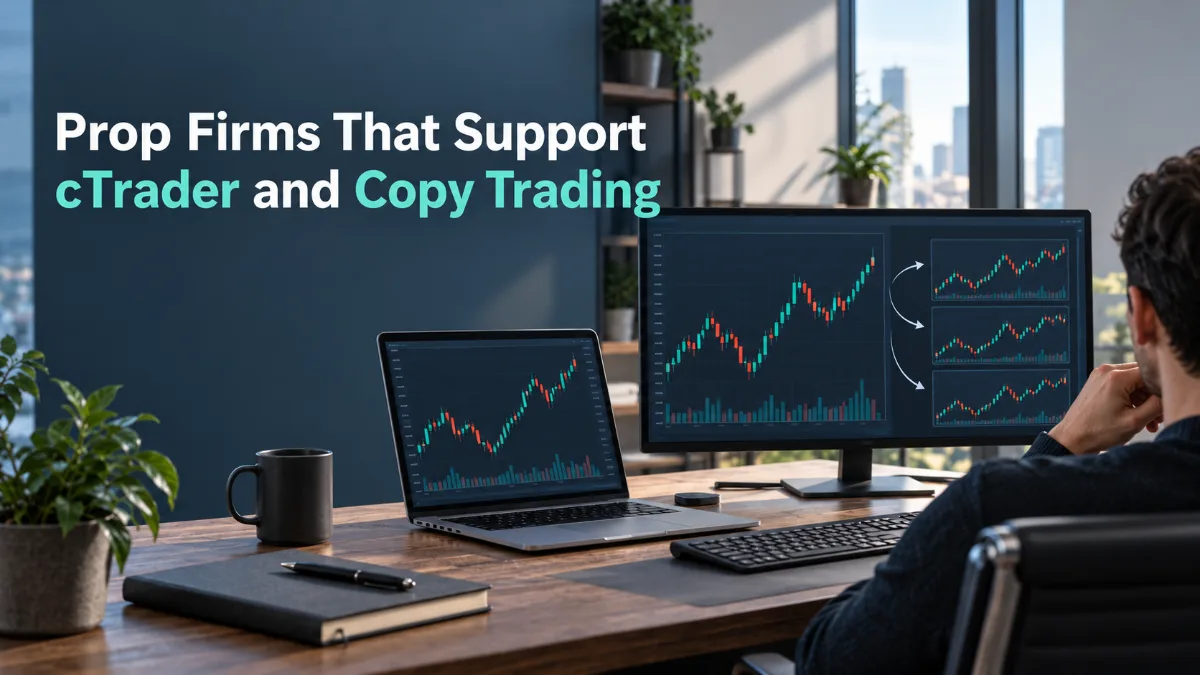
Prop firms that support cTrader and copy trading do exist, but the two permissions must be checked separately. A firm can offer cTrader while banning trade copiers, or it can allow copy trading only between accounts owned by the same person. The most important distinction is that copying your own strategy across your own accounts is not the same as subscribing to another trader through cTrader Copy. Most prop firms that permit copying are referring to self-owned account mirroring, not third-party social trading.
For a trader who wants a cTrader prop firm, the practical question is therefore not simply whether cTrader appears at checkout. You need to know which account types support cTrader, whether automated copying is permitted, whether an external account can act as the master, whether the rule changes after funding and whether regional restrictions apply. Current policies show several usable combinations, but no single copy-trading rule applies across the industry.
Prop firms that support cTrader and copy trading
The following comparison focuses on firms whose current official materials show both cTrader availability and some form of copy trading permission. It is a policy snapshot rather than a permanent guarantee because prop firms can change platforms, account models and copying rules without keeping older accounts on the same terms.
| Prop firm | cTrader support | Copy trading position | Important limitation |
|---|---|---|---|
| FundingPips | Yes | Own-account copying is permitted and an internal Trade Copier supports cTrader | A FundingPips account must be the lead account in its internal copier and external accounts can be followers |
| The Trading Pit | Yes for eligible CFD products | Manual or automated copying between your own accounts is permitted | Third-party signals are prohibited and account-stage allocation rules still apply |
| BrightFunded | Yes outside restricted regions | Copying is allowed between accounts owned by the same person | Cross-account hedging remains prohibited even when the accounts are yours |
| Instant Funding | Yes outside the US | Same-owner copying from personal broker or prop accounts is permitted | Collusion and unrelated account copying are prohibited |
| The5ers | Yes for non-US CFD clients | Copying your own trades is permitted on supported programs | Program-specific capital and account limits can restrict when copying is allowed |
| FundedNext | Yes for eligible non-US accounts | Copying between your own Challenge Accounts is allowed under stated limits | Automated or algorithmic trading is not allowed on cTrader so automated copier workflows are a poor fit |
This table should be read as a compatibility screen rather than a ranking. A trader who needs an automated cTrader copier has a different requirement from a trader who only wants to place the same discretionary trade manually across two personal accounts.
What makes a cTrader prop firm copy friendly?
A useful cTrader prop firm copy-trading policy answers four separate questions. First, does the firm offer cTrader for the exact challenge or instant account you plan to buy? Second, may one of your accounts copy another account that you also own? Third, may software automate that replication? Fourth, does the same permission continue after you move from evaluation to an earning or funded-style account?
These distinctions matter because the phrase prop firm copy trading is used for several different workflows. One trader may run a master cTrader account and mirror it to three challenge accounts. Another may copy a personal brokerage account into a prop account. A third may subscribe to a public strategy provider. Those activities can look technically similar because trades are replicated automatically, yet a firm's rules may treat them very differently.
- Self-copying: You make the trading decision and replicate it across accounts that you own.
- External master copying: Your personal broker or another prop account is the master and your prop account follows it.
- Third-party signal copying: Another trader makes the decision and your account mirrors it.
- Social copy trading: You subscribe to a strategy provider through a platform feature such as cTrader Copy.
Among prop firms that allow copy trading, the first category is the most commonly accepted. The third and fourth categories are often prohibited because they can make the account reflect another person's trading decisions instead of the account holder's own strategy.
cTrader Copy is not the same as a prop trade copier
cTrader includes an integrated service called cTrader Copy. In that system, a strategy provider trades a strategy account and investors allocate funds to copy the provider's trades automatically. Position size is adjusted according to the relationship between the provider's equity and the investor's equity. The follower is therefore copying the provider's decisions rather than merely distributing the follower's own trade across personal accounts.
That is fundamentally different from the copier workflow most prop firms mean when they say copy trading is allowed. A prop trader usually wants one personally controlled account to act as the master while other personally controlled accounts act as followers. The firm is evaluating one trader's strategy across several accounts rather than allowing one customer to depend on an unrelated strategy provider.
This distinction prevents one of the most common rule errors. A prop firm can support cTrader without permitting cTrader Copy subscriptions on the prop account. Platform functionality never overrides the firm's contract. If a cTrader feature is technically visible but the firm's rules prohibit third-party signals, using that feature to follow another trader can still breach the account.
How the main cTrader prop firm options differ
FundingPips has direct cTrader copier support
FundingPips currently offers MT5, cTrader and Match-Trader and also provides its own Copy Trader feature. Its copier can connect cTrader accounts as lead or follower accounts and can scale copied position size based on balance or equity. The firm's current trading conduct rules permit copying between personal FundingPips accounts owned by the same individual.
The direction of the copying relationship matters. Within the firm's built-in copier, a FundingPips account can be the lead and another FundingPips account or an external account can follow it. An external broker or prop account cannot be used as the lead through that internal workflow. FundingPips also prohibits inbound copying from an external source into a FundingPips account under its general copy-trading policy. That makes it a strong fit for traders who want a FundingPips cTrader account to be the strategy source, but not for traders who insist on using an outside master account.
The Trading Pit permits own-account replication
The Trading Pit offers cTrader for eligible CFD programs and permits copy trading between accounts owned by the same user. Its CFD rules allow trades to be copied manually or automatically across personal Challenge accounts and also allow copying from an external master account when that external account belongs to the same trader.
The important boundary is ownership. Copying another person's account or a signal source that the trader does not own is prohibited. Traders also need to watch the transition from Challenge accounts to Earning Accounts because allocation limits still apply even when the copying itself is permitted. For someone looking for prop firms that support cTrader and copy trading with an external self-owned master, this policy structure is comparatively flexible.
BrightFunded allows same-owner copy trading
BrightFunded currently offers cTrader alongside MT5 and DXTrade, with cTrader unavailable in some restricted locations including the United States. Its copy-trading policy permits replication between accounts owned by the same individual, including the trader's own evaluation-firm or retail brokerage accounts.
The additional risk rule is important: same-owner copying does not create an exception to the firm's cross-account hedging restriction. A copier configuration that leaves one account long and another account short on the same instrument can still breach the rules. Traders using proportional sizing or multiple master sources should therefore check that the copier cannot accidentally create opposite exposure across accounts.
Instant Funding accepts same-owner external copying
Instant Funding offers cTrader to global clients outside the United States and permits copying from personal accounts held with other prop firms, retail brokers or external sources when the accounts belong to the same individual. Its policy focuses on ownership rather than requiring every copied trade to originate inside the firm.
That can suit traders who already maintain a primary cTrader or brokerage account and want the prop account to follow the same strategy. The restriction is that unrelated copying, collusion and coordinated reverse trading are not allowed. Each account also remains responsible for its own drawdown and program rules regardless of where the original trade was placed.
The5ers uses program-specific copy rules
The5ers offers cTrader to non-US CFD clients and permits copy trading between a trader's own accounts on supported programs. The exact ceiling depends on the program. For example, some account families impose managed-capital thresholds after which copying across accounts is no longer allowed.
This makes The5ers a case where a simple yes or no answer is incomplete. The cTrader platform may be available and self-copying may be permitted, but the trader still needs to verify the specific program, account size and total managed allocation. A copier setup that is valid at a smaller allocation can become non-compliant after adding more accounts.
FundedNext needs a manual cTrader workflow
FundedNext offers cTrader on eligible accounts for non-US traders, with cTrader purchases currently limited to smaller account sizes than its largest available balances. It also allows copying between a trader's own FundedNext Challenge Accounts subject to its combined-capital rules.
The complication is automation. FundedNext currently states that automated and algorithmic trading is not allowed on cTrader. That means a trader should not interpret its general copy-trading permission as approval for an automated cTrader copier. For a manual trader who can replicate entries personally, the combination may work. For someone whose requirement is an always-on automated copier, another firm is a cleaner match.
How to verify prop firms that allow copy trading
Do not purchase an evaluation based only on a comparison table. The safest process is to verify the exact workflow you intend to use before the first trade. A firm can change one rule while leaving another help page unchanged, and some rules differ between evaluation, funded-style and instant programs.
- Confirm cTrader at checkout. Make sure cTrader is available for your country, program and account size. Platform support can vary by region.
- Identify the master account. Decide whether the master will be another account at the same firm, an account at a different prop firm or a personal brokerage account.
- Confirm ownership requirements. Check whether every master and follower must be registered in exactly the same legal name.
- Check automation permission. A firm may allow manual copying while prohibiting EAs, cBots, API automation or cloud copiers.
- Check both stages. Confirm that the rule applies during evaluation and after you receive the funded-style or earning account.
- Review exposure rules. Copied trades must still comply with daily loss, maximum drawdown, news, consistency, hedging and maximum allocation rules.
- Save written confirmation when needed. If the rule is ambiguous, ask support about your exact software and account direction before connecting the copier.
Why copied cTrader accounts can produce different results
Even when a copier works correctly, the follower account may not finish with the same profit or loss as the master. The first cause is execution timing. A copier receives the master trade and then sends an order to the follower. During a fast market, the follower may fill a few points away from the master. That difference is small on one trade but can become material for scalping strategies or accounts operating close to a drawdown boundary.
The second cause is account specification. Two cTrader accounts can have different balances, leverage, commissions, swaps or symbol settings. A copier that scales by balance may therefore generate a different risk percentage from one that scales by equity. If the follower has less free margin, the full copied position may also fail to open.
The third cause is rule asymmetry. A personal brokerage master may have no daily loss rule while a prop follower does. The master can survive a temporary floating loss that causes the prop account to breach. News restrictions, weekend rules and maximum position limits can create the same problem. For that reason, the most conservative design is to treat the strictest follower account as the risk constraint for the whole copying group. The master strategy should be sized so every follower remains compliant even after modest slippage or spread expansion.
Copy trading risks that platform support does not solve
Trade copying reduces repetitive order entry but it does not remove trading risk. A copied order can execute at a different price, use a different contract specification or produce a different margin requirement on the follower account. Small differences become especially important when several accounts are close to a daily loss or maximum drawdown limit.
Position sizing also needs to be designed for each follower account rather than assumed to be identical. Copying one lot from a $100,000 master into a much smaller account can create disproportionate exposure. Balance-ratio or equity-ratio sizing can help, but the result still depends on leverage, symbol specifications and the firm's rule engine.
For traders who also use personal retail forex accounts, leverage can amplify losses as well as gains. The Commodity Futures Trading Commission warns that leveraged retail forex can produce rapid losses and that customers should understand the trading arrangement and counterparty before committing funds. A prop evaluation is often simulated rather than a retail brokerage deposit, but the underlying risk-management lesson still applies: automation does not make oversized exposure safer.
Which setup fits your copy-trading workflow?
If your priority is an integrated cTrader copier, FundingPips is notable because its own Trade Copier explicitly supports cTrader. If you want your own external account to act as the master, The Trading Pit and Instant Funding publish rules that accommodate same-owner external copying. BrightFunded also allows same-owner copying, but its hedging rules require careful copier configuration. The5ers can fit traders who stay inside the relevant program and capital limits. FundedNext is better treated as a manual cTrader option because its cTrader automation restrictions conflict with the typical automated copier workflow.
The decision should therefore be based on copy direction, automation method, account stage and ownership, not on the platform logo alone. The clearest answer to the long-tail question "which prop firms allow copy trading?" is that several do, but almost always under the condition that the trading decisions and the accounts being mirrored belong to the same trader. For cTrader users, that ownership rule is only the first filter. The second is whether the firm allows the exact copier technology and account direction you plan to use.