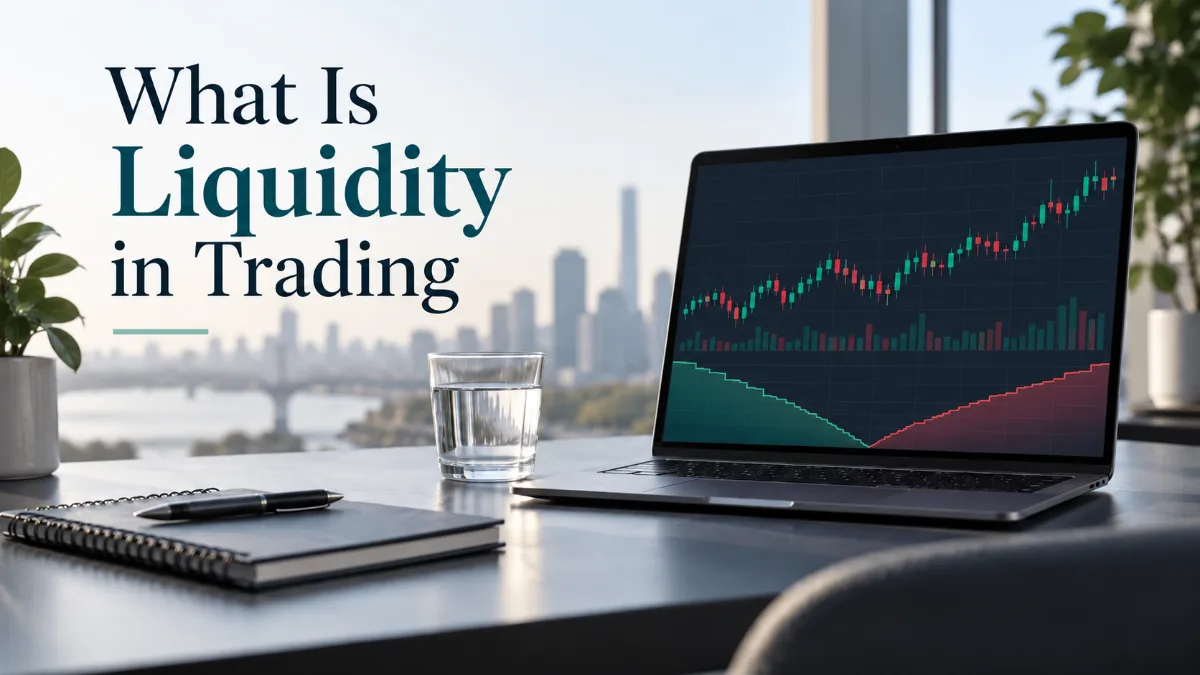
Liquidity in trading is the ability to buy or sell an asset quickly at a price close to the current market price without the trade itself causing a large price move. A highly liquid market usually has many active buyers and sellers, competitive bid and ask prices, enough available size near those prices and a relatively small price impact when orders are executed. A less liquid market has fewer willing counterparties or less available size, so trading can become slower, more expensive or more disruptive to price.
Liquidity matters because the price shown on a screen is not the same thing as the price at which a trader can necessarily complete an order. The Federal Reserve describes market liquidity in terms of the ease of buying and selling an asset and highlights bid-ask spreads and market depth as important measures. For traders, that translates into a practical question: how much can you trade before execution quality starts to deteriorate?
What Does Liquidity Mean in Trading?
When traders ask what does liquidity mean in trading, they are usually asking how easily an order can be matched with the other side of the market. A buyer needs a seller and a seller needs a buyer. Liquidity is strong when enough participants are willing to transact at nearby prices and in sufficient size.
Liquidity is not a single number. It has several dimensions. Tightness refers to how close the bid and ask prices are. Depth refers to how much quantity is available near the current price. Price impact measures how much the market moves when an order is executed. Resilience describes how quickly available quotes and depth recover after a large trade or temporary shock.
| Liquidity dimension | More liquid conditions | Less liquid conditions |
|---|---|---|
| Bid-ask spread | Narrow spread | Wide spread |
| Market depth | More size near the best prices | Less size near the best prices |
| Price impact | Larger orders move price less | Orders move price more |
| Execution consistency | Fills tend to stay closer to quoted prices | Slippage and partial fills become more likely |
| Resilience | Quotes replenish quickly after trades | Depth can remain thin after a shock |
These dimensions explain why a market can look active yet still offer poor execution for a particular order size. A small retail order may be easy to fill while a much larger institutional order moves through several price levels. Liquidity therefore has to be considered relative to the size of the intended trade.
How Liquidity Affects Trade Execution
The clearest effect of liquidity is on transaction cost. A trader who buys at the ask and later sells at the bid immediately gives up the spread. When liquidity is strong and competition between quotes is high, that spread is usually tighter. When liquidity weakens, the spread can widen because liquidity providers require more compensation for taking risk or because fewer participants are competing to trade.
Liquidity also affects slippage. A market order asks for immediate execution at the best available prices, not a guaranteed single price. If there is not enough quantity at the best quote, the remainder of the order can fill at progressively worse levels. This effect is more important for large orders and in thin markets.
Limit orders approach the problem differently. They specify the worst acceptable price, which controls price but not execution. In a liquid market a limit order near the current price may have a better chance of filling because trading activity is deeper. In a thin market the price may move away before the order is completed. Liquidity therefore shapes the trade-off between speed and price certainty.
Liquidity and Trading Volume: What Is the Difference?
Trading volume and liquidity are related but they are not identical. Volume measures how much trading occurred during a period. Liquidity measures how easily trading can occur without excessive cost or price impact. High volume often supports liquidity because active markets attract counterparties and liquidity providers, but volume alone does not reveal the spread, available depth or the effect of a large order.
A burst of heavy trading during a news event illustrates the distinction. Volume can rise sharply at the same time that quotes become less stable and spreads widen. Conversely, a market can have moderate volume but still provide orderly execution for small orders if there is enough depth around the current price. This is why traders should treat volume as one liquidity indicator rather than a complete definition of liquidity.
What Makes a Market Liquid?
Liquid markets usually combine broad participation with efficient ways to match orders. More buyers and sellers create more opportunities for opposite interests to meet. Competition among dealers or other liquidity providers can narrow spreads, while electronic matching can make prices and available size easier to access.
Market design also matters. Standardized instruments with widely understood contract terms are generally easier for participants to compare and trade than highly customized exposures. Active market-making can add two-sided quotes, but market makers manage inventory and risk rather than supplying unlimited liquidity at fixed prices. If their risk rises, they can quote smaller size or demand a wider spread.
Liquidity can also differ across venues for the same underlying exposure. A security may trade on multiple platforms, or an over-the-counter instrument may be quoted by different dealers. The displayed quote on one venue represents the liquidity available there, not necessarily the entire market. For that reason, execution quality depends on both the asset and the route through which the order reaches counterparties.
Factors Affecting Forex Market Liquidity
The foreign exchange market is often described as highly liquid because it has enormous global turnover. The Bank for International Settlements reports that global FX turnover averaged about $9.5 trillion per day in April 2025 across spot and derivative instruments. That headline size does not mean every currency pair has the same liquidity at every time of day.
Currency pair activity is one of the main factors affecting forex market liquidity. Pairs involving currencies used heavily in global trade and finance usually attract more dealers and end users. Less frequently traded currencies can have fewer competing quotes, wider spreads and less depth, especially for larger orders.
Time of day changes the number of active participants. FX trading follows business hours across Asia, Europe and the Americas. Liquidity is typically stronger when major financial centers are open and activity overlaps. Research published by the Bank for International Settlements has found that currency-market liquidity is typically highest around the London open and during the overlap between London and New York. This is a market pattern rather than a guarantee for every pair.
News and volatility can alter liquidity quickly. Economic releases, central-bank decisions, geopolitical developments or unexpected policy news may attract more trading while simultaneously increasing the risk of quoting firm prices. Liquidity providers may react by widening spreads or reducing quoted size. High trading activity can therefore coexist with weaker depth. It is also possible for liquidity to remain resilient during volatile periods, so volatility should not be treated as a mechanical signal that liquidity has disappeared.
Dealer risk capacity matters because much of FX trading is intermediated. Dealers and other liquidity providers absorb customer flow, manage inventory and hedge exposures. Their willingness to warehouse risk can influence the price and size they offer. During stressed conditions, the cost of taking additional exposure can rise and quotes can become less favorable.
Order size and execution method are equally important. A price that is realistic for a small order may not be available for a much larger one. Request-for-quote trading, streaming prices, order books and algorithmic execution can expose different slices of liquidity. In FX there is no single centralized order book containing every available bid and offer, so visible depth on one platform should not be mistaken for total market depth.
Why Major Forex Pairs Often Feel More Liquid
Major currency pairs tend to feel more liquid because a large and diverse set of participants continually needs to exchange or hedge those currencies. Banks, asset managers, corporations, trading firms, central banks and other institutions can all contribute flow. More independent sources of buying and selling generally improve the probability that orders can meet without requiring a large change in price.
The practical signs are usually narrower spreads and more stable execution for ordinary order sizes. By contrast, a less active or emerging-market currency can trade normally during its local business hours but become much thinner outside those hours. A trader comparing two pairs should therefore look beyond the label of "forex" and assess the liquidity of the specific pair at the intended trading time.
How to Measure Liquidity Before You Trade
No single metric captures liquidity perfectly, so a useful check combines several observable signals. The first is the bid-ask spread. A consistently narrow spread suggests strong competition near the current price. A sudden widening can indicate changing risk or fewer available counterparties.
The second is depth. In an order-book market, depth shows how much quantity is resting at or near the best prices. Traders should examine more than the top quote because a large order may consume several levels. In dealer or OTC markets, displayed depth can be incomplete, so actual executable size from the relevant venue or counterparty matters more than a generic market snapshot.
The third is price impact. If modest trades repeatedly push price away from the execution level, liquidity is weaker than a tight top-of-book spread might suggest. Historical slippage records can help a trader estimate this in the actual account and order type being used.
The fourth is activity at the intended trading time. Average daily volume can hide large intraday differences. Compare spreads, depth and fill quality during the specific session in which the strategy operates. For FX, this can be especially important around session transitions, major data releases and periods when the home markets of both currencies are relatively inactive.
Finally, measure liquidity relative to your order size. A market does not need to be illiquid in general to be illiquid for a particular trade. If the intended order is large compared with visible or historically executable size, consider splitting execution, using a limit price or applying an execution method designed to reduce market impact.
Why Liquidity Can Disappear During Market Stress
Liquidity is supplied by participants who are willing to take the other side of trades. During calm conditions, they can estimate risk with greater confidence and often compete aggressively on price. During a shock, uncertainty about the fair price and the cost of holding inventory can increase quickly. Participants may then reduce order size, cancel quotes or widen spreads.
This creates a feedback problem. A market can have many participants in normal conditions yet become thin precisely when many traders want to transact at once. Stop orders and market orders can then sweep through limited depth, producing gaps or unusually large slippage. The effect is not proof that the market has stopped functioning, but it shows why normal-condition liquidity statistics should not be assumed to hold during stress.
Resilience is therefore as important as ordinary depth. A resilient market can absorb a large trade or information shock and then rebuild two-sided liquidity. A fragile market may show acceptable spreads before the event but fail to replenish once quotes are consumed.
Liquidity and Volatility Are Different Risks
Liquidity and volatility can interact but they describe different things. Volatility is the size and speed of price changes. Liquidity is the ease and cost of trading at or near the current price. A market can be volatile and still liquid if many participants continue quoting meaningful size on both sides. It can also be relatively quiet but illiquid if few counterparties are willing to trade.
This distinction matters when choosing order size and order type. A volatile but deep market may move quickly while still filling ordinary orders efficiently. A thin market may move only slightly until one large order consumes available depth and causes a sudden jump. Traders should therefore monitor both price movement and execution conditions rather than using volatility as a substitute for liquidity.
High Liquidity Does Not Remove Trading Risk
Liquidity improves the mechanics of getting into and out of positions, but it does not make the underlying trade safer. A highly liquid asset can still move sharply because new information changes its value. Deep markets can transmit price changes very quickly because large numbers of participants react at the same time.
Liquidity also does not eliminate slippage. Fast price changes can occur between order submission and execution, and an online broker may offer a narrower or broader pool of liquidity than the broader market. Traders using leverage face an additional problem: a relatively small adverse price move can have a large effect on account equity even when execution itself is efficient.
For risk management, the correct conclusion is that liquidity reduces certain execution frictions. It does not remove market risk, leverage risk, counterparty risk or the possibility of losses.
Practical Rules for Trading Around Liquidity
- Check the spread before entering. Compare the current spread with what is normal for the same instrument and trading session.
- Match order type to the objective. Use a market order when immediate execution matters more than exact price. Use a limit order when price control matters more than certainty of execution.
- Scale position size to executable depth. A position that is easy to enter may be difficult to exit if it is large relative to normal liquidity.
- Expect conditions to change around scheduled events. Quotes can widen and depth can fall just before or after important economic releases.
- Evaluate real fills rather than advertised spreads alone. Execution quality includes spread, slippage, rejected orders, partial fills and the time needed to complete the order.
- Reassess liquidity when volatility changes. Historical averages are most useful when current market conditions resemble the period from which those averages were calculated.
What Liquidity Tells You Before You Place an Order
Liquidity tells you how much confidence you can place in the connection between the quoted market price and the price you are likely to receive. Strong liquidity generally means tighter spreads, deeper two-sided interest and lower price impact for a given order size. Weak liquidity means execution cost and uncertainty become a larger part of the trading decision.
The most useful way to think about liquidity is not as a permanent label attached to an asset. It is a condition that changes with the instrument, venue, order size, time of day, participant activity and market stress. Before trading, evaluate those conditions together. That gives a more realistic answer to what is liquidity in trading than volume alone and helps explain why the same strategy can execute smoothly in one market window and poorly in another.