


Pepperstone review 2026: Standard and Razor accounts across Pepperstone, MT4, MT5, cTrader and TradingView
Pepperstone is a Melbourne-based OTC/NDD forex and CFD broker founded in 2010. Licensed by ASIC, FCA, BaFin, and CySEC under multiple licenses, it trades on Pepperstone, MT4, MT5, cTrader, and TradingView with Standard and Razor accounts. It serves retail and professional clients across 93 forex pairs, share CFDs, indices, commodities, ETFs, and cryptocurrency CFDs.
What is Pepperstone?
Pepperstone is an Australian forex and CFD (Contract for Difference) broker founded in 2010, with its group headquarters in Melbourne. The business uses an OTC (over-the-counter) and NDD (no-dealing-desk) execution model across several regulated entities. Its structure separates client relationships by jurisdiction, so account protections and product access depend on the legal entity serving the trader. The group supports retail and professional clients rather than operating as a single-country brokerage.
The corporate structure includes Pepperstone Group Limited in Australia, Pepperstone Limited in the United Kingdom, and Pepperstone EU Limited in Cyprus. Other regulated entities cover Germany, Dubai, Kenya, The Bahamas, and Seychelles. This multi-entity model matters because leverage caps, compensation schemes, and negative balance rules can change with the applicable regulator.
Which regulators license Pepperstone?
The regulatory framework spans both major onshore authorities and additional regional regulators. The verified regulatory record includes ASIC (Australian Securities and Investments Commission), FCA (UK Financial Conduct Authority), and BaFin (German Federal Financial Supervisory Authority). It also records CySEC (Cyprus Securities and Exchange Commission). Additional oversight includes DFSA (Dubai Financial Services Authority) and CMA Kenya (Capital Markets Authority of Kenya). It also includes SCB (Securities Commission of The Bahamas) and FSA Seychelles (Financial Services Authority).
- Pepperstone Group Limited: ASIC, Australian Financial Services Licence AFSL 414530.
- Pepperstone Limited: FCA, 684312.
- Pepperstone GmbH: BaFin, 151148.
- Pepperstone EU Limited: CySEC, 388/20.
- Pepperstone Financial Services (DIFC) Limited: DFSA, F004356.
- Pepperstone Markets Kenya Limited: CMA Kenya, 128.
- Pepperstone Markets Limited: SCB, regulated in The Bahamas.
- Pepperstone International Markets Limited: FSA Seychelles, regulated in Seychelles.
Eligible UK clients can fall within the Financial Services Compensation Scheme, with coverage up to £85,000 under applicable conditions. Cyprus retail clients can fall within the Investor Compensation Fund, which covers eligible claims subject to its statutory limits. The broker also discloses UAE Capital Market Authority and Mauritius FSC relationships. Public-record checks on September 18, 2026 did not independently verify those two claims. That status should not be read as confirmation of an active licence.
ASIC also included Pepperstone Group Limited among seven CFD issuers involved in a 2023 leverage-limit remediation process. The issuers self-reported breaches and proposed remediation programs (source: ASIC, November 9, 2023). This finding concerns past compliance with retail CFD leverage limits, not a licence revocation or suspension.
Trading platforms
Trading platform coverage includes MetaTrader 4, MetaTrader 5, cTrader, TradingView, and the Pepperstone platform. MT4 and MT5 (MetaTrader 4 and MetaTrader 5) support Expert Advisors, which are automated trading scripts. cTrader provides another execution and charting environment, while TradingView adds browser-based charting and account connectivity. The proprietary Pepperstone interface covers web and mobile access.
Platform choice affects workflow more than regulation. Automated traders can use MetaTrader tools, while chart-focused users can use cTrader or TradingView. The group also supports application programming interface (API) access for eligible advanced users. This can matter for systematic or high-volume strategies.
Account types
The account structure centers on Standard and Razor accounts, with Professional, Swap-Free, and Demo variants also listed. Standard pricing places more trading cost inside the quoted spread. Razor pricing separates the raw market spread from a commission on eligible forex trades. The broker does not list cent or micro accounts.
Professional classification changes more than leverage. Professional clients can access leverage up to 1:500 in applicable regions, but guaranteed negative balance protection does not apply to them. Retail clients retain stronger regulatory protections under the relevant entity rules.
Minimum deposit
The main account minimum used in this review is $10. Funding thresholds can still vary by payment method and jurisdiction. A $10 entry amount does not reduce the capital required to absorb normal market movement. Position size and leverage determine effective risk after funding.
Deposit size also has no direct effect on spread tier. Standard and Razor accounts differ by pricing structure rather than a high mandatory starting balance. Traders comparing funding routes should therefore separate account minimums from payment-method minimums.
Deposit and withdrawal methods
Funding methods include bank transfer, debit and credit cards, Apple Pay, Google Pay, PayPal, Neteller, Skrill, BPAY, PayID, and crypto where available. Payment availability changes by country and regulated entity. Third-party payment restrictions can also require the funding source to match the account holder.
Withdrawal speed depends on the rail used. E-wallet and card routes can process faster than bank transfers, while international bank withdrawals can carry extra charges. Bank transfers are the slower withdrawal route. That difference matters for users who prioritize rapid access to settled funds.
Tradeable instruments
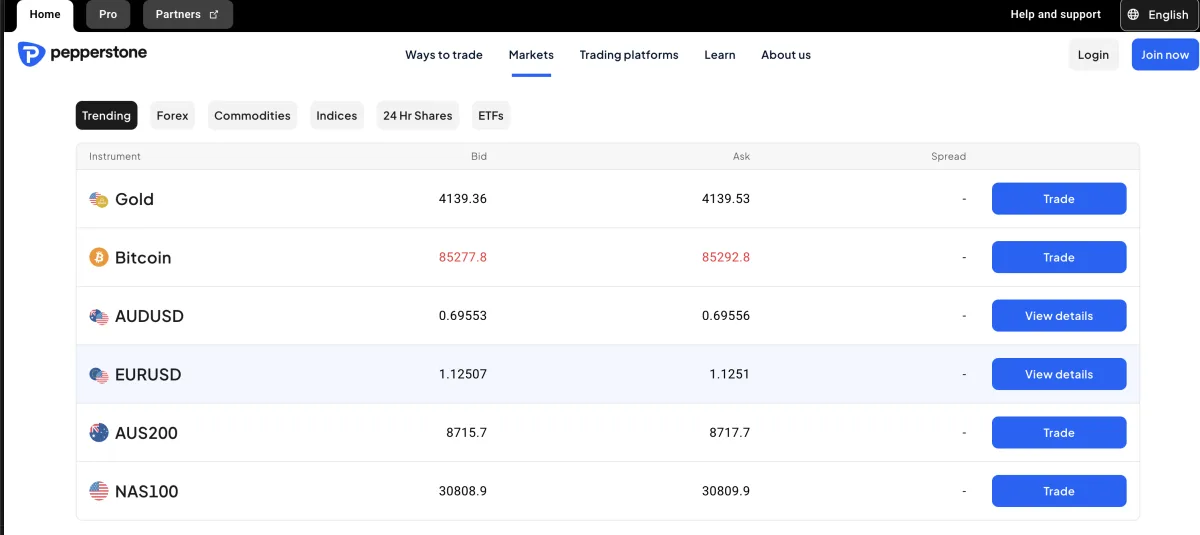
The product list covers 93 forex pairs plus share CFDs, indices, commodities, ETFs (exchange-traded funds), and cryptocurrency CFDs. A CFD tracks price movement without transferring ownership of the underlying asset. The product range lists more than 1,350 markets across these categories. Instrument counts can vary by region and platform.
Forex breadth includes major, minor, and exotic currency pairs. Share and ETF CFDs broaden the account beyond currencies, while commodities and indices support macro trading. Crypto exposure is also offered through derivatives where the serving entity permits it.
Spread and commission structure
A spread is the gap between the bid and ask price, measured in pips for most forex pairs. Razor pricing starts from 0.0 pip on eligible forex markets, with commission charged separately. Standard accounts use spread-inclusive pricing and generally avoid a separate forex commission. Share CFDs can carry their own commission schedule.
Razor commission makes transaction cost easier to separate into spread plus fee. Standard pricing bundles more of that cost into the quoted spread. Overnight positions can also incur swap charges, meaning financing adjustments for holding leveraged positions past the broker's daily rollover time.
Leverage and margin requirements
Leverage lets a trader control a larger position with a smaller amount of margin, which is the capital set aside for the trade. Retail leverage is capped at 1:30 in major regulated regions covered by this review. Eligible professional accounts can reach 1:500. Higher leverage increases both position sensitivity and potential loss speed.
Retail accounts receive negative balance protection under the broker's main regulated retail framework. Platform stop-out systems can close positions when equity falls below required levels, but execution still depends on market liquidity. Professional status removes some retail safeguards in exchange for wider leverage limits.
Customer support
Customer support operates through the broker's official support channels, including email, phone, and online assistance. The broker lists support@pepperstone.com and the Australian phone number +61 3 9020 0155. Entity-specific contact details can differ because local subsidiaries maintain their own regulatory and service channels.
Support is most relevant when an issue involves verification, withdrawals, platform access, or account classification. Regulatory questions should identify the exact legal entity on the account. That entity determines which regulator, complaint route, and protection framework applies.
Mobile app and trading experience
Mobile access is available through the Pepperstone app and supported third-party platforms. Users can also access MT4, MT5, cTrader, and TradingView through mobile-compatible interfaces. This gives the account multiple execution paths rather than a single proprietary terminal. Platform features still differ, especially for automation and advanced order handling.
The table below summarizes the main account and regulatory details used in this review. It separates platform, funding, leverage, and registration details into one reference view. Regional conditions can vary according to the legal entity serving the account.
| Feature | Pepperstone Information |
|---|---|
| Founded | 2010 |
| Headquarters | Melbourne, Australia |
| Disclosed regulators | ASIC 414530; FCA 684312; BaFin 151148; CySEC 388/20; DFSA F004356; CMA Kenya 128; SCB; FSA Seychelles |
| Registration verified | ASIC, FCA, BaFin, CySEC, DFSA, CMA Kenya, SCB and FSA Seychelles recorded as regulated; UAE CMA and Mauritius FSC unverified |
| Trading platforms | Pepperstone, MT4, MT5, cTrader, TradingView |
| Minimum deposit | $10 |
| Maximum leverage | 1:30 retail / 1:500 professional |
| Account types | Standard, Razor, Swap-Free, Professional, Demo |
| Islamic account | Swap-Free account available |
| Customer support | Email, phone, online support |
| Deposit methods | Bank transfer, cards, Apple Pay, Google Pay, PayPal, Neteller, Skrill, BPAY, PayID, crypto |
Who is Pepperstone best for?
Pepperstone's feature set is oriented toward traders comparing multiple platform ecosystems under a multi-jurisdiction regulatory structure. Its main strengths are platform breadth, 93 forex pairs, Razor spreads from 0.0 pip, and several regulated legal entities. Retail users also receive stronger protection than professional clients in areas such as negative balance rules.
The trade-offs are equally specific. The account lineup has no cent or micro option, and professional status removes guaranteed negative balance protection. ASIC's 2023 remediation record also belongs in the compliance history. The UAE CMA and Mauritius FSC claims should remain treated as unverified until their public-register status is independently confirmed.
Forex and derivative products carry high leverage; some or all invested capital may be lost. This content is for information only, not investment advice. Verify the broker's current regulation status with the relevant authority's official site before any investment decision.
