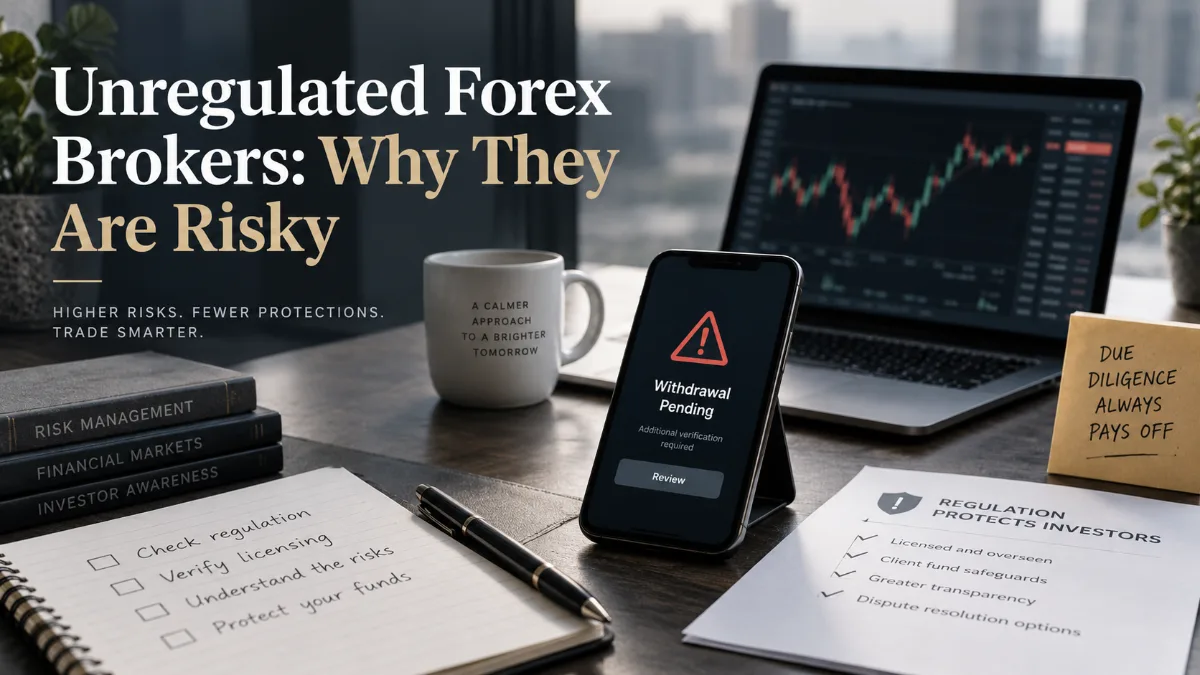
An unregulated forex broker is a firm that offers foreign exchange trading without the authorization or registration required for the activity and customer location involved. The practical risk is not simply that the broker lacks a badge on its website. It is that the customer may have no effective regulator supervising the firm, no local complaints route, weaker safeguards around client money, and fewer realistic options if the broker blocks withdrawals or disappears.
There is also an important distinction between a broker that is completely unlicensed and a broker that holds a license somewhere else but is not authorized to serve you. A foreign license may be genuine, yet it may not give a customer in another country the protections available under local law. Before depositing, the relevant question is therefore not only "Is this broker regulated?" but "Which legal entity will hold my account, which regulator supervises that entity, and is it permitted to serve customers where I live?"
What is an unregulated forex broker?
A forex broker is unregulated for a particular customer when the entity providing the trading service is not subject to the regulatory authorization that should apply to that relationship. Depending on the jurisdiction and product, oversight can include licensing, capital requirements, conduct rules, client money requirements, risk disclosures, reporting duties, complaints procedures, and restrictions on how leveraged products are sold.
Being unregulated does not by itself prove that a broker is fraudulent, but it removes or weakens safeguards that make misconduct easier to challenge. The term can cover several different situations. A company may have no financial services license at all. It may claim a license that belongs to another entity. It may be incorporated in one country but lack permission to provide forex or CFD services. It may also belong to a larger group with a regulated affiliate while directing your account agreement to a different offshore company. A polished website does not resolve any of those questions. The same applies to trading apps: a familiar interface or popular platform shows that software is being used, not that the company operating the account is licensed.
Regulators focus on the legal entity because that is the party that owes you contractual obligations. A brand name may appear across several companies, but your protections depend on the entity named in the client agreement and on the permissions attached to that entity.
Why an unregulated broker is risky
The central problem is accountability. Regulation does not prevent every failure or every dishonest act, but it creates enforceable obligations and a supervisory framework. Without that framework, a broker can be much harder to challenge when its conduct changes after you have deposited money.
| Issue | Regulated relationship | Unregulated relationship |
|---|---|---|
| Authorization | Entity and permissions can be checked on an official register | No applicable authorization may exist or the claimed license may not cover your account |
| Client money | Rules may govern how customer funds are held and reconciled | Comparable safeguards may be absent or difficult to verify |
| Complaints | A regulator or approved dispute process may be available | You may depend mainly on the broker's own response |
| Business conduct | Marketing and sales practices are subject to enforceable rules | Oversight may be weak or nonexistent |
| Failure or misconduct | Local legal remedies and compensation arrangements may apply in some jurisdictions | Recovery can depend on cross-border litigation or tracing assets |
These differences matter most when something goes wrong. A broker that processes deposits smoothly but resists withdrawals can leave the customer with a practical enforcement problem. A trading balance shown on a platform is not the same thing as money that can be returned to your bank account.
What happens if a broker is unregulated?
If a broker is unregulated, the first consequence is that normal regulatory protections may not apply. What that means in practice depends on your country. In the United Kingdom, the Financial Conduct Authority explains that customers dealing with an unauthorized firm generally do not have access to the Financial Ombudsman Service and are not protected by the Financial Services Compensation Scheme if the firm fails. Other jurisdictions have different systems, so the exact protection must be checked locally.
The second consequence is weaker leverage in a dispute. A licensed firm can face supervisory action, restrictions, fines, license consequences, or formal complaint obligations. With an unregulated broker, there may be no domestic regulator able to compel records, inspect conduct, or require the firm to address a complaint. You may still have contractual or legal rights, but enforcing them can be expensive and difficult if the company and its assets are abroad.
The third consequence is uncertainty over the trading environment itself. Retail over-the-counter forex is often traded through a dealer rather than on a centralized exchange. The Commodity Futures Trading Commission warns that customers connect to the dealer's platform and that unregistered offshore dealers have been the subject of complaints involving manipulated trade data and refused withdrawals. That does not mean every unregulated broker manipulates prices. It means customers have fewer independent controls when the dealer is both the counterparty and the operator of the trading interface.
Finally, an unregulated status can affect what happens after insolvency. If the firm fails, closes its website, or transfers customer funds elsewhere, you may have to pursue a foreign company through local insolvency or civil procedures. The smaller the deposit, the more likely recovery costs can exceed the amount at stake.
How unregulated broker withdrawal problems develop
An unregulated broker withdrawal problem often appears only after the customer tries to move money out. Deposits may be instant and account managers may be highly responsive while the customer is adding funds. The relationship can change when a withdrawal request is submitted.
Common patterns include repeated requests for new identity documents, unexplained compliance reviews, pressure to cancel the withdrawal and keep trading, sudden bonus conditions, invented taxes, or demands for another deposit before funds can be released. Some verification requests are legitimate because financial firms have anti-money laundering and identity obligations. The warning sign is not the existence of verification itself. It is a process that keeps changing, has no clear contractual basis, or requires additional payment merely to release your own money.
The CFTC has specifically reported complaints in which customers deposited with unregistered retail forex dealers and later could not withdraw principal or earnings. It also warns that fraudulent dealers may demand undisclosed commissions, made-up taxes, or more investment before approving a withdrawal. A demand for a new payment described as tax should be verified independently against your local tax rules before you send anything, especially when the charge did not appear in the account terms.
If a broker says your withdrawal cannot proceed until you reach a higher account level, complete more trading volume, or pay a "liquidity fee" that was never disclosed in the account terms, stop sending additional money until the demand is independently verified. Continuing to deposit can increase the amount exposed without improving your ability to recover the original balance.
Regulated does not mean risk free
Choosing a regulated broker reduces certain legal and operational risks, but it does not remove trading risk. Leveraged forex and CFDs can produce rapid losses even when the broker is legitimate and properly supervised. Regulation also does not guarantee that a firm will never fail or that every dispute will be decided in the customer's favor.
This distinction matters because scammers sometimes exploit it in both directions. One scammer may say regulation is unnecessary because "forex is global." Another may display a real license number and imply that every company using the same brand is covered. Neither claim should be accepted without checking the legal entity and permissions on the regulator's own register.
For example, Australia's Moneysmart guidance tells consumers to check that a forex provider holds an Australian Financial Services licence and notes that Australian consumer protections may not apply when using an overseas provider without that license. The broader lesson is jurisdictional: a license is useful only when it actually covers the entity, service, and customer relationship in question.
How to verify a forex broker before depositing
Verification should be done independently rather than through links sent by a salesperson. A convincing website can copy a regulator logo, license number, address, executive biography, or even the full identity of a real company.
- Identify the contracting entity. Read the account agreement and legal footer. Record the exact company name, registration number, address, and stated regulator.
- Find the regulator yourself. Use the official government or regulator website. Do not rely on a certificate image or a link supplied in a chat message.
- Search the official register. Confirm the legal name and license number. Check whether the status is active and whether the permissions cover retail forex or CFDs.
- Match contact details. Compare the website domain, phone number, email domain, and address against the regulator's record where those details are available. A mismatch can indicate a clone firm.
- Check the entity in your agreement. A regulated parent or sister company does not automatically protect an account opened with a separate offshore entity.
- Review withdrawal terms before funding. Look for fees, identification requirements, processing conditions, bonus restrictions, and any clause giving the broker unusual discretion over withdrawals.
- Test with a small withdrawal early. A successful small withdrawal is not proof of safety, but an unexplained refusal is valuable information before more capital is exposed.
Do not treat incorporation as financial regulation. A company registration proves that a legal entity was formed under a corporate registry. It does not necessarily mean the company has permission to provide investment or leveraged trading services.
Red flags that matter more than marketing claims
Unregulated brokers often compete on features that feel attractive precisely because regulated firms may face restrictions. Very high leverage, deposit bonuses, aggressive account managers, guaranteed returns, and frictionless crypto deposits can all be presented as advantages. They should instead trigger closer scrutiny of the legal entity and withdrawal process.
- Guaranteed or near-guaranteed profits: forex prices are uncertain and no broker can honestly guarantee trading returns.
- Pressure to deposit immediately: urgency prevents customers from checking licenses and contracts.
- Remote access requests: a broker or "analyst" should not need control of your computer or banking app to help you trade.
- Only private messaging support: disappearing chat accounts make complaints and evidence preservation harder.
- Crypto-only funding: digital asset payments can be legitimate in some contexts but may make reversal and tracing more difficult.
- License details that do not match: a real license number paired with a different domain or company name can signal impersonation.
- Withdrawal fees invented after the request: undisclosed release fees are especially concerning when they must be paid by a new transfer.
No single red flag proves fraud. The risk rises when several appear together, especially when the broker cannot be verified on the relevant official register.
What to do if your broker is already unregulated
If you have already deposited with an unregulated broker, focus first on preserving evidence and limiting further exposure. Do not send more money merely because the broker says an additional payment will unlock a withdrawal.
- Request the withdrawal in writing. Keep the request clear and save the date, amount, and broker response.
- Preserve records. Download account statements, transaction history, contracts, emails, chat logs, wallet addresses, payment receipts, and screenshots of the broker's website and legal pages.
- Contact your payment provider promptly. Ask what dispute, recall, chargeback, or fraud procedures may be available for the payment method used. Availability depends on the transaction type, timing, and local rules.
- Report the firm to the relevant regulator or financial authority. Even if the regulator cannot recover your money directly, reports can support warnings and enforcement work.
- Consider police or cybercrime reporting if deception is involved. This is especially important when identity theft, forged documents, unauthorized transactions, or impersonation may have occurred.
- Be cautious with recovery services. Victims of trading scams are often targeted again by people claiming they can recover funds for an upfront fee. Verify any lawyer or recovery professional independently before paying.
If the broker is merely offshore rather than fraudulent, the dispute may still be contractual rather than criminal. Evidence remains important because you may need to show which entity accepted the funds, what the withdrawal terms said, and how the broker responded.
Can an offshore broker still be regulated?
Yes. Offshore and unregulated are not synonyms. A broker can be based outside your country and still hold a valid financial services license in its home jurisdiction. The harder question is whether that license is meaningful for you.
Ask three separate questions. First, is the license real? Second, does it authorize the specific entity that will hold your account? Third, does that entity have permission to serve customers in your country? A "yes" to only the first question is not enough.
Protections also differ between regulators. Rules for leverage, client money, complaints, compensation arrangements, financial reporting, and marketing can vary substantially. Comparing brokers only by whether a license exists can therefore miss the practical differences that matter during a dispute.
How to choose a safer alternative
A safer broker selection process starts with regulatory fit rather than leverage or bonuses. Identify the regulator responsible for retail forex or CFDs where you live, then verify candidates on that regulator's official register. Prefer the exact regulated entity that will sign your client agreement rather than relying on a group's overall reputation.
Next, examine withdrawal mechanics before deposit size. A broker should explain how withdrawals are requested, what identification is required, which payment routes are supported, and what legitimate fees may apply. Terms that allow broad discretion to delay payments or impose unclear bonus turnover conditions deserve careful review.
Finally, separate broker safety from trading strategy. A regulated broker can still offer a product that is too risky for your experience, finances, or loss tolerance. The decision has two filters: whether the intermediary is properly supervised and whether leveraged forex is appropriate for you at all.
The decision rule
If you cannot independently verify the broker's legal entity and relevant authorization before depositing, treat that uncertainty as a reason not to fund the account. If the broker is already holding your money and a withdrawal is being delayed, stop escalating deposits, document every interaction, and use official payment dispute and reporting channels available in your jurisdiction.
The key question is not whether an unregulated forex broker offers better spreads, higher leverage, or a more persuasive account manager. It is whether you can enforce your rights when the broker has your money. Regulation cannot eliminate market losses or misconduct, but a valid and relevant license gives you a framework for supervision, complaints, and accountability that an unregulated relationship may not provide.