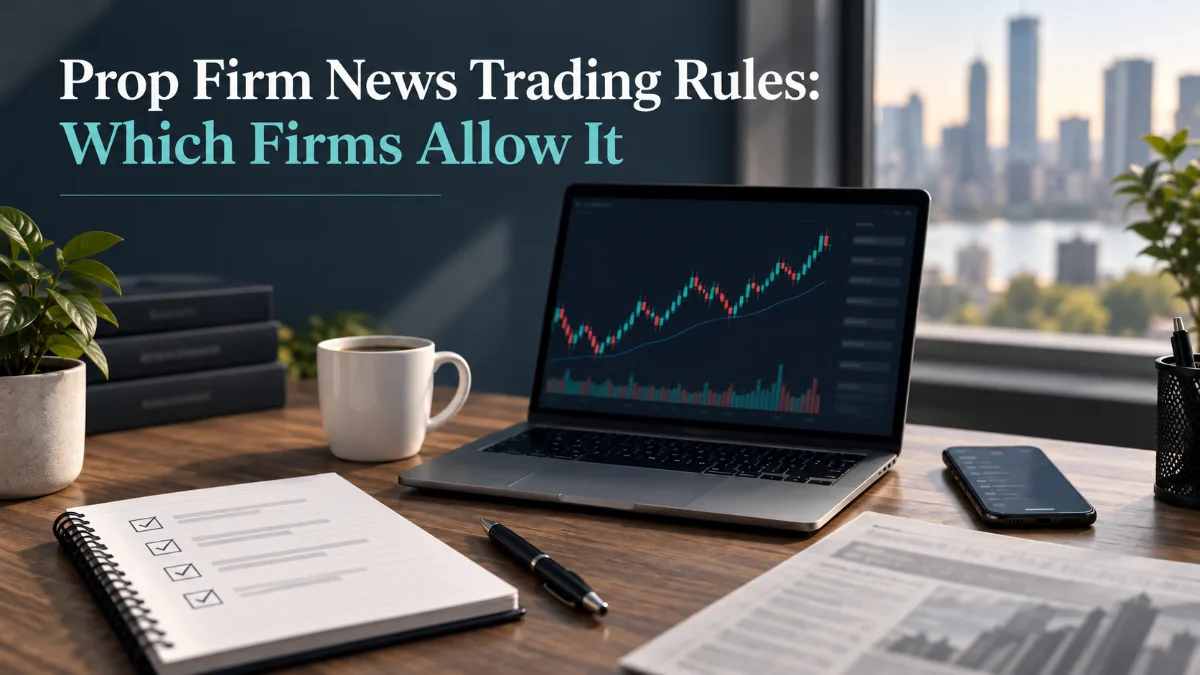
Prop firm news trading is not governed by one industry-wide rule. A firm may allow you to hold a position through an economic release while banning new entries near the release time. Another may permit the trade but reduce the profit that counts toward a payout. A third may allow normal trading during news but prohibit a strategy built specifically to capture a one-off volatility spike.
That distinction matters more than a simple yes or no label. Traders who use CPI, employment data, central-bank decisions or other scheduled releases need to check the exact account type, stage and execution window. Evaluation rules can also differ from funded-account rules. The safest interpretation is that the current program terms for your exact account control, not a general statement that a firm is "news friendly."
What does a prop firm news trading rule control?
A prop firm news trading rule determines what you may do around scheduled market-moving announcements. The restriction can apply to opening a trade, closing a trade, holding an existing position, triggering a pending order or earning profit from a trade executed inside a specified window.
The phrase news trading can therefore describe several different behaviors. A trader may enter seconds before a release in anticipation of a price jump. Another may already be in a swing trade and simply remain exposed through the announcement. A third may place buy-stop and sell-stop orders on both sides of price and wait for volatility to trigger one or both. Firms often treat those behaviors differently.
High-impact events commonly include labor-market reports, inflation releases, gross domestic product data and central-bank decisions. For US events, traders can verify scheduled labor and inflation releases through the U.S. Bureau of Labor Statistics, policy meeting dates through the Federal Reserve and GDP or personal-income releases through the U.S. Bureau of Economic Analysis. A prop firm may still use its own calendar and impact classification for compliance purposes.
Which prop firms allow news trading?
Several established firms currently allow some form of news trading, but the permission is often program-specific. Futures programs tend to be more permissive in the examples below, while some CFD programs impose short restricted windows or profit adjustments on funded accounts.
| Firm or program | News trading position | Important limitation |
|---|---|---|
| FTMO Futures | Allowed during all phases | Trading still must comply with forbidden-practice and risk-management standards |
| FTMO CFDs | Allowed in evaluation and on Swing accounts | Standard funded accounts restrict execution around selected releases |
| The5ers Futures | Allowed | Other account and risk rules still apply |
| The5ers Hyper-Growth and Bootcamp | Allowed | Bracket strategies around news are prohibited |
| The5ers High Stakes | Holding is allowed | New order execution is restricted around high-impact releases |
| FundedNext | Allowed in challenge phases | Some funded models reduce counted profit around listed high-impact events |
| Topstep | Positions do not have to be flattened for economic releases | Slippage losses remain the trader's responsibility |
| Apex Trader Funding | Normal trading may continue during news | News-chasing and windfall-style strategies are prohibited |
| FundingPips | Conditional by model and stage | Master-stage deductions and specific prohibitions can apply |
This is a rule comparison rather than a ranking. Availability by country, platform, product and account model can change independently of the news rule.
Rules by firm and account type
FTMO
FTMO separates its futures and CFD policies. FTMO Futures allows news trading during any phase without a special release-time blackout. Its broader conduct rules still matter, including a warning against concentrating activity around scheduled events in a way that is inconsistent with the trader's normal approach.
For CFDs, the Evaluation Process permits trading through macroeconomic releases for both Standard and Swing account types. Once a trader reaches an FTMO Account, Swing accounts remain unrestricted for news. Standard accounts are different: on affected instruments, traders may not open or close positions from two minutes before until two minutes after selected releases. Pending-order execution, including a Stop Loss or Take Profit trigger, can count as a breach inside that window. Existing positions may be held if they were opened before the restricted period.
The5ers
The5ers also varies the news trading rule by program. Its futures program allows trading during economic releases without a dedicated news blackout. Hyper-Growth and Bootcamp permit news trading but prohibit bracket-style strategies that place opposing stop entries around the event.
High Stakes is more restrictive. Traders may hold existing positions through high-impact news, but new orders must not execute during the two-minute period before or after a relevant high-impact release. A trade triggered in that restricted window can be treated as a soft breach, with profit removed while losses remain.
FundedNext
FundedNext permits news trading in its challenge phases. On funded models covered by its News Reward Share Rule, however, execution around a listed high-impact event changes how profit is treated. Trades opened or closed within five minutes before or five minutes after a correlated high-impact event are subject to an adjustment under which only 40% of the profit is counted. Losses are applied in full.
The practical point is that the trade itself may be allowed while its economic value to the trader is reduced. A strategy that depends on making most of its return during release windows therefore needs more scrutiny than a strategy that only occasionally overlaps news.
Topstep
Topstep does not require traders to flatten positions during economic releases in simulated or funded accounts. That makes it relatively straightforward for traders who need to remain in a futures position through scheduled data. The firm still emphasizes execution risk: slippage around releases can worsen fills, and trades affected by economic releases are not treated as grounds for account exceptions or reset credits.
Apex Trader Funding
Apex allows a trader's normal day-to-day strategy to operate during news, but that is not the same as unrestricted news-event speculation. Its rules prohibit behavior such as chasing the market specifically for a news windfall, placing opposing orders to gamble on the outcome or otherwise using the event as a one-off account-betting tactic.
For a trader with a repeatable directional system that sometimes trades through releases, this can be compatible. For a trader whose entire method is built around pre-news straddles or sudden oversized event bets, it is not.
FundingPips
FundingPips is more conditional. Its current materials state that evaluation-stage accounts can hold and manage trades through news, while Master accounts can face profit deductions when trades are opened or closed near restricted high-impact news or speeches. The firm also states that purposely trading news can be prohibited, and its Zero model prohibits news trading entirely.
Because the wording distinguishes ordinary exposure from purposeful news trading, traders whose strategy is specifically designed for releases should treat FundingPips as a restricted choice unless their exact model terms clearly permit the intended execution pattern.
What counts as a prop firm news restriction?
A prop firm news restriction is broader than an instruction not to click buy or sell at the release second. Before paying for an evaluation, check each of the following actions separately:
- Opening a market order: Some firms prohibit new entries for a fixed number of minutes before and after high-impact news.
- Closing a market order: A firm may allow you to hold the position but forbid manually closing it during the restricted window.
- Pending-order activation: Buy stops, sell stops, limits and other entry orders can be judged by execution time rather than placement time.
- Stop Loss and Take Profit execution: On stricter programs, an automated exit inside the window can still violate the rule.
- Holding an existing position: Many programs permit holding even when new entries are restricted.
- Bracket trading: Placing orders on both sides of the market around a release is specifically prohibited by some firms even when ordinary news exposure is allowed.
- Profit eligibility: Some firms do not breach the account but deduct or reduce profit earned during the news window.
- Strategy concentration: A firm may allow occasional news exposure while rejecting a pattern that looks like repeated event gambling or an attempt to exploit simulated execution.
This is why the search for "prop firms that allow news trading" should be refined into a more useful question: Which firms allow the exact news behavior my strategy requires?
How news rules work in real trade scenarios
Consider a trader holding EURUSD before a major US inflation release. Under a rule that bans only new execution, the trader may be permitted to keep the position open through the announcement. Under a stricter rule, however, a Stop Loss or Take Profit triggered inside the restricted window could still count as prohibited execution. The same market position can therefore be compliant at one firm and a breach at another.
A second case is a pending breakout order. Suppose a buy stop is placed ten minutes before a release but does not trigger until several seconds after the data is published. If the firm evaluates the execution time, placing the order early does not protect the trader. The trade is treated as a news-window entry because that is when the order became a position.
A third case is profit adjustment rather than prohibition. A trader enters a correlated instrument during a permitted release window and earns a $1,000 gain. Under a model that counts only 40% of qualifying news-window profit, only $400 would be counted under that rule while a comparable loss would still be recognized in full. This creates an asymmetric payoff that can materially change the expectancy of a news strategy even though the trade is technically allowed.
A final case is a trader whose normal futures strategy generates a valid signal at the same time as an economic release. Programs such as Topstep may permit the trade without requiring the position to be flattened. Apex can permit a normal strategy to operate during news as well, but its rules distinguish that behavior from deliberate news chasing or a one-off windfall attempt. Strategy intent and trading pattern can therefore matter in addition to clock time.
How to compare prop firms that allow news trading
Start with the account stage. A challenge may allow unrestricted news trading because the firm is evaluating performance, while the funded stage adds a blackout or profit adjustment. If you only read the challenge page, you can pass an evaluation with a method that becomes impractical after funding.
Next, identify the official calendar used by the firm. "High impact" is not a universal technical classification. One firm may reference its dashboard calendar, another may use an external calendar and another may list specific releases. The relevant currency or instrument also matters. A USD release may restrict USD pairs and gold while leaving an unrelated cross unaffected.
Then calculate the real usable window. A rule that blocks two minutes before and two minutes after an event creates a four-minute restricted period. A five-minute rule on each side creates a ten-minute period. Speech restrictions can be longer because the market-moving information may arrive throughout the speech rather than at a single scheduled timestamp.
Finally, check the consequence. A hard breach that closes the account is very different from a soft breach that removes profit. A profit haircut is different again. For a release-focused strategy, these consequences should be treated as part of the strategy's expected economics rather than as fine print.
How can traders avoid accidental news rule breaches?
- Build the firm's calendar into your routine. Do not rely only on a generic economic calendar if the program designates another source for compliance.
- Convert all event times to platform or server time. A correct release time in the wrong time zone can still produce a rule violation.
- Check open orders before the restricted window. A forgotten pending order may trigger even when you intended not to trade the event.
- Know whether exits are restricted. A Stop Loss or Take Profit can matter just as much as a new entry under some rules.
- Reduce size when execution risk rises. Even when news trading is permitted, a volatile fill can push equity through a daily or maximum loss limit.
- Keep your strategy consistent with the account rules. Firms that permit normal trading during news may still prohibit oversized event bets, opposing orders or behavior that cannot reasonably be replicated in live conditions.
Why allowed news trading can still be risky
Permission does not remove market risk. Scheduled releases can produce sharp price movement, thin liquidity and slippage. A stop order may trigger at one price and fill at a materially worse one. On an account with a tight drawdown limit, that difference can turn a planned loss into an account breach.
News rules also interact with consistency requirements. A single unusually large event win can make a challenge harder to complete if the program limits how much of total profit may come from one day or one trading pattern. The news rule and the consistency rule must therefore be read together.
For that reason, a trader should not choose a prop firm solely because it advertises news trading. Drawdown methodology, position limits, payout conditions, consistency tests and prohibited-strategy language can be just as important to whether the strategy is viable.
Which rule structure fits a news trader?
For a futures trader who needs to stay active through scheduled releases, FTMO Futures, The5ers Futures and Topstep currently provide comparatively direct permission, subject to their broader risk and conduct rules. Apex can also accommodate ordinary trading during news, but its prohibition on news-specific windfall behavior makes it less suitable for strategies built around chasing release volatility.
For CFD traders, FTMO Swing accounts are more compatible with unrestricted news exposure than FTMO Standard funded accounts. FundedNext allows the execution itself but can reduce the profit counted from trades around listed high-impact events. The5ers High Stakes permits holding through news while restricting new execution near the release.
The key decision is not whether a firm uses the words "news trading allowed." It is whether the firm permits your exact entry, exit, pending-order and holding behavior in the exact account stage you intend to trade. Verify that rule immediately before purchasing or activating an account because prop firm terms can change.