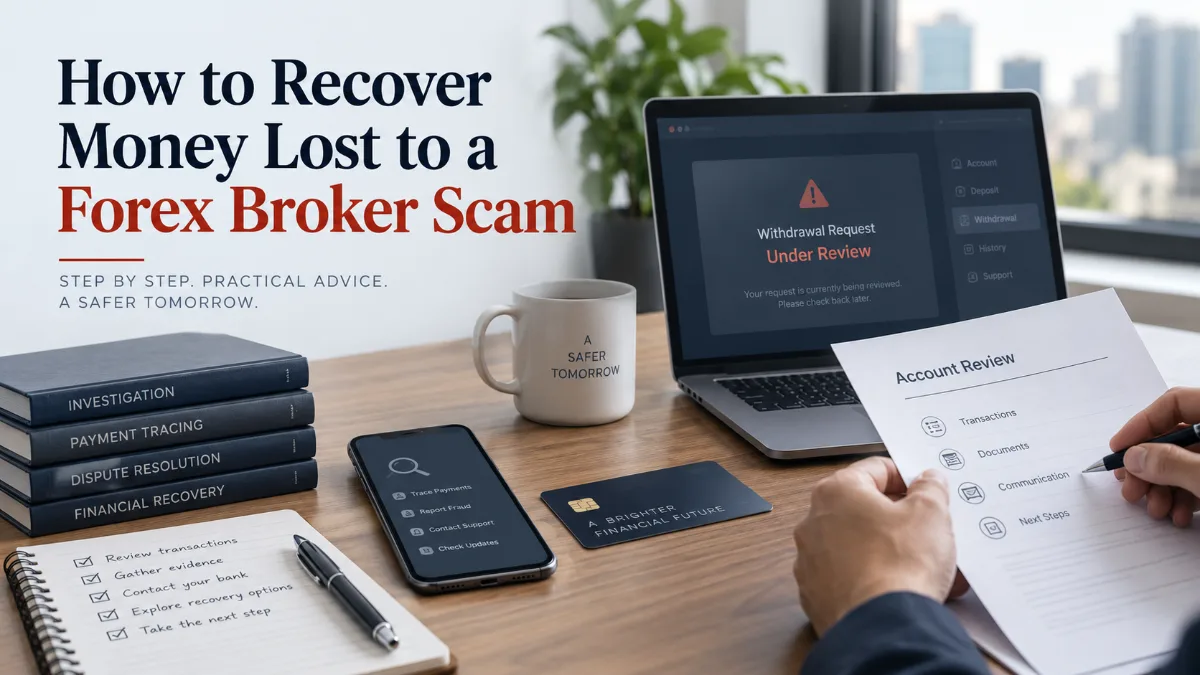
Recovering money from a scam broker is possible in some cases, but speed and the payment method matter. The first priorities are to stop sending money, contact the bank or payment provider that moved the funds, preserve evidence, and report the fraud to the relevant authorities. A card payment may be eligible for a dispute or chargeback, while a bank transfer may sometimes be recalled or traced. Cryptocurrency is usually harder to recover because blockchain transfers generally cannot simply be reversed.
Do not pay the broker another fee to release a withdrawal. Scam operators often invent taxes, insurance charges, verification deposits, liquidity fees, or account upgrades after a victim asks for money back. A balance shown on a trading dashboard is not proof that real funds are held for you. Treat any demand for more money as a warning to stop and verify independently.
What should you do immediately after discovering the scam?
The most useful forex scam recovery work begins before evidence disappears or money moves through additional accounts. Act on the payment channels first rather than spending days arguing with the broker. The Federal Trade Commission advises scam victims to contact the company used to send the money and ask whether the transaction can be reversed or refunded. The exact legal rights and procedures depend on your country and payment method.
- Stop all further payments. Do not send a withdrawal fee, tax, commission, security deposit, or recovery charge.
- Contact your bank or payment provider. Use the fraud or disputes team and clearly state that the payment was connected to an investment or trading scam.
- Ask for the correct remedy. Depending on the transaction this may be a card dispute, chargeback, transfer recall, fraud trace, account freeze request, or payment-app dispute.
- Secure your accounts. Change passwords if you shared credentials and contact your bank immediately if the broker had remote access to your computer or online banking.
- Preserve the evidence. Save statements, transaction IDs, wallet addresses, emails, chat logs, phone numbers, account screenshots, withdrawal requests, contracts, and advertisements.
- Report the scam. Notify your local financial regulator and the police or national fraud-reporting service where appropriate.
When speaking to a bank, be precise. If you personally authorized a card payment after being deceived, do not describe it as an unauthorized transaction. Explain the actual facts: what the broker represented, what service was promised, what happened when you attempted to withdraw, and why you believe the merchant acted fraudulently. An accurate chronology is more useful than an exaggerated claim that can be contradicted by transaction records.
Which recovery route fits your payment method?
| Payment method | First action | What may be possible |
|---|---|---|
| Credit or debit card | Contact the card issuer's disputes or fraud team | A dispute or chargeback may be available depending on the facts and applicable rules |
| Bank transfer | Call the sending bank immediately | The bank may attempt a recall, contact the receiving bank, flag the beneficiary, or start a fraud trace |
| Wire transfer service | Contact the transfer company immediately | A transfer that has not completed may sometimes be stopped or reversed |
| Payment app or e-wallet | Open a fraud dispute with the provider | The provider may investigate and may also direct you to the linked card or bank |
| Cryptocurrency | Notify the exchange or service used to send the assets | Recovery is difficult but an exchange may be able to flag an address or freeze assets that reach a controlled account |
None of these routes guarantees recovery. The receiving account may already be empty, the merchant may challenge the dispute, the transfer may have settled, or the scammer may operate through accounts in several jurisdictions. The point of acting quickly is to preserve every available option before the money moves further.
How does a chargeback for a forex broker work?
A chargeback is a card-network process in which a cardholder disputes a transaction through the card issuer. It is not a special forex refund program and it is not automatically available just because trading produced a loss. A credible chargeback forex broker case normally turns on the merchant's conduct and the transaction facts rather than on whether the investment was profitable.
Possible grounds can include misrepresentation, services not provided as promised, a refusal to process a legitimate withdrawal, or other conduct recognized by the issuer and card scheme. The correct category depends on what actually happened. Ask the issuer which dispute route applies and what evidence it requires. Card schemes and local law can impose deadlines, so contact the issuer promptly even if you are still collecting documents.
Build a chargeback file that tells one clear story
Organize evidence in chronological order. Include the card statement, merchant descriptor, deposit confirmation, account agreement if available, screenshots of the trading account, withdrawal requests, rejection messages, and any demand for additional money before withdrawal. Add advertisements or messages containing specific promises that influenced the payment. If the broker claimed to be licensed, save the claim and the regulator search result that contradicts it.
Separate genuine market losses from disputed payments. If you deposited $10,000 and lost $3,000 through actual trades before the platform blocked withdrawal of the remaining balance, do not present the whole $10,000 as if no trading occurred. A fact-specific claim is easier for an issuer to evaluate and less vulnerable to the broker's response.
Can a bank transfer to a scam broker be recovered?
Bank transfers are often harder to reverse after settlement, but you should still contact the sending bank immediately. Ask for the fraud team and request a recall or recovery attempt. Provide the beneficiary name, account number, transfer date, amount, reference, and the reason you believe the recipient is connected to fraud. If the payment crossed borders, provide any SWIFT or international transfer details shown on your receipt.
Your bank may contact the receiving institution and ask it to hold or return funds that remain available. Whether that succeeds depends on timing, the receiving bank's procedures, applicable law, and whether the funds are still in the account. A police or fraud report number can also help connect later correspondence to a documented case, although filing a report does not itself force a refund.
If you made several transfers, list each one separately. Scam operations commonly rotate beneficiary accounts or use payment intermediaries. A clean transaction schedule can reveal that different payments went to different legal entities or countries, which may affect both bank recovery efforts and any later legal action.
What about cryptocurrency sent to a forex scam?
Cryptocurrency has no general chargeback mechanism comparable to a card dispute. Once a blockchain transaction is confirmed, the sender usually cannot reverse it unilaterally. That does not mean every recovery route is closed. Contact the exchange, wallet provider, or crypto service you used to send the assets and report the transaction as fraud. Give them the transaction hash, destination address, asset, amount, and any police report reference.
If stolen assets later arrive at an exchange or other service that controls customer accounts, that service may be able to act under its compliance procedures or in response to lawful requests from authorities. This is different from paying a private person who claims to have hacked the scammer's wallet. Do not send crypto, seed phrases, private keys, or advance fees to someone promising a guaranteed blockchain recovery.
How to recover money lost to a binary options broker scam
The recovery process for a binary options scam is broadly the same as for a fraudulent forex platform: stop payments, challenge recoverable transactions, preserve evidence, and report the operator. The Commodity Futures Trading Commission and the SEC have warned about complaints involving internet-based binary options platforms that refused to credit accounts or reimburse funds, misused personal information, or manipulated software to create losing trades.
If you are trying to work out how to recover money lost to binary options broker scam activity, document the difference between normal trading risk and conduct suggesting fraud. Useful evidence includes deposits, the advertised payout terms, trade history, withdrawal attempts, unexplained account changes, bonus conditions, support messages, and requests for additional fees. If a platform suddenly changes the reason it cannot pay you, preserve every version of that explanation.
Do not keep trading merely to satisfy a supposed turnover requirement unless you have independently verified that the condition is lawful and genuinely part of the agreement you accepted. Scam platforms can use bonus or volume conditions as a moving barrier that keeps a victim depositing and trading while withdrawal remains impossible.
What evidence strengthens a forex scam recovery case?
Think of your evidence file as a reconstruction of what happened. A bank, regulator, investigator, lawyer, or court should be able to follow the sequence without relying on your memory alone. Keep original files where possible rather than only edited screenshots.
- Identity of the broker: website addresses, company names, claimed license numbers, office addresses, phone numbers, email addresses, and social-media profiles.
- Money trail: bank statements, card statements, receipts, beneficiary account details, wallet addresses, transaction hashes, and payment processor records.
- Sales representations: promised returns, claims about regulation, withdrawal assurances, bonus terms, risk statements, and messages from account managers.
- Account activity: trade logs, balance history, deposit history, withdrawal requests, cancellations, and platform screenshots.
- Post-loss conduct: demands for taxes or fees, threats, pressure to borrow more money, requests for remote computer access, and recovery offers from new contacts.
Create a short timeline with dates, amounts, and events. Keep it factual. A concise timeline attached to the underlying evidence often communicates the case better than a long emotional narrative.
Should you report the broker to a regulator or police?
Yes. Reporting serves a different purpose from a bank dispute. A bank focuses on the payment and its rules. A financial regulator may investigate unauthorized financial activity or misconduct within its jurisdiction. Police or a national fraud-reporting body can record the criminal allegation and may coordinate with financial institutions or foreign authorities.
Report to the regulator for the country where you live and also consider the regulator where the broker claims to be licensed. If the broker is using the identity of a real regulated company, state that you suspect a clone or impersonation. Do not rely on contact details supplied by the broker. Find the regulator's official website independently and verify the firm's status there.
Regulatory reporting does not guarantee compensation. A regulator can warn the public or take enforcement action without having a direct mechanism to reimburse every victim. If the firm is genuinely regulated or has entered insolvency, however, there may be a formal complaint, ombudsman, compensation, receivership, or creditor process that is more appropriate than treating the case solely as an anonymous online scam.
When is legal action worth considering?
Legal action becomes more realistic when the loss is substantial and you can identify a real defendant, a usable jurisdiction, and assets or counterparties that may be reached. Before spending more money, ask a qualified lawyer to assess the entity named in the contract, where payments went, the governing law, possible causes of action, limitation periods, and the practical prospects of enforcement.
A court judgment has limited value if the scam operator cannot be identified or has no reachable assets. For smaller losses, bank recovery procedures and official reporting may be more proportionate. For larger losses involving identifiable companies, payment processors, agents, or multiple victims, professional legal advice may uncover options that are not available through a simple card or bank dispute.
How can you avoid a forex scam recovery scam?
Victims of investment fraud are frequently targeted again. A new caller may claim to be a regulator, lawyer, forensic investigator, bank employee, blockchain specialist, or recovery company that already knows your loss amount. The Financial Conduct Authority warns that recovery room scams approach people who have already lost money and offer to recover it in return for an upfront fee.
Be especially cautious if the recovery contact is unsolicited, guarantees success, claims that recovered funds are already waiting, or demands tax, insurance, court, wallet activation, or administrative fees before release. Verify any professional independently using the regulator or professional body's own directory and contact details. Do not rely on a website link, phone number, license image, or testimonial supplied by the person asking for money.
A legitimate professional may charge for real legal or investigative work, so an upfront fee alone does not prove fraud. The key questions are whether the provider is real, appropriately authorized where required, transparent about the work, realistic about uncertainty, and willing to put the scope and fees in writing. Guaranteed recovery is a major warning sign because no private service controls banks, courts, exchanges, or foreign authorities.
What mistakes reduce the chance of recovery?
- Sending one more payment. Scam brokers often say the next deposit will unlock the account. It usually increases the loss.
- Waiting for the broker to cooperate. Start bank and payment-provider procedures while preserving communications with the broker.
- Deleting messages in frustration. Even obvious lies can become useful evidence when compared with payment records or licensing data.
- Misstating the dispute. Do not call an authorized payment unauthorized. Explain the deception and the failed service accurately.
- Paying an unverified recovery agent. A second scam can cause additional losses and expose more personal information.
- Sharing remote access or security credentials. Remove remote-access software you no longer need and change compromised passwords immediately.
A practical forex scam recovery sequence
There is no single service that can recover money from every scam broker. The strongest approach is a coordinated sequence based on the payment trail.
- Stop the loss. Make no further deposits and cut off remote access.
- Open payment disputes immediately. Contact card issuers, banks, transfer services, apps, or exchanges through official channels.
- Preserve and organize evidence. Build a timeline and transaction schedule with supporting files.
- Verify the broker's legal identity. Check the regulator the firm claims to be licensed by and record any mismatch.
- Report the fraud. File reports with the relevant financial regulator and law-enforcement or fraud-reporting authority.
- Escalate proportionately. For a significant loss, consider qualified legal advice about civil recovery, insolvency, or cross-border enforcement.
- Protect against follow-up scams. Treat unsolicited recovery offers as high risk until independently verified.
The central principle is simple: follow the money rather than the scammer's promises. A strategy to recover money from a scam broker is strongest when it combines fast payment action, accurate evidence, official reporting, and realistic expectations. Even when full recovery is not possible, these steps can improve the chance of stopping a transfer, recovering part of a payment, documenting the fraud for authorities, and preventing a second loss.