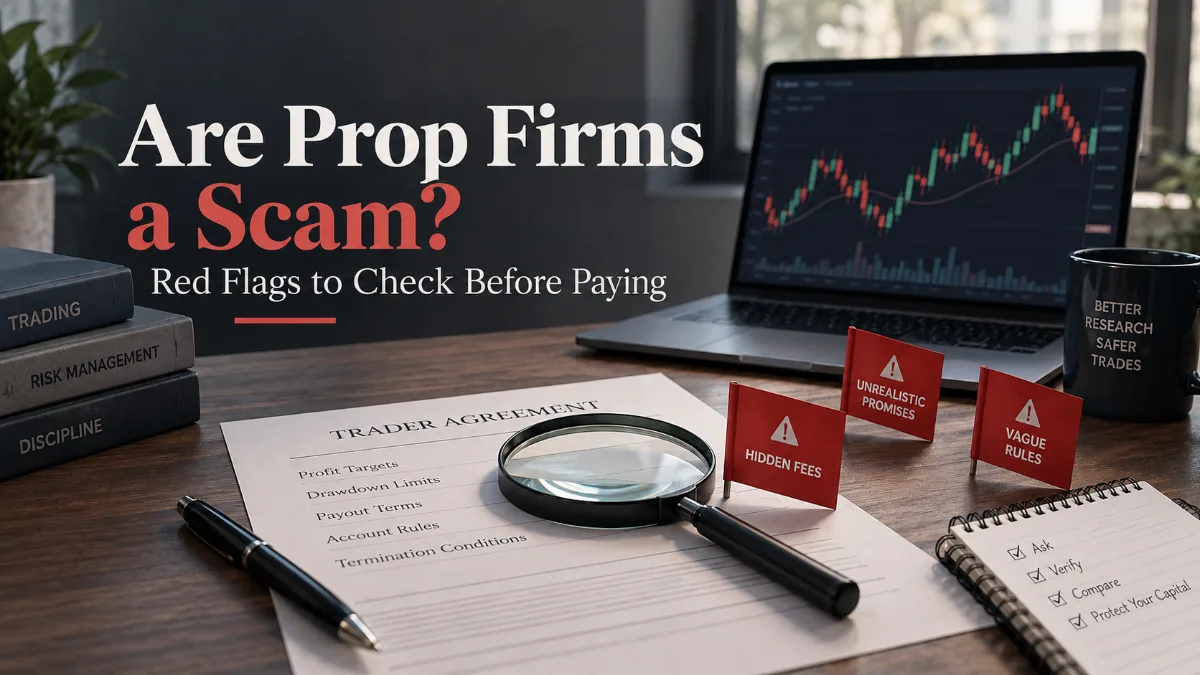
Prop firms are not automatically scams, but the label “prop firm” does not prove that a business is legitimate either. Retail funded-trader programs range from established companies with clear evaluation contracts to short-lived operators that hide their legal identity, change rules after purchase, or block payouts behind new conditions. The safest way to judge a prop firm is to verify exactly what you are buying, who the contracting company is, how payouts are earned, and whether the rules you must follow are complete before you pay.
A challenge fee is usually payment for access to an evaluation program, not a deposit into a normal brokerage account. Some programs use simulated accounts during evaluation and may continue using simulated accounts after a trader qualifies. Others may route selected traders or trades differently. That distinction matters because words such as “funded,” “capital,” and “account size” can sound like conventional investment-account terms even when the product is structurally different. A legitimate provider should explain this clearly rather than relying on marketing language.
Are Prop Firms Legit?
Some prop firms operate legitimate funded-trader programs, but “legit” should be tested in several separate ways. A company can exist legally yet still have confusing rules, weak payout practices, poor customer support, or a business model you would not choose if you understood it fully. Corporate registration proves only that an entity was formed or registered in a jurisdiction. It does not by itself prove that every financial claim on its website is accurate or that a regulator supervises the specific service being sold.
For a trader, legitimacy is better treated as a chain of verifiable facts. The legal entity named in the terms should match the business taking payment. The product description should state whether trading is simulated or live. Challenge rules should be accessible before checkout. Payout eligibility should be defined in writing. The company should not claim regulatory status it cannot verify. Contact details, payment recipients, legal documents, and support channels should also point to the same organization.
This means the question “are prop firms legit?” has no industry-wide yes or no answer. The useful question is whether a specific firm can demonstrate a coherent legal identity, transparent contract, stable rules, credible payment process, and evidence that matches its marketing.
Prop Firm Red Flags Before You Pay
The strongest prop firm red flags are not minor complaints about strict drawdown limits or difficult targets. They are contradictions that prevent you from understanding who is taking your money or what must happen before you can receive a payout.
- No clear legal entity: The site shows a brand name but no company name, jurisdiction, business address, or contracting entity in its terms.
- Different names at checkout: The payment recipient appears unrelated to the company named in the terms and the firm cannot explain the relationship.
- Missing or fragmented rules: Important payout restrictions exist only in chat messages, private communities, old FAQ pages, or support replies rather than one accessible rule set.
- Rules that can change retroactively: The contract gives the firm broad discretion to apply new conditions to trades completed under earlier rules.
- Unclear account status: Marketing repeatedly implies that traders control real firm capital while the terms do not clearly explain whether accounts and executions are simulated.
- Undefined payout discretion: The firm promises a profit split but gives no objective standard for when a payout may be rejected, delayed, capped, reduced, or reviewed.
- False or vague regulation claims: Phrases such as “regulated,” “licensed,” or “approved” appear without the regulator, legal entity, registration number, and relevant permission.
- Pressure-based sales: Constant countdowns, urgent discounts, or claims that you must buy immediately are used to shorten the time available for due diligence.
- One-way payment methods: The firm pushes difficult-to-reverse payment methods while providing little information about the entity receiving funds.
- Support cannot answer contractual questions: Staff can sell upgrades quickly but cannot explain payout rules, prohibited strategies, dispute procedures, or the legal company behind the product.
None of these signs alone always proves a prop firm scam. Several together, especially hidden ownership plus unclear rules plus payment irregularities, should materially raise the standard of proof you require before paying.
How to Spot a Fake Prop Firm
If you want to know how to spot a fake prop firm, work from facts that are difficult to fake consistently. Do not begin with influencer reviews or payout screenshots. Begin with identity, contract terms, regulatory claims, payment flow, and internal consistency.
- Identify the contracting company. Find the legal name in the terms and privacy documents. Search the appropriate official corporate register. Check whether the company is active and whether its registered jurisdiction matches what the website claims.
- Match the brand to the entity. Confirm that the domain, support email, checkout descriptor, and legal documents identify the same business or explain any parent company, subsidiary, or payment processor relationship.
- Verify regulatory claims in the right database. In the United States, the Commodity Futures Trading Commission advises customers to verify registration and disciplinary history for firms or people required to register for futures, forex, options, commodity pools, and other covered derivatives activity. An evaluation-only prop program may not automatically fall into the same registration category, so an absent record is not by itself proof of fraud. A false claim that the firm is registered when it is not is a much stronger warning.
- Read the rules before checkout. Save the version that applies to your purchase. Pay particular attention to drawdown calculations, minimum trading days, consistency rules, prohibited strategies, news restrictions, copy trading, automation, account sharing, IP policies, and payout conditions.
- Reconstruct the payout formula. You should be able to calculate what amount is eligible, what percentage you receive, when you may request it, what caps apply, and what happens to remaining profits after payment.
- Look for contradictions. Compare homepage claims with the contract. If advertising says “no restrictions” but the rulebook contains broad discretionary restrictions, use the contract as the more important signal.
- Test support before buying. Ask one or two precise rule questions in writing. Save the replies. Vague answers such as “our risk team decides” are not reassuring when the question concerns an objective payout condition.
- Check the exit path. Read refund rules, dispute procedures, account termination clauses, and what happens if the firm suspends operations. A product is easier to evaluate when the downside is defined before money changes hands.
What Payout Rules Need Extra Scrutiny?
Strict payout rules are not automatically fraudulent. A prop firm can impose difficult conditions if they are disclosed clearly and applied consistently. The risk rises when a material condition appears only after a trader has paid, passed an evaluation, or requested money.
Review any rule that changes the difference between displayed profit and withdrawable profit. Examples include consistency limits that reduce credit for one unusually profitable day, maximum eligible profit per day, payout caps, minimum profitable-day requirements, account balance resets after payout, scaling thresholds, and rules that remove profits generated by a prohibited strategy. These provisions can materially change the economics of an account even when the headline profit split looks generous.
Also inspect the firm’s definition of a rule violation. A contract that specifically describes latency arbitrage, account sharing, prohibited copy trading, or restricted news trading is easier to evaluate than a clause allowing the firm to void profits for any behavior it considers “unrealistic” without defining the term. Discretion may be necessary for abuse reviews, but unlimited discretion creates uncertainty because a trader cannot know in advance whether compliant-looking activity will qualify for payment.
| Claim or rule | What to verify | Higher-risk signal |
|---|---|---|
| Profit split | Eligible profit definition and calculation | Advertised percentage applies only after undisclosed deductions |
| Payout frequency | Waiting period and request schedule | New waiting periods appear after qualification |
| Trading freedom | Strategy restrictions in the written rules | Support adds restrictions after profitable trades |
| Drawdown | Static or trailing method and reset behavior | Different pages describe different calculations |
| Rule enforcement | Objective breach criteria and review process | Undefined discretion can erase profits without explanation |
Marketing and Social Proof Can Mislead
A polished website, large community, visible influencers, and screenshots of payouts can all exist without proving that your own contract will be honored. Social proof is easy to select, sponsor, or manipulate. The U.S. Securities and Exchange Commission warns that fraudsters may use fake testimonials or credentials, unrealistic return promises, impersonation, and pressure to act quickly. Those are general investment-fraud warnings, but the verification principle applies equally well when a prop firm uses similar tactics to sell a trading evaluation.
Look beyond the existence of positive reviews. Check whether reviews describe the same product version you are considering, whether reviewers disclose affiliate relationships, and whether the firm answers detailed complaints with evidence rather than generic statements. A payout screenshot proves at most that one image exists. It does not establish how often payouts are approved, whether the account was simulated, whether the poster was compensated, or whether later customers face the same rules.
Be especially careful with claims such as “guaranteed funding,” “risk-free income,” or “any trader can get paid.” A genuine evaluation business may market opportunity aggressively, but it cannot know in advance that an individual trader will pass risk limits or produce eligible profits.
Does Regulation Prove a Prop Firm Is Safe?
No. Regulatory status can be an important verification point, but it is not a universal seal of quality and it must relate to the exact legal entity and service you are buying. A prop firm may operate a challenge product that is different from a broker, futures commission merchant, investment adviser, or other regulated intermediary. Conversely, a company should not borrow the registration of an affiliate or service provider and present it as if the prop program itself has the same permissions.
Jurisdiction matters. In the United Kingdom, the Financial Conduct Authority maintains a warning list and notes that absence from the list does not prove a firm is authorised or genuine. The FCA also advises consumers to check the firm’s permissions and contact details because clone firms can copy the identity of genuine businesses.
Apply the same logic anywhere else: use the regulator named by the firm, search the exact legal entity, verify the registration number independently, and confirm that the permission covers the activity being claimed. If the firm never claims to offer a regulated service, do not invent a requirement that may not apply. Instead, evaluate its actual product structure and the consumer protections available in its jurisdiction.
Check the Full Cost Before Checkout
A low challenge price can distract from the total cost of reaching a payout. Before buying, identify every mandatory charge that can arise between checkout and withdrawal. Depending on the program, that may include evaluation fees, activation fees, recurring account charges, data fees, resets, platform charges, or withdrawal-related costs. The issue is not that every extra fee is improper. The issue is whether a reasonable buyer can see the full payment path before committing money.
Optional add-ons deserve the same scrutiny. Features marketed as higher profit splits, easier drawdown rules, faster payouts, or fewer minimum days should be reflected consistently in the checkout summary and governing terms. If an add-on changes a material trading rule, save proof of the purchased version. A firm that advertises one price while making unavoidable later charges difficult to discover creates a different risk than a firm that publishes the entire cost structure upfront.
Use a Prepayment Decision Checklist
A good due-diligence process should make it possible to reject a weak provider before the size of a discount influences you. Before paying any challenge fee, confirm the following points:
- The legal company name and jurisdiction are visible and independently verifiable.
- The entity taking payment matches the contract or has a clearly explained relationship to it.
- The site states whether evaluation and funded stages use simulated or live trading.
- Profit targets and all drawdown rules can be calculated from the written terms.
- Payout timing, profit split, caps, minimum days, and post-payout account treatment are defined.
- Prohibited strategies are specific enough for you to know what behavior creates a breach.
- Regulatory claims can be verified directly with the named regulator when such claims are made.
- Refund, cancellation, suspension, and account termination terms are available before payment.
- Support can answer rule questions consistently in writing.
- You can afford to lose the entire fee without relying on a payout to meet personal expenses.
If several items fail, do not rationalize each one separately. The combined pattern matters. A missing address may be an administrative weakness. A missing address plus an unrelated payment recipient, unverifiable registration claim, and undefined payout discretion is a much more serious risk profile.
What If You Already Paid?
If you believe the firm has changed rules, denied a payout unfairly, stopped responding, or disappeared, preserve evidence before accounts or pages change. Save the version of the terms you purchased under, checkout receipt, payment descriptor, account statements, trade history, payout requests, support messages, and screenshots showing the disputed rule or balance.
Do not send extra money merely because someone says a payout can be released after a new “tax,” “verification,” “liquidity,” or “unlock” payment. A genuine contractual fee should have a clear basis in the terms. Unexpected payment demands at the withdrawal stage are a recognized fraud pattern in financial scams.
If the dispute involves a card payment, ask the issuer what dispute rights and time limits apply. If the conduct may involve fraud or an unauthorised regulated activity, report it to the relevant financial regulator or consumer-protection authority in the firm’s jurisdiction and your own. If you receive a later message from someone promising to recover your money for an upfront fee, treat that as a separate transaction requiring fresh verification.
Are Prop Firms a Scam: A Better Decision Rule
Do not decide from the industry label. Decide from the contract and the evidence. A prop firm deserves more confidence when its identity is verifiable, its product structure is explicit, its rules are stable, payout conditions can be calculated before purchase, and its regulatory claims match official records. It deserves less confidence when the business asks you to trust marketing where a contract should exist.
The key distinction is between a hard program and an unverifiable program. A challenge can be expensive, strict, and difficult to pass without being a scam. The serious warning signs appear when the firm cannot establish who it is, what it sells, what rules govern payment, or why those rules changed. Before paying, make sure every material condition that could turn a profitable account into a zero payout is already visible in writing.