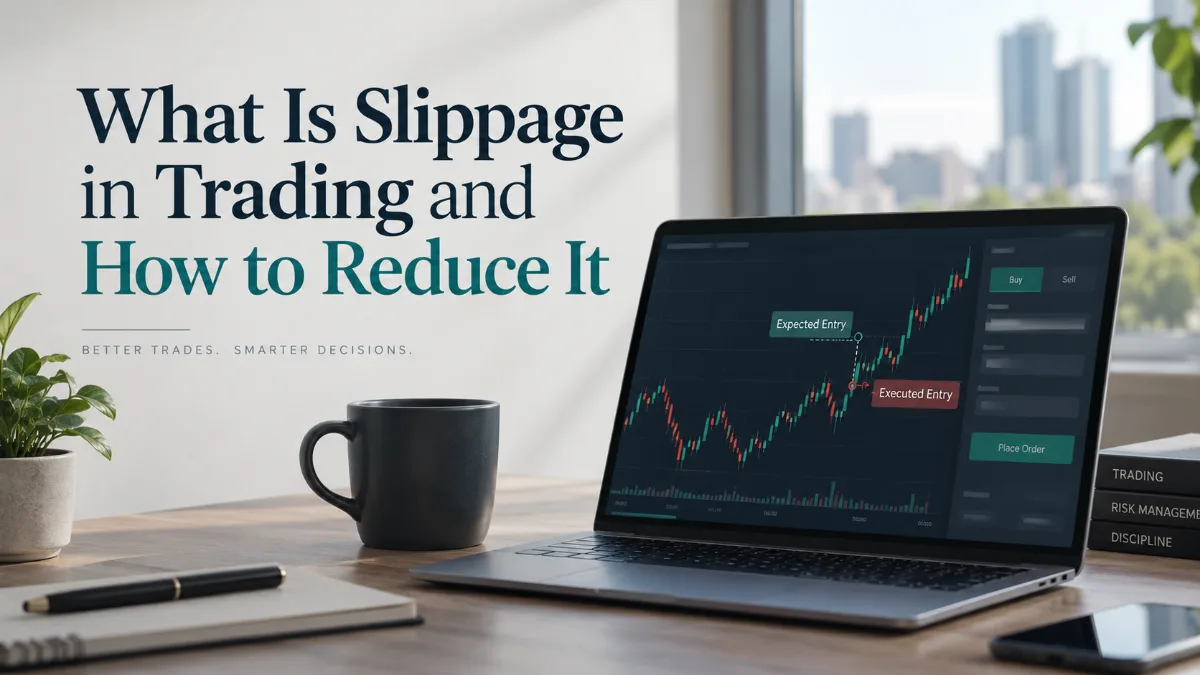
Slippage is the difference between the price you expect for a trade and the price at which the order is actually executed. It can be negative when the fill is worse than expected or positive when the fill is better. Slippage is most noticeable when prices are moving quickly or when there is not enough liquidity available at the quoted price for the full size of an order.
Slippage is not automatically a broker error and it is not the same thing as the bid-ask spread. A quoted price is a snapshot of available buying and selling interest at a moment in time. Once an order is sent to the market or trading venue the available price can change before the order is filled. For market orders the priority is execution rather than a guaranteed price. The U.S. Securities and Exchange Commission explains that a market order generally executes immediately but does not guarantee the execution price.
What is slippage in trading?
In practical terms slippage measures execution uncertainty. Suppose a trader sees an ask price of $50.00 and submits a market order to buy 100 shares. If the order fills at $50.08 the trader has experienced 8 cents of negative slippage per share. If it fills at $49.96 the trader has received 4 cents of positive slippage per share.
The same logic applies when selling but the favorable direction is reversed. A sell order filled above the expected price is positive slippage. A sell order filled below the expected price is negative slippage. The concept appears across stocks forex futures and other markets where an order can reach execution after the displayed or expected price has changed.
The key point is that the price on a screen is not necessarily a reserved price. It usually represents a quote or the most recent transaction available at that instant. Execution happens against actual available liquidity. If another order consumes that liquidity first or if new quotes arrive while the order is being routed the final fill can differ.
Why slippage happens
Slippage usually comes from the interaction of price movement liquidity and execution time. It is therefore better understood as a market microstructure issue than as a single platform setting.
- Fast price movement: News releases market openings and sudden order imbalances can change quotes between submission and execution.
- Thin liquidity: If only a small quantity is available at the best bid or ask a larger order may need to trade at several price levels.
- Large order size: An order that is large relative to available depth can consume the best price and continue into worse prices. This is sometimes called market impact.
- Routing and processing time: Orders require time to travel through a broker venue or liquidity provider. Even very small delays can matter in a rapidly changing market.
- Gaps: A market can reopen or jump from one tradable price to another with little or no liquidity between them. An order triggered inside that gap may execute at the next available price.
The U.S. Securities and Exchange Commission also notes in its investor guidance that a quote may cover only a specific number of shares and that prices can change before an order reaches the market. This makes the important distinction between seeing a price and actually receiving that price in a fill.
Positive slippage and negative slippage
Positive slippage occurs when execution improves the trader's price. A buy order filled below the expected price is favorable because the trader pays less. A sell order filled above the expected price is favorable because the trader receives more. Negative slippage is the opposite: a buy fills higher or a sell fills lower than expected.
Positive slippage is not theoretical. The Commodity Futures Trading Commission has described both positive and negative slippage in the context of retail forex execution as price changes between order placement and execution. That distinction is useful because a fair assessment of execution quality should consider favorable and unfavorable price changes rather than looking only at bad fills.
| Order | Expected price | Execution price | Result |
|---|---|---|---|
| Buy | $50.00 | $50.08 | Negative slippage of $0.08 |
| Buy | $50.00 | $49.96 | Positive slippage of $0.04 |
| Sell | $50.00 | $49.90 | Negative slippage of $0.10 |
| Sell | $50.00 | $50.06 | Positive slippage of $0.06 |
A single fill tells very little about long-term execution quality. Traders who want to evaluate slippage should examine a meaningful sample of orders and separate buys from sells market orders from limit orders normal sessions from volatile periods and small orders from larger ones.
How to calculate slippage
The simplest calculation compares the expected price with the volume-weighted average execution price of the order. Using a single fill price is fine when the whole order executes at one price. When an order is split across several fills the weighted average is more accurate.
For a buy order an execution-cost version of the calculation is execution price minus expected price. A positive number means the trader paid more than expected. For a sell order use expected price minus execution price. Again a positive number means the result was worse than expected. This convention expresses slippage as a cost so the interpretation stays consistent for both directions.
Example: a trader expects to buy 1,000 shares at $25.00. Five hundred shares fill at $25.00 and five hundred fill at $25.04. The average execution price is $25.02. Slippage is therefore $0.02 per share or $20 across the 1,000-share order before commissions and other trading costs.
Slippage can also be measured in percentage terms. Divide the per-unit slippage by the expected price and multiply by 100. In the example above $0.02 divided by $25.00 equals 0.08%. Percentage slippage can make comparisons easier across instruments with very different price levels.
Partial fills deserve separate attention because they can hide the true average price. A 1,000-unit order might receive 200 units at the displayed price and the remaining 800 at progressively worse levels. Looking only at the first fill would understate slippage. Use the complete execution report and calculate the weighted average across every fill associated with the order.
Slippage vs spread and gaps
Slippage is often confused with the spread because both can make a trade appear to start at a disadvantage. They are different costs or effects.
| Concept | What it means | When it matters |
|---|---|---|
| Spread | The difference between the current bid and ask | When entering or exiting at available quoted prices |
| Slippage | The difference between expected and actual execution price | When the fill occurs at a different price than expected |
| Gap | A jump between tradable price levels | When the market moves without continuous trading through intermediate prices |
A trader can pay the spread and also experience slippage on the same order. For example a market buy may be submitted against the current ask but fill even higher because the best offer disappears before execution. A gap can create especially large slippage if a stop order activates after price has jumped beyond the stop level.
How order type changes slippage risk
Order type determines whether price certainty or execution certainty receives priority. This trade-off is central to how to avoid slippage because the strongest price protection normally comes with a greater risk that the order will not fill.
| Order type | Price protection | Execution certainty | Slippage profile |
|---|---|---|---|
| Market order | Low | High when liquidity is available | Can fill above or below the expected price |
| Limit order | High | Lower | Cannot execute beyond the limit but may not execute at all |
| Stop order | Low after activation | Generally higher after activation | Can slip because it becomes a market order after the trigger |
| Stop-limit order | High after activation | Lower | Controls the worst acceptable price but can remain unfilled |
A limit order therefore does not eliminate all execution risk. It converts one type of risk into another. Instead of accepting an uncertain fill price the trader accepts the possibility of no fill or only a partial fill. That distinction matters when an exit is urgent.
How to avoid slippage and reduce execution risk
It is not realistic to eliminate slippage from every trade. The practical goal is to reduce unnecessary exposure to it while preserving the ability to execute when execution matters most.
Use limit orders when price matters most
A limit order specifies the worst price you are willing to accept. A buy limit executes only at the limit price or lower and a sell limit executes only at the limit price or higher. This directly prevents an execution outside the stated boundary. The trade-off is that the market may touch or move through the area without filling the order if sufficient liquidity is not available to you.
Trade when liquidity is deeper
Slippage tends to become more difficult when the available quantity near the best bid and ask is small. If your strategy allows it favor periods when the instrument normally has active participation and tighter spreads. For exchange-traded instruments this often means avoiding unusually quiet sessions. For globally traded markets liquidity varies by instrument and by time of day.
Avoid predictable volatility when it is not part of the strategy
Scheduled economic releases earnings announcements and market openings can produce rapid repricing. If the strategy does not depend on trading those events waiting until quotes stabilize can reduce execution uncertainty. This is a risk-control choice rather than a rule that volatility should always be avoided.
Match order size to available liquidity
A large order may sweep several price levels. Reducing the size of each order or using staged execution can lower immediate market impact in some circumstances. However splitting orders is not automatically better because price can move while the remaining pieces wait. The relevant question is how large the intended trade is relative to visible and typical market depth.
Use stop-limit orders with care
A stop-limit order can prevent a stop from turning into an execution far beyond a chosen price. The cost of that protection is non-execution. During a sharp decline a sell stop-limit order can trigger and then remain unfilled while the market continues lower. Traders should choose between price protection and exit certainty based on the purpose of the order rather than assuming one order type is always safer.
Review execution data instead of isolated fills
Record the quote or expected price at submission the final execution price order size order type and market conditions. Over time this creates a slippage distribution rather than a collection of memorable bad trades. If negative slippage is consistently larger or more frequent than positive slippage under comparable conditions investigate the broker venue order settings and strategy assumptions.
Reduce avoidable technical delay
A stable connection and responsive trading platform can reduce delays that originate on the trader's side. They cannot remove slippage caused by market movement venue queues or disappearing liquidity. Treat faster hardware or internet access as one small part of execution quality rather than a complete solution.
How slippage affects stop losses
A stop price is usually a trigger rather than a guaranteed exit price. Once a standard stop order is activated it becomes a market order and executes at the next available prices. If the market gaps through the stop level or moves sharply after activation the fill can be materially worse than the stop price.
This is why a stop loss controls the instruction to exit but does not always cap the exact monetary loss. A trader who sizes a position using a fixed distance between entry and stop should allow for the possibility that realized loss may be larger during gaps or extreme volatility. Using a stop-limit order can cap the acceptable execution price but introduces the separate risk of staying in the position.
When slippage matters most
For a long-term investor placing a small trade in a highly liquid security a few cents of slippage may have little practical effect. For a short-term strategy with narrow profit targets frequent trading or large position sizes the same amount can materially change expected performance.
Slippage deserves particular attention when a strategy depends on precise entries when trading costs already consume a meaningful share of expected profit or when orders are large relative to normal depth. It also matters in backtesting. A simulation that assumes every order fills exactly at the signal price can overstate real-world results. Sensible testing should include conservative execution assumptions based on the market and order types actually used.
How much slippage is acceptable?
There is no universal acceptable slippage figure. A reasonable level depends on the instrument order type liquidity position size holding period and the strategy's expected edge. One cent can be irrelevant for one trade and destructive for another. The useful comparison is not slippage in isolation but slippage relative to the economics of the strategy.
For example suppose a short-term strategy expects an average gross gain of $0.40 per share. If average adverse slippage is $0.05 on entry and another $0.05 on exit total slippage consumes $0.10 per share before commissions. That is 25% of the expected gross gain. A strategy that looked attractive before execution costs may be much less robust after realistic fills are included.
Track at least three measures: average slippage per trade the percentage of trades with positive versus negative slippage and the worst slippage observed under comparable conditions. Segment the data by order type session volatility and trade size. This helps distinguish ordinary market movement from a recurring execution problem. A broker comparison is meaningful only when the orders and market conditions are genuinely similar.
A practical slippage checklist
- Know whether the order prioritizes immediate execution or price control.
- Use limit orders when an unacceptable price would be worse than missing the trade.
- Expect more uncertainty during fast markets gaps and thin liquidity.
- Check whether order size is large relative to available depth.
- Understand that stop prices can trigger market orders at different execution prices.
- Measure average slippage over many comparable trades rather than judging one fill.
- Track positive slippage as well as negative slippage.
- Include realistic execution costs when evaluating a strategy.
The answer to how to avoid slippage is therefore not to search for a setting that makes it disappear. Slippage is part of real execution whenever price can change before a trade is completed. The most effective controls are choosing the right order type trading in appropriate liquidity keeping order size realistic and measuring actual fills. Those steps do not guarantee a perfect price but they make execution risk visible and manageable.