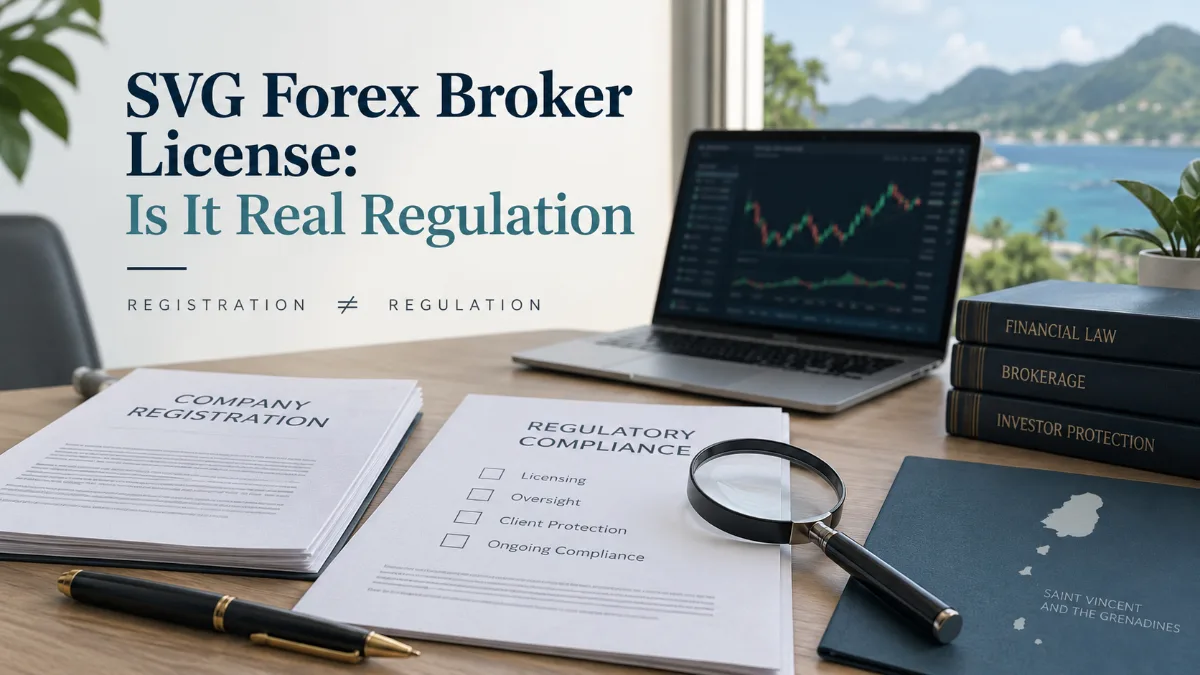
An SVG forex broker license is commonly described online as if Saint Vincent and the Grenadines issues a conventional retail forex brokerage license. That description is misleading. The Financial Services Authority of Saint Vincent and the Grenadines, usually called the SVG FSA, has explicitly stated that forex trading and brokerage activities are not licensed in the jurisdiction. A broker can therefore operate through a company incorporated or registered in SVG without holding a local SVG license that authorizes and prudentially supervises retail forex brokerage.
This distinction matters because company registration and financial regulation solve different problems. Registration establishes a legal entity and places it within a corporate framework. A genuine brokerage license normally grants permission to perform regulated investment services and is accompanied by rules on capital, governance, client money, conduct, reporting, supervision and enforcement. An SVG company certificate does not by itself provide those protections.
Is an SVG forex broker license actually a license?
No, not in the usual regulatory sense of a license that authorizes retail forex brokerage in Saint Vincent and the Grenadines. The Financial Services Authority has warned that forex trading brokerage activities are not licensed in SVG. It also explains that a registered Business Company or Limited Liability Company engaging in forex brokerage does so without a license from that jurisdiction.
That does not mean every SVG broker is fictitious or illegal. It means the phrase forex broker license SVG can blur two separate statuses: being legally incorporated in SVG and being licensed somewhere to provide regulated brokerage services. A broker may have an SVG company while also holding a genuine financial services license in another country. The second status is the one that needs to be verified when assessing regulatory protection.
The safest reading of a claim such as "SVG registered" is therefore narrow. It can indicate that a company exists in the SVG corporate system. It should not be interpreted as proof that the SVG FSA has approved the broker's trading platform, leverage model, execution practices, custody arrangements or treatment of client funds.
What SVG FSA regulation actually means
SVG FSA regulation is broader than forex and the authority has real supervisory responsibilities in the country's non-bank and international financial services framework. The problem arises when that institutional role is used to imply that every company registered through the SVG system is a licensed financial intermediary.
For a forex trader, the relevant question is not simply whether the company appears in an official registry. The question is whether the exact legal entity taking the client's deposit and acting as contractual counterparty is authorized for the specific investment or brokerage activity it offers.
| Claim or document | What it can establish | What it does not establish by itself |
|---|---|---|
| SVG certificate of incorporation | The company was incorporated under the applicable corporate framework | Authorization to provide regulated retail forex brokerage |
| SVG company or registration number | An identifier for the legal entity | Prudential supervision of trading activity |
| Reference to the SVG FSA | A connection to the jurisdiction's authority or registry framework may exist | A local forex dealer or broker license |
| Foreign financial services license | Potential authorization by another regulator if the entity and permissions match | Protection for clients booked through a different unlicensed group entity |
This is why wording matters. "Registered in Saint Vincent and the Grenadines" is materially different from "licensed by the SVG FSA to provide forex brokerage." The first can be accurate. The second should not be accepted without evidence of a regulatory regime and authorization that actually cover forex brokerage.
Why so many brokers use SVG companies
Saint Vincent and the Grenadines became familiar in the online trading sector because corporate formation could be used as part of an international business structure while local forex brokerage was not subject to a dedicated SVG licensing regime. For a broker, a corporate vehicle can provide legal personality, contracts, ownership structure and administrative continuity without creating the same regulatory burden as a full investment services license in a tightly supervised market.
That difference can reduce barriers to establishing an international brokerage business, but it also shifts more due diligence onto the customer. Where a licensed regulator does not impose detailed forex conduct and prudential rules on the entity taking the account, the trader cannot assume that familiar safeguards exist merely because an authority's name appears in the broker's legal disclosures.
The business model also explains why two brokers with SVG companies can have very different risk profiles. One may belong to a group with licensed entities in several major jurisdictions and use the SVG company only for certain international clients. Another may have no meaningful financial license anywhere. Their place of incorporation can look similar while the actual regulatory protection is completely different.
What changed for SVG brokers after the FSA tightened requirements?
The SVG FSA later introduced revised requirements for Business Companies and LLCs that engage or seek to engage in forex activity. In its official guidance the Financial Services Authority explains that where no forex license is required in the jurisdiction in which the activity is conducted, the company can provide a letter from the relevant competent authority confirming that no license is required. The guidance also describes sanctions for noncompliance.
This change is important, but it should not be misunderstood. It does not turn SVG company registration into an SVG forex broker license. Instead, it places requirements on SVG companies concerning the regulatory position in the jurisdiction where their forex activity takes place. A company may therefore need to demonstrate foreign authorization or an official basis for why authorization is not required there.
For traders, the practical lesson is that a broker's continued SVG registration is not a substitute for checking the actual foreign license it relies on. If a broker says it is "licensed internationally" or "authorized in multiple jurisdictions," identify the regulator, legal entity name, license number and permitted services. Then verify all four directly with that regulator.
Are SVG brokers safe?
There is no reliable yes or no answer based solely on SVG incorporation. Are SVG brokers safe is really a question about the specific entity holding the account, the external licenses it has and the protections attached to those licenses. SVG registration alone is not strong evidence of brokerage safety because it is not the same as local authorization and supervision of retail forex activity.
A broker using an SVG company can still have strong controls voluntarily or through a wider regulated group. It may segregate client money, use reputable banking partners, publish audited statements or submit parts of its business to oversight elsewhere. Those factors can improve the risk picture, but each one must be verified rather than inferred from group branding.
Conversely, a polished website, long operating history or company registration number cannot replace regulatory protections. The most important question is which entity appears in the client agreement and receives the funds. A global brokerage group may advertise licenses held by related companies while assigning some customers to an SVG entity that is outside those licenses. Regulatory benefits generally attach to the licensed entity and activity, not automatically to every company sharing the brand.
How to verify an SVG broker before depositing money
Start with the broker's legal documents rather than its homepage badges. The customer agreement, terms of business, deposit page and account opening disclosure should identify the contracting entity. Record the exact legal name because similar names across a corporate group can create false confidence.
- Identify the contracting entity. Confirm the company named in the client agreement and check whether the payment recipient is consistent with that entity.
- Separate incorporation from authorization. Treat an SVG registration number or certificate as evidence of company status only. Do not label it a forex license.
- Find every claimed external regulator. Search the regulator's official register for the exact entity name and license number. Check whether the authorization is current and whether it includes the services being offered to you.
- Check which entity covers your account. A license held by a UK or European affiliate does not necessarily protect a customer contracted with an SVG affiliate.
- Review client money rules. Determine whether the governing license requires segregation of client assets and whether the broker clearly explains where customer money is held.
- Check complaint and compensation routes. Find out whether an independent ombudsman or statutory compensation mechanism applies to your particular account. Do not assume one exists.
- Read withdrawal terms. Look for unusually broad discretion to delay withdrawals, cancel profits, change leverage or close positions. Contract terms can reveal risks that marketing pages omit.
- Test with limited exposure. Even after regulatory checks, operational risk remains. A small initial deposit and withdrawal test can reveal payment or support problems before more capital is committed.
This process is more useful than asking whether an SVG broker is "regulated" in the abstract. It maps the protection to the actual contract and the actual regulator that can intervene.
Red flags in forex broker license SVG claims
Marketing language deserves extra scrutiny when it compresses incorporation and regulation into a single phrase. Some statements may be technically constructed around a true fact while encouraging a broader conclusion that the fact does not support.
- "Licensed and registered in SVG." Ask for the specific forex license and enabling law. A certificate of incorporation is not enough.
- "Regulated by the SVG FSA." Ask what regulated activity the authority has authorized for that exact company. A registry relationship should not be presented as brokerage supervision.
- "FSA number" without a searchable permission record. A corporate registration identifier does not show that the entity has investment service permissions.
- Multiple regulator logos but one offshore client contract. The licenses may belong to affiliates that are not your counterparty.
- No clear legal entity on the website. If the broker makes it difficult to identify who receives client funds, that is a serious due diligence problem.
- Claims that regulation is unnecessary because forex is global. Cross-border activity does not remove the need to determine which laws and permissions apply where services are offered.
A credible broker should be able to explain its legal structure without relying on vague terms. The answer should identify who contracts with the customer, where that entity is incorporated, which regulator authorizes it if applicable and what protections apply to that specific account.
How SVG compares with a conventional forex licensing regime
The core difference is not the prestige of one jurisdiction versus another. It is whether the entity is subject to a defined regulatory perimeter for the service being sold. Conventional retail forex regulation typically combines authorization with ongoing obligations. The exact rules vary by country, but the framework commonly addresses governance, financial resources, reporting, client disclosures, conflicts of interest and handling of customer assets.
By contrast, an SVG corporate registration does not itself demonstrate that those brokerage-specific requirements apply. General corporate, anti-money laundering or registry obligations can still matter, but they should not be conflated with a dedicated retail forex supervisory regime.
| Decision factor | SVG company registration | Conventional forex broker authorization |
|---|---|---|
| Creates a legal entity | Yes | Usually relies on an existing legal entity |
| Authorizes retail forex brokerage | No by itself | Yes when the permission expressly covers the activity |
| Broker-specific capital requirements | Not established by incorporation alone | Commonly part of the licensing framework |
| Ongoing conduct supervision | Not created by corporate registration alone | Normally part of the regulatory relationship |
| Client compensation protection | Not created by SVG registration | Depends on jurisdiction and account eligibility |
| Regulatory complaint route | Not equivalent to a dedicated forex conduct regime | Often defined by the applicable framework |
When an SVG broker may still be acceptable
An SVG entity is not automatically unsuitable for every trader. The key is whether the customer understands what protections are absent and what other evidence compensates for that gap. A sophisticated client may knowingly choose an international entity because it offers instruments, leverage or account terms unavailable under a more restrictive domestic regime. That is a risk choice, not proof that the SVG entity is locally licensed.
The case is stronger when the same legal entity has a verifiable license elsewhere that covers the offered service and the client's jurisdiction. It is also stronger when ownership is transparent, financial statements are available, client money arrangements are clearly documented and the broker has a credible dispute process. None of those factors should be assumed merely because related companies are regulated.
For a retail client who prioritizes legal recourse and standardized protections, contracting directly with a broker entity licensed by a recognized financial regulator is generally easier to evaluate. The relevant comparison is between the protections attached to the actual account, not between marketing brands.
What a real license check should prove
A meaningful regulatory check should end with a chain of matching facts. The broker's legal name on the client agreement should match the name on the regulator's register. The license should be active. The permitted activities should cover the service being sold. The regulator's record should identify the same website or contact details where possible. The client's account should actually be booked with that licensed entity.
If one of those links breaks, investigate before funding the account. A valid license belonging to a sister company does not regulate a different company by association. Likewise, a real SVG company registration cannot be upgraded into a forex authorization through marketing language.
The practical answer to the search terms svg broker and svg fsa regulation is therefore precise: Saint Vincent and the Grenadines provides a legitimate corporate and financial services framework, but the SVG FSA does not issue the kind of local retail forex broker license that the phrase "SVG forex license" often implies. Broker safety must be assessed from the exact contracting entity and any genuine regulatory authorization that applies to it.
Bottom line for traders
Do not treat "registered in Saint Vincent and the Grenadines" as synonymous with "licensed to provide forex brokerage." The SVG FSA's own position draws that line clearly. An SVG broker can be a real company and still lack a local forex brokerage license.
Before opening an account, identify the entity that will hold your money and verify any claimed external license on the relevant regulator's official register. Then check client money rules, complaint rights, compensation arrangements and contractual terms. If the broker cannot show which regulator actually supervises your account for forex activity, assume that SVG registration alone does not supply that protection.