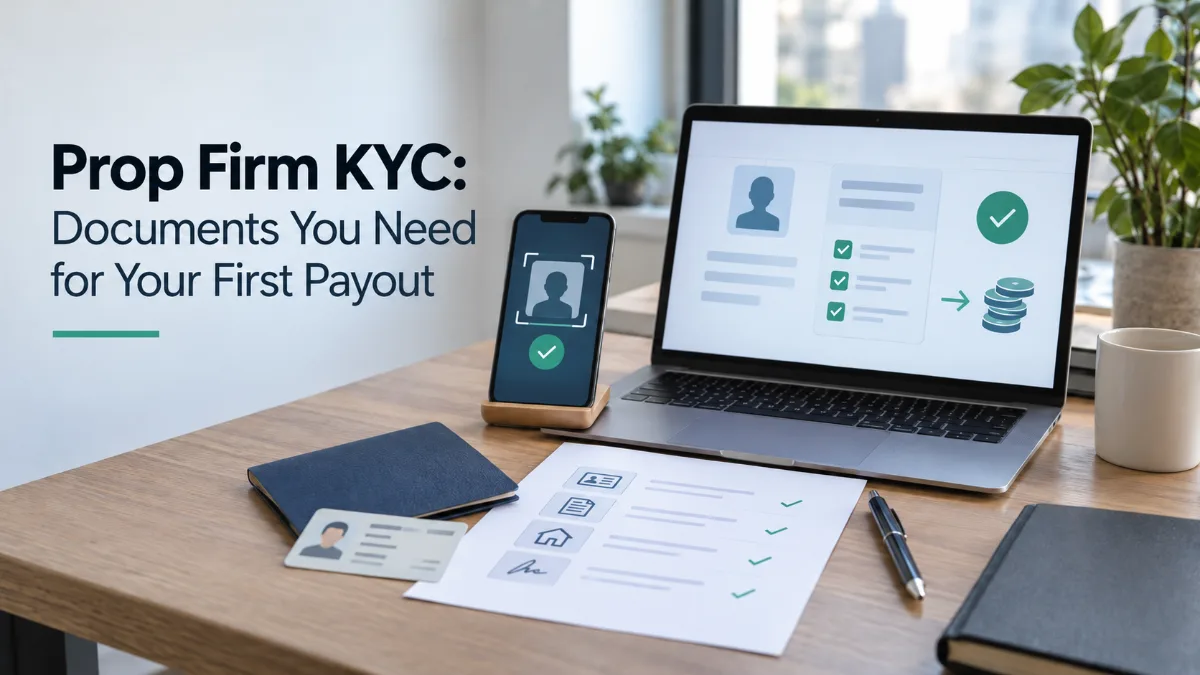
Prop firm KYC is the identity verification process a proprietary trading firm uses to confirm that the person receiving an account or payout is the same person who registered and traded it. For a first payout, the safest assumption is that you may need a valid government-issued photo ID, accurate profile information, a selfie or liveness check, and sometimes proof of address. A firm may also verify that the payout destination belongs to you.
KYC does not work exactly the same way at every prop firm. Some firms verify traders after a challenge is passed, some wait until the first payout request, and others trigger additional checks when account details change or a verification provider flags a mismatch. The required document types can also depend on your country of residence and the firm's verification provider. Prepare the standard documents before you become payout-eligible, but follow the exact instructions shown in your own account dashboard.
What prop firm KYC checks before a payout
KYC means Know Your Customer. Its core purpose is to establish the identity of the person behind an account. In regulated financial services, customer due diligence normally includes identifying a customer and verifying that identity. The Financial Action Task Force describes identity verification as using reliable and independent source documents, data or information, while also recognizing digital identity methods. Prop firms are not all subject to the same regulatory framework as banks or brokers, but many use comparable identity-verification tools to reduce impersonation, duplicate-account abuse and payment fraud.
A normal prop firm verification flow may compare several pieces of information: the legal name on your profile, the name and date of birth on your ID, your country or residence details, the person shown in a liveness check, and the owner of the payout account or payment method. If one part does not match, the firm may pause verification and ask for a new submission or additional evidence.
KYC should also be separated from a broader payout review. Passing identity verification proves that the firm accepted your identity evidence. It does not necessarily prove that every trading rule was satisfied or that a payout method is valid. A first payout can therefore be delayed even after KYC approval if the firm is still checking account activity, payout details or compliance with its trading terms.
Prop firm KYC documents you should prepare
The exact checklist depends on the firm, but most first-time verification requests can be handled with a small set of documents and device-based checks. The table below separates the documents commonly requested from the conditions that often cause rejection.
| Verification item | What it usually proves | What to check before submitting |
|---|---|---|
| Passport | Legal identity and nationality | Valid document with a clear photo and all requested edges visible |
| National ID card | Legal identity and personal details | Use the physical document if required and capture the requested front or back sides |
| Driver's license | Identity where the firm accepts it | Acceptance can depend on country and provider rules |
| Residence permit | Identity or residence status where accepted | Confirm that the specific permit type appears on the accepted-document list |
| Proof of address | Current residential address | Name and address should match the profile and the document must fall within the firm's accepted age limit |
| Selfie or liveness check | That a real person matches the submitted ID | Use a working camera with good natural lighting and follow movement prompts exactly |
| Payout account details | That the requested destination can be tied to the verified trader | Use your own bank or payment account when the firm's rules require matching ownership |
For the photo ID, use a document that is valid on the day of verification. Do not assume an expired passport or license will be accepted just because the photograph still resembles you. Verification software often reads the document number, expiration date and machine-readable fields in addition to checking the image.
Proof of address is not universal. When requested, common examples include a bank statement or utility bill that shows your full name, residential address, issuer and issue date. The firm may impose a recency requirement, so a document that was acceptable for another service may be too old for the current prop firm KYC check. Downloading an official statement from your bank is usually safer than submitting an informal screenshot of a banking app.
How prop firm verification usually works
The first step is normally a prompt inside the trader dashboard or a secure verification link sent through the firm's approved channel. You enter or confirm your personal information and then submit the requested identity document. Many firms use a third-party identity provider, so the upload screen may have different branding from the prop firm's main dashboard.
- Confirm your profile data. Check the spelling of your legal name, date of birth, address and country before uploading anything.
- Select an accepted ID. Use the document type permitted for your country and make sure it is unexpired.
- Capture the document clearly. Photograph the original document in good light. Avoid glare, blur, cropped corners and fingers covering text.
- Complete the selfie or liveness step. Follow on-screen instructions so the system can compare a live image with the ID portrait.
- Provide address evidence if requested. Submit the exact category of document allowed by the verification page.
- Wait for an approved status. A submission confirmation is not the same as successful verification. Do not assume KYC is complete until the dashboard shows approval or the firm confirms it.
- Submit the payout details. Use a payout method that meets the firm's ownership and country rules.
The Financial Conduct Authority explains that firms carrying out customer due diligence should identify customers and verify their identities, with additional information collected when risk requires it. That principle helps explain why two traders at the same company can sometimes see different verification requests. An extra document does not automatically mean something is wrong. It can be a response to incomplete data, a higher-risk match, a provider limitation or a need to resolve conflicting information.
Why prop firm payout verification can fail
Most preventable failures come from inconsistency or poor document capture rather than from the concept of KYC itself. Automated systems are designed to compare structured fields. A small difference that looks harmless to a person can create an exception that requires manual review.
- Name mismatch: Your dashboard uses a nickname, shortened surname or different transliteration from the government ID.
- Expired document: The ID was valid when you bought the challenge but expired before verification.
- Unreadable image: Glare, blur, low resolution or cropped edges prevent the software from reading security features or text.
- Unsupported document: The document is genuine but the firm or verification provider does not accept that type for your country.
- Address mismatch: Your profile shows an old address while the submitted statement shows the new one.
- Screen copy instead of original: The provider expects a live capture of a physical document rather than a screenshot or photograph displayed on another device.
- Liveness failure: Poor lighting, camera permissions or failure to follow movement prompts stops the face match from completing.
- Payout ownership mismatch: The requested bank or payment account is in another person's name when the firm's rules require the verified trader to be the owner.
Do not alter an identity document to make it look cleaner. Cropping out security features, covering information, applying filters or editing text can cause a genuine document to fail. If the firm allows certain sensitive fields to be hidden, follow its instructions precisely rather than deciding yourself what to obscure.
How to fix common KYC problems
Start with the rejection reason shown by the verification provider or support team. Resubmitting the same image repeatedly is rarely useful if the underlying problem is a name mismatch or unsupported document type. Fix the cause first.
If your legal name differs from the name on the trading profile, ask the firm how it handles profile corrections before making another attempt. Do not create a second account simply to force a different name through the system. Duplicate profiles can create a separate compliance problem under firm rules.
If proof of address is rejected, check four fields before replacing it: your full name, full residential address, issuer and issue date. A bank statement may be more useful than a utility bill when utilities are registered to a landlord or family member. If you recently moved, contact support before changing profile data so you know which address and evidence the firm expects.
If the selfie step fails, switch to a device with a better camera, allow camera permissions and use even lighting. Remove anything that blocks your face unless it is required for medical or religious reasons. When an accessibility or document issue prevents standard verification, ask whether the provider supports a manual or alternative process. Do not send sensitive files through an unofficial social-media account or a support contact you cannot authenticate.
What firms may check beyond your ID
Prop firm payout verification can include more than document recognition. A firm may need to confirm that the same person controls the trader profile and the payout destination. It may also review whether the account was registered with accurate personal information and whether multiple accounts are being used in a way that violates its terms.
Some verification systems also perform screening that is not visible to the trader. In formal financial-sector customer due diligence, the depth of checks can increase when risk is higher. The FCA's customer due diligence guidance describes enhanced measures for higher-risk situations. A prop firm's own obligations depend on its legal structure, location, payment partners and service providers, so traders should not assume that every prop firm performs the same screening or is regulated in the same way.
Tax documentation is another area that is often confused with KYC. A firm or payout provider may request a tax form, tax identification number or residency declaration. That request can be necessary for payment administration, but it is not the same thing as proving your identity with a passport or national ID. Treat tax forms as a separate requirement and complete only the forms that apply to your circumstances and the payer's instructions.
How to prepare for your first payout
The best time to prepare for prop firm KYC is before the payout button becomes available. Waiting until the last day can turn a simple document problem into a frustrating delay. A short pre-payout check can prevent most avoidable issues.
- Make sure the legal name on your prop firm profile matches your current government ID.
- Check that your ID will remain valid through the expected verification period.
- Keep an accepted proof-of-address document available in case the firm requests one.
- Use a phone or computer with a reliable camera for a liveness check.
- Confirm that your payout method is permitted in your country and is registered to you when required.
- Read the firm's current KYC and payout rules inside its official dashboard or help center before submitting.
- Resolve profile changes such as a new address or legal name before requesting the payout where possible.
- Keep confirmation emails or dashboard messages showing that verification was approved.
Also separate the three questions that determine whether money can actually be released: Is your identity approved? Is the payout destination acceptable? Is the trading account eligible for a payout under the firm's rules? A trader can pass the first question and still need to resolve one of the other two. This distinction makes support conversations much faster because you can ask which layer of the payout process is still pending.
KYC privacy and document safety
KYC involves high-value personal data. Use only the firm's official website, authenticated dashboard or verification link generated through an official channel. Before uploading documents, check the domain carefully and review the firm's privacy notice to understand whether a third-party verification provider processes the data.
Do not post identity documents in public forums or send them to people claiming they can speed up a payout. A legitimate verification process should give you a defined submission route. If support asks for a document by email or another channel, confirm that the request came from an address or ticket system listed by the firm itself.
Digital verification is not inherently less valid than physical-document review. FATF guidance recognizes that reliable digital identity systems can be used for customer identification and verification. What matters is whether the process reliably links the evidence to the person being verified. For the trader, the practical rule is simpler: follow the approved capture process and do not bypass security steps with edited files or borrowed documents.
Questions about prop firm payout verification
Do all prop firms require KYC before the first payout?
No. Many do, but the trigger differs by firm. Verification may occur after passing an evaluation, before a funded account is activated, before the first payout or after a later compliance trigger. Check the current rules for the specific account type you purchased.
Which ID is best for prop firm KYC?
A valid passport or national identity card is usually the safest starting point because these are widely supported by identity-verification systems. A driver's license or residence permit may also be accepted, but eligibility can depend on your country and the firm's provider. Use the document list shown in your verification flow rather than assuming every government ID qualifies.
Do I always need proof of address?
No. Some verification flows request only a photo ID and liveness check. Others require proof of address for all traders or only when additional verification is needed. If it is requested, use a document category specifically allowed by the firm and make sure it shows your current name and residential address.
Can I use a screenshot of my ID?
Only if the verification instructions explicitly permit it. Many systems require a fresh camera capture of the original physical document and can reject screenshots, scans or images displayed on another screen. Follow the capture method shown by the provider.
Can someone else receive my prop firm payout?
Do not assume so. Many payout and anti-fraud controls are designed to keep the verified trader and payment recipient consistent. If you want to use a joint account, business account or another person's payment method, ask the firm whether that setup is allowed before submitting the request.
Does approved KYC guarantee that I will be paid?
No. Approved KYC resolves the identity-verification requirement. The firm may still need to confirm payout-method eligibility, trading-rule compliance and any other conditions in the account agreement. If a payout is pending after KYC approval, ask whether the remaining review concerns identity, payment details or trading activity.