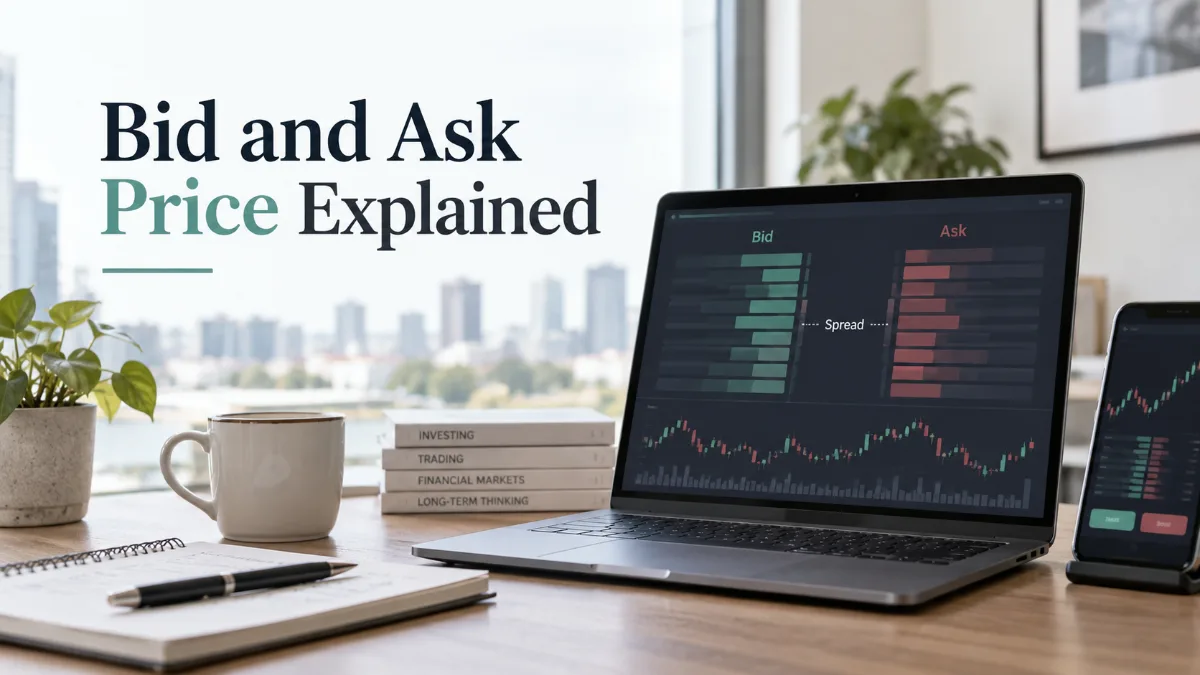
The bid is the highest price a buyer is currently willing to pay for an asset and the ask is the lowest price a seller is currently willing to accept. The ask is also called the offer. In a normal two-sided market the bid sits below the ask. The difference between them is the bid ask spread.
This distinction explains why the buy price is usually higher than the sell price. A trader who wants to buy immediately must generally trade with the lowest available seller at the ask. A trader who wants to sell immediately must generally trade with the highest available buyer at the bid. The two prices are therefore not competing labels for one value. They represent opposite sides of the market.
Bid vs ask price: the core difference
The easiest way to understand bid vs ask price is to treat a quote as a live negotiation. Buyers post prices they are willing to pay. Sellers post prices they are willing to accept. When the best buying interest and best selling interest are displayed together they form the current bid and ask.
The U.S. Securities and Exchange Commission's investor education site defines the bid as the highest price a buyer will pay and the ask as the lowest price at which a seller will sell. It also identifies the difference as the spread. The same basic terminology is summarized by Investor.gov.
| Quote element | What it represents | What an immediate trader normally does |
|---|---|---|
| Bid | Highest current buying price | Sells into the bid |
| Ask | Lowest current selling price | Buys from the ask |
| Spread | Ask minus bid | Pays for immediacy when crossing the market |
| Midpoint | Halfway between bid and ask | Uses it as a reference rather than a guaranteed trade price |
Suppose a stock is quoted at $49.98 bid and $50.02 ask. An immediate seller may receive about $49.98 per share while an immediate buyer may pay about $50.02 per share. The midpoint is $50.00 but there may be no order available exactly at that midpoint. A midpoint is a useful reference value rather than a promise that a trade can occur there.
Why is the buy price higher?
The buy price is higher because an immediate buyer is accepting the price offered by sellers. The best seller currently wants $50.02 in the example above. The best buyer currently offers only $49.98. If you insist on buying now instead of waiting for a seller to lower a price or for your own limit order to be matched then you cross the spread and trade at the ask.
The same logic works in reverse. If you insist on selling now then you accept the best available buying interest and trade at the bid. That is why a platform may show a position slightly negative immediately after entry even if the broader market has not visibly moved. A position bought at the ask is often marked against a bid or another reference price that is lower.
This does not mean every broker simply adds an arbitrary surcharge to every buy order. In exchange-traded markets the bid and ask emerge from available orders and liquidity across trading venues. Dealers and market makers can also quote two-sided prices. The spread compensates liquidity suppliers for costs and risks that can include adverse price moves and inventory exposure. Market structure differs by asset class so the economic meaning of the displayed spread should not be reduced to a single universal fee.
How the bid ask spread becomes a trading cost
The spread becomes most visible when a trader buys and then sells without any favorable market movement. If the quote is $99.95 bid and $100.05 ask then the quoted spread is $0.10. Buying one share at $100.05 and immediately selling it at $99.95 would create a $0.10 loss before commissions and other charges. For 100 shares the difference would be $10 if both executions occurred at those quoted prices and the quote did not change.
A useful relative measure is the spread divided by the midpoint. With a $99.95 bid and $100.05 ask the midpoint is $100.00. A $0.10 spread is 0.10% of the midpoint or 10 basis points. Relative spread makes comparisons easier when two assets have very different price levels.
It is also useful to distinguish the quoted spread from the trader's actual execution cost. A marketable order can sometimes receive price improvement inside the displayed spread. A larger order can also execute across several price levels and cost more than the top quote suggests. The displayed spread is therefore an important first measure of trading cost but not a complete measure of execution quality.
What makes the bid ask spread narrow or wide?
Spreads tend to be narrower when many buyers and sellers compete near the current market price and when liquidity providers can manage risk with relatively little uncertainty. They tend to widen when trading interest is thin or when the risk of prices moving before a liquidity provider can offset a position increases.
- Liquidity: More competing orders near the market can reduce the gap between the best bid and best ask.
- Volatility: Fast price changes increase the risk that a standing quote becomes stale before it can be adjusted.
- Trading activity: Quiet instruments can have fewer orders close to the current price and therefore wider gaps.
- Time of day: Liquidity can vary across the trading session. Conditions outside regular hours can be materially different.
- News and uncertainty: New information can cause participants to cancel or reprice orders quickly.
- Order size: A small displayed spread says little about how much quantity is available at the best prices.
These factors interact rather than operate as fixed rules. A heavily traded asset can still experience a wider spread during a sudden information shock. Conversely a normally quiet asset can temporarily show a tight spread if buyers and sellers happen to compete closely at that moment.
Bid ask prices and market depth
The top bid and ask show only the best displayed prices. They do not tell you how much can be traded at those prices. Market depth describes the quantities available at multiple price levels. This matters because a large market order may exhaust the quantity at the best quote and continue into worse prices.
Imagine an ask of $25.01 with only 100 shares available. The next offers are 400 shares at $25.03 and 1,000 shares at $25.07. A market order to buy 1,000 shares cannot be assumed to fill entirely at $25.01. It may consume several offer levels. The average execution price could therefore be above the initial ask even though the displayed spread looked small when the order was submitted.
This is one reason experienced traders evaluate both spread and depth. A one-cent spread with very little available size can be less favorable for a large order than a two-cent spread supported by substantial depth. The relevant question is not only "How wide is the spread?" but also "How much can I trade before the price changes?"
Market orders and limit orders around the spread
A market order prioritizes immediate execution but does not guarantee the execution price. A limit order places a boundary on price but does not guarantee execution. FINRA explains that a market buy generally executes at or near the current ask while a market sell generally executes at or near the current bid. It also notes that the last-traded price is not necessarily the price a new market order will receive.
Assume the market is $40.00 bid and $40.10 ask. A trader who submits a market buy is asking for the best available sell liquidity now. A trader who instead submits a buy limit at $40.03 refuses to pay more than $40.03. If that order is eligible for display and becomes the highest displayed buying interest then it can improve the bid. It may still remain unfilled if no seller accepts that price.
This creates the central trade-off between immediacy and price control. Crossing the spread usually increases the chance of trading quickly. Posting a non-marketable limit order can seek a better price but introduces waiting risk and non-execution risk. Neither order type is automatically superior in every situation.
Why your execution price can differ from the quote
A displayed bid ask quote is a snapshot. Markets can change between the moment you see a quote and the moment an order reaches an execution venue. The quantity available at the best price may also be smaller than your order. These effects can produce slippage which is the difference between an expected price and the actual execution price.
Execution can also be better than the displayed quote. For example a marketable buy could receive a fill below the displayed ask if a broker or venue provides price improvement. This is why the full quoted spread should not always be treated as the exact cost of one trade. Actual cost depends on the execution price relative to the market that existed when the order was handled.
For a practical check compare the execution price with the bid and ask that were available when the order became executable. For larger orders also examine whether the fill was split across multiple prices. A single final average price can hide the fact that the first portion traded at the best quote while later portions consumed deeper liquidity.
How bid and ask work in forex
Forex quotes use the same basic two-sided logic but the quote represents the value of one currency in terms of another. If EUR/USD is quoted at 1.1000 bid and 1.1002 ask then a trader buying euros against U.S. dollars generally pays the ask of 1.1002. A trader selling euros against U.S. dollars generally receives the bid of 1.1000. The spread is 0.0002 in the quoted exchange rate.
Investor.gov likewise describes the ask as the amount required to purchase a currency and the bid as the lower amount received when selling it. In retail off-exchange forex the investor trades with a counterparty rather than through a centralized stock exchange so the source and presentation of quotes can differ from exchange-traded equities.
The key reading rule remains stable: identify which currency you are buying or selling and then identify which side of the quote applies. Confusion often comes from thinking only about the currency pair as a single object rather than recognizing that one currency is being exchanged for the other.
How to read bid ask quotes in practice
A quote becomes easier to interpret when you follow the same sequence each time.
- Identify the bid. This is the highest currently displayed buying price relevant to the quote you are viewing.
- Identify the ask. This is the lowest currently displayed selling price relevant to that quote.
- Calculate the spread. Subtract the bid from the ask.
- Check the size. Determine how much quantity is actually available at or near the best prices if your platform provides depth data.
- Match the side to your action. An immediate buy generally interacts with the ask while an immediate sell generally interacts with the bid.
- Choose the order type. Decide whether immediacy or price control is more important for that trade.
Suppose a quote reads $72.40 bid and $72.46 ask. The spread is $0.06. If you want 20 shares and sufficient size is available at $72.46 then an immediate buy may fill around the ask. If you instead place a buy limit at $72.42 then you are offering more than the current bid but less than the current ask. You may get a better price if a seller accepts it but the market can move upward without filling your order.
Common bid ask mistakes
Treating the last price as the buy price is one of the most common errors. The last price records a completed transaction. It may sit at the bid at the ask or somewhere between them and it can become stale. A new market order interacts with currently available liquidity rather than automatically receiving the previous trade price.
Assuming the spread is fixed is another mistake. Bid ask prices can update rapidly. A spread that is narrow during an active session can widen when liquidity falls or uncertainty rises. A trading plan based on a spread observed earlier may not describe the cost available when the order is actually sent.
Ignoring order size can be costly. The best ask may be attractive but available for only a small quantity. A larger purchase can move through several offer levels. The same applies to a large sale moving through several bids.
Calling the entire spread a broker commission oversimplifies market structure. A spread can reflect competition among public limit orders and professional liquidity providers. Some trading models also embed compensation in quoted prices. Commissions and spread costs should therefore be evaluated separately unless a venue explicitly combines them.
Assuming a limit order must fill because the market touched the price is also unsafe. Other orders can have priority and available quantity can be exhausted before your order executes. A limit controls the worst acceptable price. It does not promise a fill.
When the spread matters most
The spread matters whenever trading frequency or order urgency makes transaction costs important. A long-term investor making an occasional trade in a highly liquid security may experience a small spread relative to the investment horizon. A short-term strategy that enters and exits repeatedly can be much more sensitive because the spread is encountered again and again.
Spread sensitivity also increases for illiquid securities and during periods when quotes are changing quickly. A seemingly small percentage cost can become meaningful when repeated across many transactions. For that reason the right comparison is not simply whether a spread looks large in cents. Consider the spread relative to the asset price and the intended holding period as well as the size of the order.
The most useful mental model is simple: the bid is where immediate sellers find buyers and the ask is where immediate buyers find sellers. The gap between them is the bid ask spread. Once that model is clear the apparent mystery of why the buy price is higher disappears. You are seeing two sides of a live market rather than two contradictory prices for the same trade.