Forex Blog
Latest news, guides and expert analyses from the forex market.
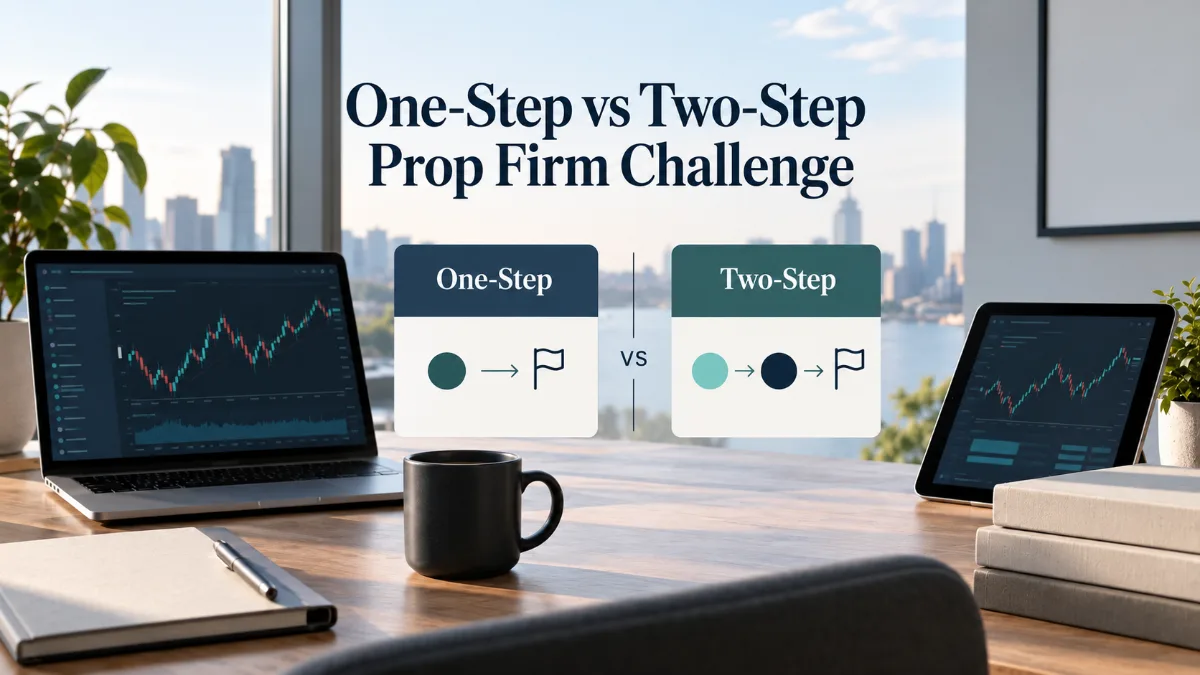
One-Step vs Two-Step Prop Firm Challenge
One-step challenges use a single evaluation phase, while two-step challenges require traders to qualify twice. Neither format is automatically easier because targets, drawdown rules, time limits, costs and post-pass conditions determine how well each challenge fits a trading strategy.

Prop Firm Challenge Explained: Phases, Targets and Limits
A prop firm challenge tests whether a trader can reach a profit target while staying within defined loss and conduct rules. The article explains evaluation phases, daily and total drawdown limits, consistency requirements, funded account conditions and how to compare challenge difficulty.

Cheapest Prop Firm Challenges: Lowest Fees Compared
The cheapest prop firm challenge depends on more than the entry fee. This comparison reviews listed fees, billing models, activation costs, refund conditions and rule differences to show which low cost prop firm options may offer the lowest total cost for different traders.

Futures Prop Firm vs Forex Prop Firm: Which Fits You
Futures prop firms suit traders who prefer exchange traded contracts, centralized pricing and contract based risk management. Forex prop firms may fit traders who focus on currency pairs, flexible lot sizing and retail FX trading conventions. The best choice depends on strategy fit, drawdown rules, costs and payout conditions.

Best Futures Prop Firms Compared by Rules and Cost
This comparison evaluates futures prop firms by evaluation cost, drawdown mechanics, consistency rules, payout requirements and post-pass fees. It covers Topstep, Apex Trader Funding, Take Profit Trader, My Funded Futures and Tradeify while explaining which rule structures suit different trading styles.
Instant Funding Prop Firms: No Challenge Accounts Compared
Instant funding prop firms provide access to funded style accounts without requiring a traditional challenge first. The article compares current programs by drawdown structure, payout conditions, costs, profit splits and trading restrictions, while explaining how to judge usable risk rather than headline account size.
How to File Prop Firm Taxes: Payouts, Forms and Deductions
Prop firm payouts are generally taxable in the U.S., but the correct treatment depends on whether the income is wages, contractor compensation or another category. The guide explains common tax forms, deductible business expenses, self-employment tax, estimated payments and recordkeeping.
Common Mistakes in Funded Trading Accounts (and How to Avoid Them)
Funded trading accounts require traders to manage both market risk and firm-specific rules. Common failures include oversized positions, misunderstood drawdown limits, overtrading, ignored costs, prohibited strategies and weak payout planning.

Funded Account Trading: Rules, Costs and Payouts
Funded account trading gives traders access to a defined capital allocation or performance based program under strict trading rules. Costs, drawdown limits, payout conditions and account structure determine whether a funded account fits a trader's strategy and risk profile.

What Is a Funded Trading Account and How Do You Get One
A funded trading account gives traders access to firm capital or a program defined account after meeting specific qualification and risk rules. The article explains evaluations, drawdowns, costs, payouts, account structures, common mistakes and how to assess whether a funded program fits a trading strategy.
What Is Prop Trading? Proprietary Trading Explained
Prop trading means trading with a firm's own capital for its own economic benefit rather than managing client money. The article explains how proprietary trading works, compares it with retail trading and examines risk controls, funded trader programs and key evaluation criteria.

What Is a Prop Firm? How Proprietary Trading Firms Work
A prop firm trades financial markets using business capital and manages traders through defined risk controls. The article also explains how traditional proprietary firms differ from retail funded trader programs, including simulated accounts, evaluations, drawdown rules, fees, and payouts.