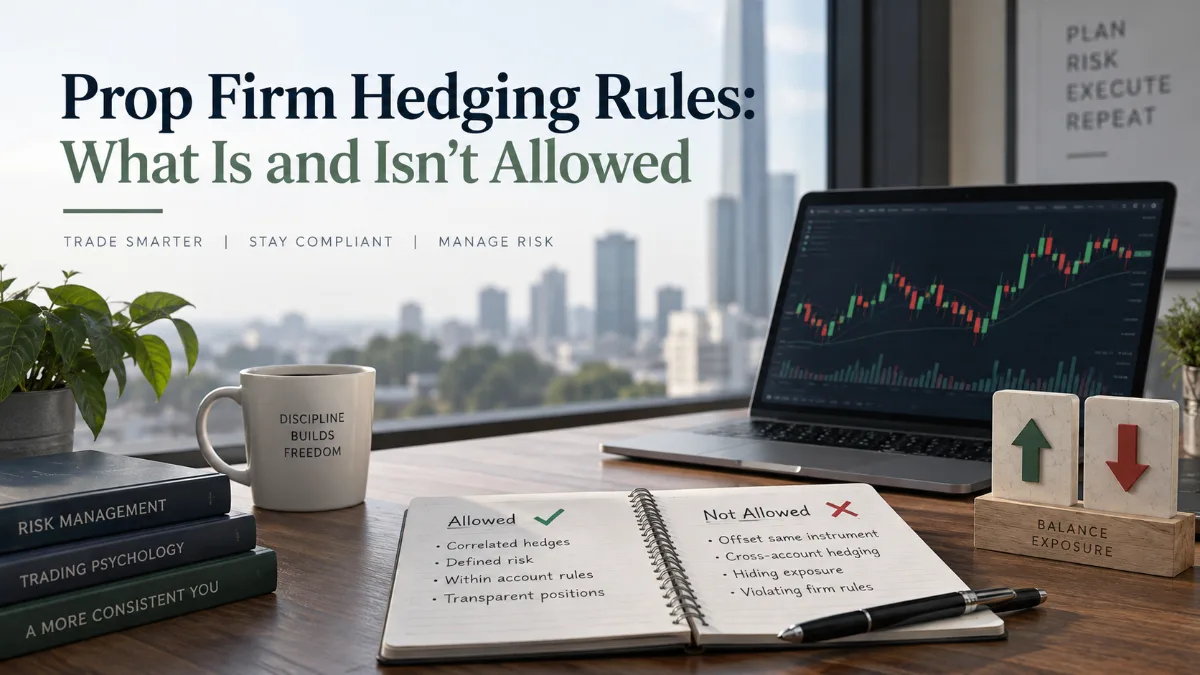
Can you hedge in a prop firm? Sometimes, but the answer depends on what the firm means by hedging. A prop firm hedging rule may allow opposite positions inside one account while banning opposite positions across two accounts. Another firm may prohibit hedging entirely. Futures programs may also use netting accounts that technically prevent simultaneous long and short positions in the same contract.
The safest way to read any prop firm hedging ban is to separate four questions: whether same-account hedging is allowed, whether cross-account hedging is allowed, whether correlated instruments count as a hedge, and whether coordinated trading with another person is prohibited. These are different rule categories even when a firm uses the single word hedging.
Prop firm hedging rules at a glance
| Trading pattern | What it means | Typical rule risk |
|---|---|---|
| Same-account hedge | Long and short positions are held in the same instrument inside one account. | Firm-specific. Some programs allow it while others ban it. |
| Cross-account hedge | One account is long while another account is short in the same or equivalent market. | Frequently prohibited because the combined positions reduce directional risk across accounts. |
| Correlated cross-account hedge | Opposite exposure is created with related instruments rather than the exact same symbol. | Potentially prohibited when the firm treats correlated markets as an offsetting structure. |
| Group hedging | Two or more people coordinate opposite positions across separate accounts. | Usually treated as prohibited coordinated trading rather than ordinary risk management. |
| Position reversal | An existing position is closed and a new position is opened in the opposite direction. | Normally distinct from hedging if there is no simultaneous opposite exposure. |
| Same-direction trading across accounts | Multiple accounts take the same directional trade. | Not automatically hedging but copy-trading or account-limit rules may still apply. |
What prop firm hedging actually means
Hedging in finance means using an offsetting position to reduce exposure to an adverse price move. The Commodity Futures Trading Commission describes futures hedging as a way for commercial participants to limit price risk. That conventional economic meaning is broader than the way many prop firms use the term in their challenge rules.
In a prop program the concern is often not hedging itself. The concern is where the offsetting exposure sits and what the combined structure does to the evaluation. If Account A is long and Account B is short with similar size, the trader may be able to concentrate losses in one account and gains in the other. A firm can therefore classify the arrangement as an attempt to reduce market risk across accounts while preserving the possibility that one account reaches a target or payout threshold.
Platform hedging is not the same as permission
Trading software can support a hedging account even when the prop firm's rules restrict hedging strategies. This distinction causes many avoidable breaches.
MetaTrader 5 supports both netting and hedging position-accounting systems. Under netting, opposite trades in the same symbol reduce, close, or reverse the existing position. Under hedging mode, multiple positions in the same symbol can remain open at once, including opposite positions.
Platform capability answers only whether the software can hold both positions. It does not determine whether the prop firm's contract permits the strategy.
Same-account hedging can be allowed or banned
A same-account hedge occurs when both sides are held inside one account. For example, a trader might hold 1.0 lot long EUR/USD and open 0.4 lot short EUR/USD without closing the long. The account then has 1.4 lots of gross open exposure but approximately 0.6 lot of net directional exposure before considering differences in entry price and transaction costs.
Some prop programs permit this because both legs remain subject to the same drawdown limit, account balance, and payout conditions. Other programs prohibit it because they want every position to express a clear directional or strategy-based risk. A netting platform may make the issue irrelevant by automatically reducing the original position when the opposite order executes.
Do not infer permission from the fact that the order ticket accepts the trade. If a firm's rules use broad wording such as "hedging is prohibited," assume same-account hedging is included unless the firm clearly states otherwise.
Why cross-account hedging gets stricter treatment
Cross-account hedging means using separate accounts as the two sides of an offset. A simple example is long EUR/USD in Account A and short EUR/USD in Account B at roughly the same time and size. The trader's combined directional exposure may be close to zero even though each account individually shows a directional trade.
That structure can change the economics of an evaluation. If a trader deliberately pushes one account long and another short, one may fail while the other gains. The structure can shift the objective from forecasting the market toward exploiting differences between account fees, loss limits, targets, and payout eligibility.
For that reason many programs treat opposite-account trading as a separate prohibited practice even if same-account hedging is allowed. The prohibition may extend beyond accounts at the same firm and may include accounts held through different registrations or coordinated with another person.
Correlated instruments can still create a hedge
A prop firm hedging ban may apply when the two legs use different symbols. The key question is whether the positions are intentionally structured to offset market risk.
Examples can include a long position in a standard futures contract and a short position in its micro equivalent, or opposite trades in two highly related equity index products. In forex, a trader could also create partially offsetting currency exposure through different pairs. The relationship is rarely perfect, so these trades carry basis and correlation risk, but a firm may still view them as cross-account hedging if their purpose is to neutralize direction.
This creates an important gray area. Legitimate relative-value strategies also trade related instruments in opposite directions. A spread trader may be expressing a view on the relationship between two markets rather than trying to game account outcomes. If the rules mention "correlated instruments," "equivalent contracts," "offsetting risk," or "related products," get written clarification before using a multi-leg strategy across accounts.
Group hedging is more than two opposite trades
Group hedging generally means coordinated offsetting activity between different people or registrations. One trader may take the long side while another takes the short side, or several accounts may be divided into opposing groups. The participants then rely on the combined account structure rather than independent trading decisions.
Prop firms often place this conduct alongside account sharing, copy trading, collusion, or other coordinated behavior. The issue is not whether the traders know the technical definition of a hedge. The issue is whether the combined trades are designed to distribute risk and outcomes across accounts in a way the program forbids.
A prop firm hedging ban is not a universal market ban
Hedging is a standard risk-management activity in many professional markets. A prop firm's restriction is usually a rule of its own program rather than a statement that hedging is inherently improper or illegal.
Regulatory rules can also differ by product and account type. In the United States, for example, National Futures Association Compliance Rule 2-43(b) requires Forex Dealer Members to offset positions in a customer account rather than carry opposite positions in the same pair. That retail forex rule should not be confused with the contract terms of a simulated prop evaluation or with hedging practices in futures and institutional markets.
The practical lesson is simple: do not use a general statement such as "hedging is legal" or "my platform supports hedging" as evidence that a specific prop strategy is permitted. The relevant question is whether your account agreement allows the exact pattern you plan to trade.
What usually does not count as hedging
Several common trading actions can look superficially similar to hedging but are economically different.
- Closing and reversing: You exit a long position and then open a short position. If the positions do not overlap, you are changing direction rather than holding an offsetting hedge.
- Reducing position size: Selling part of an existing long position lowers net exposure without creating a separate offsetting position on a netting account.
- Using a stop loss: A stop closes or reduces exposure when a trigger is reached. It does not create simultaneous opposite exposure.
- Trading the same direction in two accounts: Both accounts may be long the same market. That is not hedging because the combined directional risk is increased rather than offset. Separate copy-trading rules may still matter.
- Trading unrelated markets: A long gold position and a short position in an unrelated market are not automatically a hedge merely because the directions differ.
Intent alone does not determine classification. Firms can use objective patterns such as simultaneous positions, equivalent contract exposure, account ownership, correlation, and repeated coordination. A strategy can therefore be flagged even when the trader describes it differently.
Common hedging edge cases
Can you hedge in one prop firm account?
Only if that firm's rules permit it and the platform supports the required position accounting. Same-account hedging is explicitly allowed in some programs and prohibited in others. If the policy simply says "hedging is not allowed" without limiting the ban to multiple accounts, treat the restriction as broad until support confirms otherwise.
Can you hedge across two accounts you own?
This is one of the highest-risk patterns under prop firm hedging rules. Ownership does not make the accounts one combined portfolio. If one account is long while another is short to offset exposure, many programs classify the structure as cross-account hedging.
Can you hedge across different prop firms?
Do not assume this is safe. Some rulebooks define prohibited hedging by the trader's overall behavior rather than only by accounts on the same platform. A firm may consider external accounts when it evaluates whether positions were intentionally offset. Because firms differ in what data they use and how broadly their terms are written, this question should be confirmed before trading.
Does an accidental overlap count?
It can. A reversal order, copier delay, duplicate strategy, pending order, or automation error can temporarily create opposite positions. Some firms may distinguish brief operational mistakes from deliberate hedging while others use stricter rules. Close unintended exposure promptly and keep records showing what happened. Do not rely on intent as a guaranteed defense.
Can an EA or trade copier create a violation?
Yes. Automation does not transfer responsibility away from the account holder. A copier can send an opposite order to the wrong account, and an EA can open a hedge because of conflicting signals or duplicated instances. If your setup controls multiple accounts, test symbol mapping, direction, lot multipliers, order sequencing, and failure behavior before using it under a funded-program rule set.
Why a perfect hedge may not help your account
Even when same-account hedging is allowed, a fully matched hedge is not the same as removing the position. If you hold equal long and short exposure in the same instrument, your net directional sensitivity may be close to zero, but both legs can still generate spread, commission, financing, or other trading costs. Margin treatment also depends on the platform and account configuration.
A hedge can also lock an existing floating result rather than repair it. To regain directional exposure you eventually need to remove or resize one side.
For prop accounts, the more important question is how both legs affect the firm's drawdown calculation. Some limits use equity and therefore include open profit and loss. A hedge does not automatically protect you from commissions, swaps, spread widening, slippage, or rule calculations that continue while both positions remain open.
Safer alternatives when hedging is prohibited
If a prop firm hedging ban conflicts with your normal risk process, redesign the risk control rather than trying to reproduce the same exposure through another account.
- Reduce the original position: Partial closing lowers risk directly and is easier to interpret under most rule sets.
- Use a predefined stop: Define the point where the original trade thesis is invalid and exit rather than locking the position.
- Lower initial size: Smaller positions reduce the need to hedge after the trade moves against you.
- Separate strategies by time: Finish one directional idea before opening an opposing strategy if simultaneous exposure creates a rule conflict.
- Use independent account logic: If multiple accounts are permitted, make sure each account is traded according to an allowed strategy rather than using one account to offset another.
How to check a hedging rule before paying
- Read the prohibited-strategy section. Search for hedging, offsetting, opposite positions, correlated instruments, equivalent contracts, group trading, coordinated trading, reverse trading, copy trading, and arbitrage.
- Check the account scope. Determine whether the rule applies to one account, all accounts under your identity, other traders, external accounts, or accounts at other providers.
- Check the instrument scope. Look for language covering the same symbol as well as related contracts and correlated products.
- Check each program stage. Evaluation, simulated funded, and live funded stages can have different permissions.
- Confirm the platform model. Know whether the account uses hedging or netting position accounting. Technical capability and rule permission must both be satisfied.
- Ask with a concrete example. Instead of asking "Is hedging allowed?" describe the exact trades you intend to place. Include accounts, symbols, direction, size, and whether positions can overlap.
- Keep the written answer. If support clarifies an ambiguous rule, retain the response with the version of the terms you relied on.
The most useful question is not simply "Does this prop firm allow hedging?" Ask which hedging structure is allowed on which account type and across which instruments. That wording forces the rule to be interpreted at the level where violations actually occur.
The rule to use when the policy is unclear
If the terms are ambiguous, avoid simultaneous opposite exposure across accounts until the firm clarifies it. Cross-account hedging is the category most likely to create a serious compliance problem because it can change the economic purpose of an evaluation from directional trading to outcome distribution between accounts.
For same-account hedging, verify both the written trading policy and the platform's position-accounting method. For correlated instruments, assume that using a different ticker does not automatically make an offsetting structure acceptable. For group trading, treat coordinated opposite positions as a separate compliance risk even if every participant controls a different account.
A prop firm hedging rule is therefore best understood as an account-structure rule rather than a one-line ban on buying and selling at the same time. Once you separate same-account hedging, cross-account hedging, correlated offsets, and coordinated trading, the answer to "can you hedge in a prop firm?" becomes much easier to determine from the actual terms.