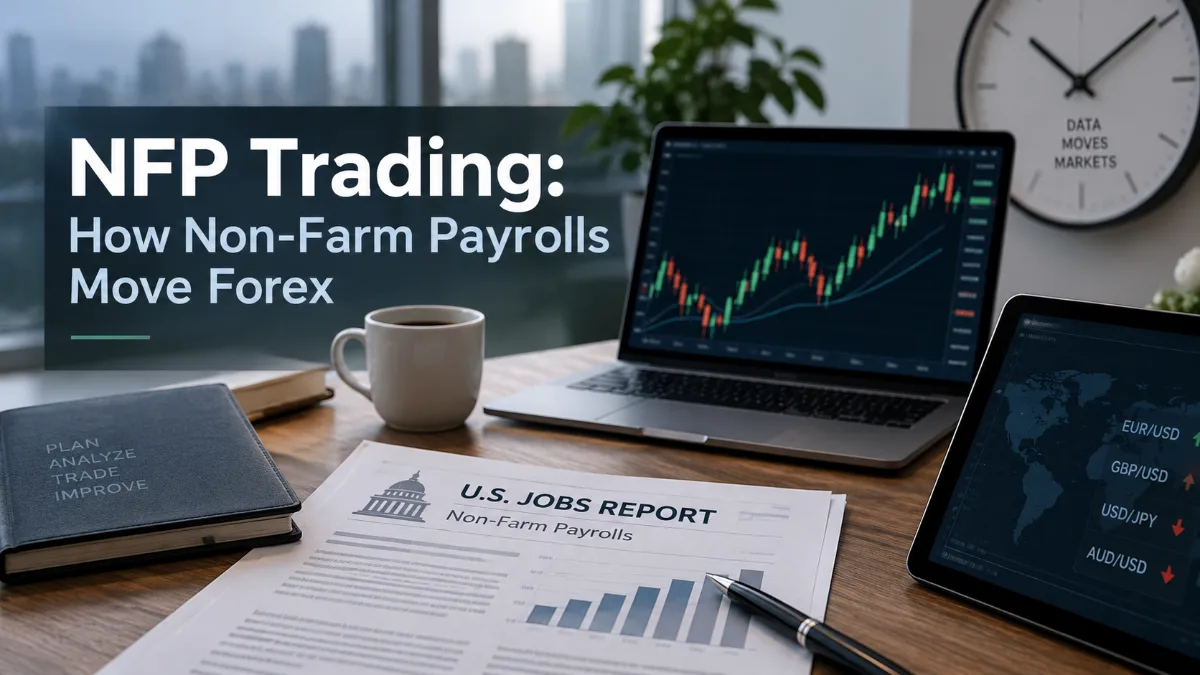
The Forex Factory calendar is an economic calendar that organizes scheduled macroeconomic releases and policy events by time, currency and expected market impact. Its main value is not that it predicts whether a currency will rise or fall. It helps traders see when market-moving information is due, what the market expected before the release and how the reported result compares with that expectation.
A useful way to read the calendar is to separate three questions. First, when is the event scheduled? Second, how important could it be for the currencies you trade? Third, once the data is released, how different is the actual result from the forecast and from the prior reading? That framework is more reliable than treating a red or green number as an automatic buy or sell signal.
What the Forex Factory calendar shows
The weekly calendar view groups events by date and displays a row for each release or scheduled event. The core fields are time, currency, impact, event name, actual, forecast and previous. Detail and graph functions can provide additional context for selected releases. The calendar legend also distinguishes expected impact levels and marks revisions to previously reported figures.
The search phrase calendar forex factory generally refers to this same event calendar. It is designed as a planning layer for traders who want to know what may affect volatility during a session. It does not replace the original release from a statistics agency or central bank when exact definitions, methodology or policy wording matter.
| Calendar field | What it tells you | How to use it |
|---|---|---|
| Time | Scheduled release or event time in the calendar's selected time zone | Check it before planning entries, exits or order placement |
| Currency | The currency most directly associated with the release | Map the event to the pairs you trade |
| Impact | Expected relative market importance | Use it to prioritize events rather than predict direction |
| Actual | The reported value once the release is published | Compare it with the forecast and previous value |
| Forecast | The market consensus estimate shown before release | Use it as the reference point for the surprise |
| Previous | The prior period's reported value | Check for trend context and possible revisions |
Not every row is a conventional economic statistic. The calendar can also include central bank appearances, meetings and other scheduled events where the market receives information through statements or remarks rather than a single numeric release. In those cases the actual, forecast and previous columns may be blank or less important. The event name, timing and follow-up details matter more because traders are interpreting language, policy signals and any change from prior communication.
How to read each economic calendar row
Time and currency
Start with the scheduled time and the currency code. A USD event can directly affect dollar pairs such as EUR/USD, GBP/USD and USD/JPY, but its influence can spread into other markets as well. A EUR event is most immediately relevant to pairs containing the euro. The relationship is not always isolated because major macroeconomic surprises can alter broader expectations for interest rates, growth and risk appetite.
Always confirm the calendar time zone before the trading day begins. A release that appears at 8:30 on one setup may correspond to a different local time for another trader. Official release calendars are useful for verification. For example, the U.S. Bureau of Labor Statistics publishes scheduled times for releases such as the Employment Situation and Consumer Price Index.
Impact rating
The impact indicator is best understood as an estimate of how much attention and volatility an event may attract. High-impact events deserve more preparation because they can produce rapid repricing, wider spreads and slippage. Medium-impact events may matter strongly when the market is already focused on the same theme. Low-impact events usually attract less attention but can still matter when the result is unusually surprising or when liquidity is thin.
Impact does not mean direction. A high-impact label does not tell you whether a currency should strengthen or weaken. It only tells you that the event is considered more likely to matter. The direction depends on the result, what traders had already priced in and how the release changes expectations about future policy or economic conditions.
Actual forecast and previous
The actual value is what was released. The forecast is the consensus estimate shown before the event. The previous value is the reading for the prior period. The most immediate market comparison is often actual versus forecast, because prices tend to respond to information that differs from expectations rather than to the raw number alone.
Suppose an inflation release shows 3.4% actual, 3.2% forecast and 3.1% previous. The result is above both the consensus and the prior reading. That may push traders to reassess interest-rate expectations. Yet the currency reaction is not guaranteed because the market may focus on a different component, a simultaneous release or a central bank's current reaction function.
How to use the Forex Factory calendar step by step
If you want to know how to use Forex Factory calendar information in a repeatable way, treat the calendar as a risk-planning tool before treating it as a signal source. The sequence below keeps the focus on what is scheduled and what would count as a meaningful surprise.
- Set the correct time zone. Verify that the calendar time matches the clock you use for trading.
- Filter for relevant currencies. If you trade EUR/USD, prioritize EUR and USD events before adding broader global events.
- Mark high-impact releases. Identify central bank decisions, inflation data, employment reports and other major releases before the session starts.
- Read the forecast and previous value. Know the consensus baseline and the recent direction of the series.
- Check whether several events share the same release time. A headline may look bullish while another simultaneous component points the other way.
- Wait for the actual value. Compare actual with forecast first, then check the previous figure and any revision.
- Observe the market response. Price reaction tells you how traders interpreted the information in context. Do not assume that a better-than-forecast number must produce a stronger currency.
This process is especially useful for traders who do not intend to trade the release itself. Knowing that a major event is approaching can influence whether you open a new position, reduce size, tighten operational controls or simply wait until spreads and price movement normalize.
How to interpret actual forecast and previous
The economic calendar becomes much more useful when you stop reading the three data columns as isolated numbers. Their relationship tells a short story about expectations and change.
- Actual above forecast: the reported result exceeded consensus. Whether that is positive for the currency depends on the indicator. Stronger growth may be supportive while a larger-than-expected unemployment rate is normally interpreted differently.
- Actual below forecast: the result missed consensus. Again, the direction depends on what the indicator measures and how it affects policy expectations.
- Actual near forecast: the headline surprise may be small. The market can then focus more heavily on revisions, subcomponents or forward guidance.
- Previous revised: the starting point for comparison has changed. A revision can alter the apparent trend and sometimes changes the meaning of the current release.
Forex Factory's legend may color a figure green when it is better than forecast or revised better and red when it is worse. Treat those colors as a comparison aid, not a trading instruction. For some indicators a higher number is conventionally considered better, while for others a lower reading may be preferable. More importantly, what is economically "better" is not always the same as what is bullish for a currency at that moment.
Which economic events matter most in forex
Not every release deserves equal attention. Currency markets are particularly sensitive to information that can change expectations for interest rates, inflation, labor conditions and economic growth. The exact hierarchy changes with the macroeconomic environment, so a trader should ask what central banks and markets are currently focused on rather than rely on a permanent ranking.
| Event type | Why traders watch it | Main interpretation question |
|---|---|---|
| Central bank rate decision | Can change the policy rate or the expected path of policy | Was the decision or guidance more restrictive or more accommodative than expected? |
| Inflation data | Can influence expectations about future interest rates | Is inflation moving above or below the path policymakers are likely to tolerate? |
| Employment data | Signals labor-market strength and wage pressure | Does the report strengthen or weaken the case for future policy action? |
| GDP | Summarizes broad economic activity | Is growth stronger or weaker than expected and is the estimate still preliminary? |
| Retail sales and activity surveys | Provide clues about demand and business conditions | Do they confirm or challenge the prevailing growth narrative? |
Central bank events require special care because the initial rate decision may be only one part of the information. Statements, economic projections and press conferences can change the interpretation minutes later. The Federal Reserve publishes its FOMC meeting calendar along with statements, minutes and projection materials for relevant meetings, making the official source useful when policy wording matters.
Why high impact does not predict currency direction
A common beginner mistake is to treat the calendar as if it contained a directional forecast. It does not. Markets price expectations continuously before the scheduled release. If traders already expect a strong employment report, a strong number may produce little reaction when it merely confirms the consensus. A moderately strong number can even be followed by currency weakness if positioning was stretched or if another part of the report disappoints.
The reaction can also depend on which variable the market considers decisive. During an inflation-focused period, wage growth or core inflation may receive more attention than the headline figure. During a recession scare, employment and growth indicators may dominate. During a policy transition, central bank language about future decisions can matter more than the current rate itself.
For that reason, the most useful question after a release is not simply "Was the number good?" Ask instead: What changed relative to expectations and does that change the expected path for monetary policy or growth? This turns the economic calendar from a color-coded signal board into a framework for interpreting new information.
Why revisions and release versions matter
Economic data is often revised as agencies receive more complete information or update seasonal adjustments. The previous column therefore deserves more attention than many traders give it. A current number can look impressive compared with the originally reported prior value but less impressive after that prior value is revised upward.
GDP is a clear example. The U.S. Bureau of Economic Analysis releases an advance estimate followed by second and third estimates as more detailed source data becomes available. That means two calendar events carrying the same GDP label can have different information value because one may be the first estimate and another a revision.
Employment data can also be revised after the initial release. The practical lesson is simple: when the previous number changes, read the new release against the revised history rather than against the number you remember. A large revision can reinforce or offset the headline surprise.
A practical pre-trade calendar routine
A trader does not need to monitor every row. A more efficient routine is to build an event map around the pairs and time window actually being traded.
- Before the session, identify the currencies in your open positions and watchlist.
- Scan the economic calendar for high-impact events tied to those currencies.
- Note events that occur within the expected holding period of any planned trade.
- Record the forecast and previous values for the releases most likely to matter.
- Check for clusters of events at the same time and for central bank speeches near major data releases.
- Decide in advance whether your strategy allows positions to remain open through the event.
- After the release, evaluate the actual surprise, revisions and price response before changing the trade thesis.
This routine separates event risk from trade direction. The calendar tells you when conditions may change quickly. Your strategy still needs its own rules for entry, exit, position size and maximum loss. A high-impact event is a reason to prepare for uncertainty, not a reason by itself to trade.
Common mistakes when reading the economic calendar
- Ignoring the time zone: a correct event time in the wrong zone is operationally the same as having the wrong time.
- Trading the impact color: impact ranks expected importance. It does not provide a bullish or bearish call.
- Looking only at actual versus previous: markets often react more strongly to the gap between actual and forecast because the forecast represents the pre-release expectation.
- Ignoring revisions: an updated prior reading can materially change the trend.
- Reading one headline in isolation: simultaneous releases can send conflicting signals.
- Assuming a better number means a stronger currency: the market response depends on expectations, positioning and implications for policy.
- Entering just before a release without accounting for execution risk: fast markets can produce wider spreads, slippage and rapid price changes.
Frequently asked questions
Is the Forex Factory calendar a trading signal?
No. It is an event and data calendar. It can show expected impact, consensus forecasts, released values and prior readings, but it does not tell you with certainty how a currency pair will move. Its strongest use is scheduling, risk awareness and post-release interpretation.
What does red impact mean on Forex Factory?
Red impact indicates an event expected to have relatively high market impact. It should be read as a warning that volatility may increase, not as a prediction that the currency will fall. The direction depends on the information released and how that information compares with expectations.
What is more important actual or forecast?
Neither number should be read alone. The difference between actual and forecast is often the key measure of surprise because the forecast reflects what the market broadly expected before the release. The previous value adds trend context and can matter more when it has been revised.
Can low-impact events move forex prices?
Yes. Impact ratings describe expected importance, not a hard limit on possible volatility. A low-impact event can matter when the result is extreme, liquidity is thin or the market is unusually sensitive to that economic theme.
Should you avoid trading during news releases?
That depends on the strategy. Some strategies are designed to trade event volatility while others explicitly avoid it. The calendar helps you identify when scheduled risk is concentrated so you can follow your own execution and risk rules consistently.